
Amplify Commodity Trust’s BDRY: Navigating Freight Rate Volatility Through a Pure-Play Futures Structure
Amplify Commodity Trust’s BDRY ETF delivers direct, exchange-cleared exposure to dry bulk freight futures—offering investors a rare, targeted tool for trading shipping rate cycles. As sector interest surges alongside volatile global trade flows, BDRY’s transparent structure and niche focus could amplify both opportunity and risk.
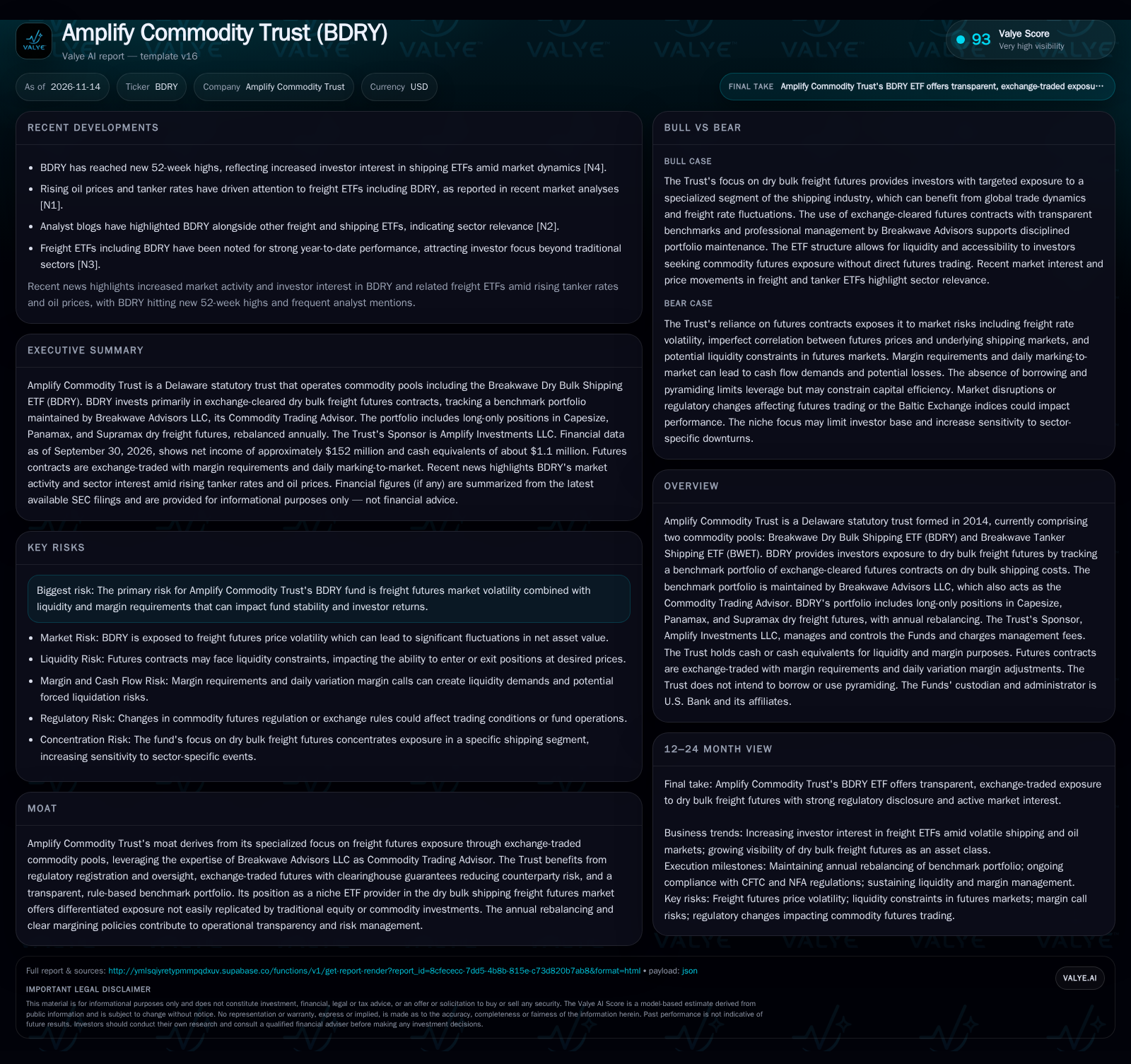
Amplify Commodity Trust’s BDRY ETF tracks a rule-based portfolio of dry bulk freight futures, providing investors with liquid, exchange-traded access to shipping rate movements. The fund’s differentiation lies in its transparent, regulated structure and specialist focus—yet its performance remains tightly coupled to the unpredictable swings of the dry bulk shipping cycle. [S1] [N2] [N4]
Amplify Commodity Trust’s Breakwave Dry Bulk Shipping ETF (BDRY) stands as a specialized financial tool for investors seeking pure-play exposure to the notoriously volatile dry bulk shipping market. By tracking a transparent, exchange-cleared futures benchmark—spanning Capesize, Panamax, and Supramax contracts—BDRY offers daily tradability and a direct line to global freight rate dynamics. Understanding BDRY’s mechanics, economic levers, and vulnerability to shipping cycles is essential for assessing its potential as both a portfolio diversifier and a volatility amplifier.
Recent Highs and Sector Interest: BDRY’s Position in a Volatile Shipping Cycle
The company reported cash and liquidity metrics for the period; these figures do not by themselves establish operating runway, investment capacity, financial flexibility, or financing capacity. BDRY has recently achieved new 52-week highs, a development closely linked to surging tanker rates and increased volatility in global shipping costs. This momentum has attracted attention from analysts and market commentators, positioning BDRY as a visible player in the niche freight ETF space. The fund’s ability to track daily changes in dry bulk freight futures through a transparent, exchange-cleared portfolio has contributed to both its recent outperformance and its sensitivity to shipping sector swings. [S1] [N2] [N4]
How BDRY’s Futures Structure Drives Returns—and Risks
BDRY generates returns by taking long-only positions in exchange-cleared futures contracts tied to dry bulk shipping rates, specifically allocating 50% to Capesize, 40% to Panamax, and 10% to Supramax contracts. The instrument’s economics are driven by changes in daily settlement prices for these contracts, with returns closely tracking the direction and volatility of the underlying freight indices. Management fees are charged by the fund sponsor, Amplify Investments LLC, while Breakwave Advisors LLC maintains the benchmark and portfolio composition.
The ETF’s use of futures contracts introduces a margin-based capital structure: typically, 10–40% of notional value must be posted as margin, with daily variation margin flows reflecting mark-to-market gains or losses. This structure creates operating leverage—magnifying both gains and losses relative to the actual cash invested—but also requires careful liquidity management, as margin calls can force asset sales or cash deployment during volatile periods. Assets not posted as margin are held in cash or cash equivalents, typically U.S. Treasuries, to facilitate redemptions or margin needs.
Without the use of borrowing or pyramiding, BDRY’s leverage is bounded by the inherent leverage of the futures contracts themselves. This design reduces tail risk compared to highly levered commodity funds but may limit the potential for capital efficiency or outsized returns during strong upswings. The fund’s annual rebalancing resets exposures to its benchmark weights, introducing periodic transaction costs and the potential for performance drag if market moves are rapid and unidirectional.
Specialization as Differentiation—But Not Immunity from Substitution
BDRY’s competitive edge lies in its pure-play, transparent exposure to dry bulk freight futures—an asset class not easily accessed through traditional commodity or shipping equity ETFs. The fund’s rule-based allocation, exchange clearing, and regulatory oversight (CFTC, NFA) provide institutional investors with a clear alternative to direct futures trading, which can be operationally complex and capital intensive.
However, the ETF landscape is increasingly crowded with thematic and sector-specific funds targeting shipping, energy, or broader commodity cycles. While BDRY’s focus on dry bulk futures is unique, substitutes exist in the form of shipping equity ETFs, multi-asset commodity funds, or even bespoke swaps and structured products offered by investment banks. These alternatives may offer different risk/return profiles, lower fees, or diversified exposure that dampens the volatility inherent in a single-segment futures portfolio.
Switching frictions for institutional investors are low, as ETF shares are exchange-traded and easily substituted. The main constraint for replication is the operational complexity of managing a rolling futures book and meeting daily margin requirements—areas where BDRY’s specialist advisor and transparent process may retain some advantage. Ultimately, the fund’s appeal will hinge on investor demand for direct, uncorrelated exposure to dry bulk shipping rates versus the broader commodity or transport universe.
Freight Supercycle: When Rate Volatility and Investor Flows Reinforce Each Other
A favorable scenario for BDRY unfolds if global trade disruptions, supply chain constraints, or commodity booms drive a sustained surge in dry bulk freight rates. In this environment, the fund’s long-only futures exposure could deliver outsized returns, with daily price movements in Capesize, Panamax, and Supramax contracts compounding rapidly. Amplified investor interest—evidenced by rising ETF trading volumes, narrowing bid-ask spreads, and persistent net inflows—could further support fund liquidity and secondary market performance.
Confirmation of this scenario would come from a combination of persistent increases in dry bulk futures prices, robust NAV growth for BDRY, and continued media and analyst coverage highlighting the ETF as a primary tool for shipping rate exposure. Additional evidence would include high margin utilization, minimal forced liquidations during volatility spikes, and sustained premium or tight tracking to NAV. Conversely, signs of rapid mean reversion in freight rates, sharp ETF outflows, or increasing tracking error would challenge the durability of this upside dynamic.
Dry Bulk Volatility Remains, but Futures Markets Normalize
The most plausible medium-term scenario is one in which dry bulk shipping rates remain volatile but do not enter a persistent supercycle. BDRY continues to offer daily liquid exposure to the freight futures curve, with fund returns oscillating alongside sector swings but not consistently outperforming or underperforming broader commodity benchmarks. Investor flows stabilize as sector enthusiasm moderates, and the ETF’s assets under management grow or shrink in line with broader risk appetite.
Evidence in support of this scenario would include moderate changes in NAV, stable or gradually evolving fund flows, and ongoing (but less sensational) analyst commentary. The benchmark rebalancing process continues annually without major disruption, and the fund maintains regulatory compliance and operational transparency. A falsification of the base case would involve either a sustained collapse in dry bulk liquidity (impairing ETF trading and tracking) or a dramatic, persistent shift in shipping economics (e.g., due to decarbonization, structural overcapacity, or regulatory shocks) that fundamentally alters the attractiveness of freight futures as an investable asset.
Margin Pressure and Market Dislocation: When Volatility Turns Against the Fund
A negative scenario for BDRY materializes if dry bulk freight rates experience a sharp reversal or prolonged decline, triggering rapid losses on the fund’s long-only futures positions. In an environment of extreme volatility or market illiquidity, margin requirements could spike, forcing the fund to deploy cash or liquidate positions at unfavorable prices. If futures market depth erodes—due to regulatory changes, exchange disruptions, or a collapse in underlying shipping demand—the ETF could face tracking error, widening bid-ask spreads, and impaired redemption processes.
Supporting evidence for this downside would include sudden NAV drawdowns, increased frequency of margin calls, forced position reductions, and news of market dislocation or regulatory intervention in freight futures trading. Persistent outflows or a sustained discount to NAV would further indicate stress. Conversely, if BDRY maintains orderly operations and liquidity through a major shipping downturn, it would suggest that risk controls and the fund’s structural guardrails are functioning as intended.
Testing BDRY’s Thesis: Operational, Market, and Regulatory Milestones to Track
Monitor NAV volatility and the fund’s ability to track its stated benchmark portfolio, especially during periods of large shipping rate swings.
Watch for changes in dry bulk futures market liquidity—bid/ask spreads, open interest, and daily traded volumes—which could impact execution and fund operations.
Track margin utilization rates and the frequency of variation margin calls; sharp increases may signal heightened risk of forced liquidations or operational strain, if disclosed.
Observe net inflows/outflows and changes in assets under management, as these reflect investor sentiment and could amplify fund volatility.
Assess the impact of the annual benchmark portfolio rebalancing, including transaction costs and any slippage versus the intended allocation.
Stay alert to regulatory developments affecting commodity futures markets or ETF operations, including CFTC/NFA rule changes or exchange-level disruptions.
A useful metric would be the fund’s realized tracking error relative to published dry bulk indices, as persistent divergence could indicate structural or market issues.
Monitor the composition and performance of the underlying dry bulk shipping market—fleet supply/demand, fuel costs, and global trade volumes—as these ultimately drive the futures prices that BDRY tracks.
Disclaimer: This is research-only, informational analysis and not investment advice. It may include AI-generated interpretation and general industry context. Always verify important details using primary sources.

Comments