
Santander Holdings USA: Financial Snapshot Highlights Reporting Gaps
Santander Holdings USA, Inc. reports substantial cash reserves and positive quarterly net income, but offers little public insight into its business model, revenue streams, or operational focus. This lack of transparency constrains analysis of its earnings quality, risk profile, and long-term strategic position.
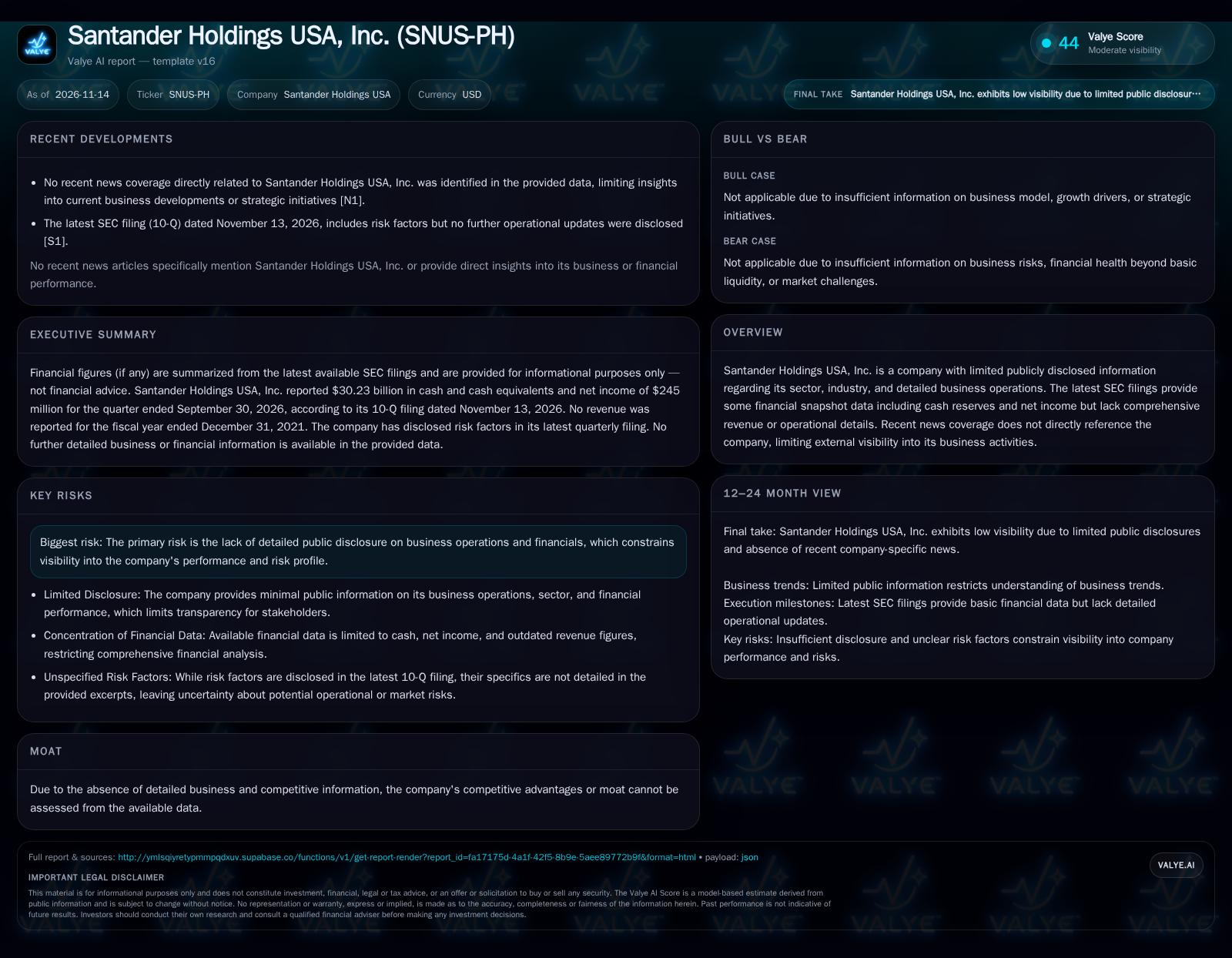
Santander Holdings USA, Inc. reported $30.23 billion in cash and cash equivalents and net income of $245 million for Q3 2026, but provides minimal disclosure on its business activities or sector. The absence of operational detail limits visibility into its earnings drivers, risk exposure, and future prospects, making it difficult to assess the durability or quality of its reported financial results. [S1]
Santander Holdings USA, Inc. presents a paradox for business analysis: while its latest SEC filings reveal a reported cash position and positive net income for the third quarter of 2026, there is a conspicuous absence of detail regarding its revenue, sector, or operational strategy. This opacity makes it challenging to evaluate the sustainability of its earnings, the sources of its profitability, or its risk exposures. For stakeholders, the question is not whether the company is currently profitable, but whether that profitability is repeatable, explainable, and durable in the context of undisclosed business mechanics.
Recent Financial Results Show Strength Despite Limited Operational Transparency
Santander Holdings USA, Inc. reported cash and cash equivalents of $30.23 billion as of September 30, 2026, alongside net income of $245 million for the same quarter. These figures indicate that the company is operating with significant liquidity and is currently profitable on a net basis. However, the absence of reported revenue for the fiscal year ending December 31, 2021, introduces uncertainty about the underlying business activities or any structural changes since that time. The company’s latest 10-Q, dated November 13, 2026, includes risk factors but does not provide further operational updates. This lack of disclosure is highly unusual for a company of this scale and makes it difficult to assess both the quality and sustainability of its reported earnings. [S1]
The company reported cash and liquidity metrics for the period; these figures do not by themselves establish operating runway, investment capacity, financial flexibility, or financing capacity. If these cash holdings are largely unproductive or held in low-yield instruments, the opportunity cost could weigh on longer-term profitability. Understanding the allocation and yield on these cash equivalents would provide critical insight into the company’s capital efficiency and strategic intent.
Exploring Revenue Opportunities and Cost Dynamics
In the absence of detailed operational disclosure, any assessment of Santander Holdings USA’s business economics is necessarily hypothetical. If the company functions as a typical U.S. financial holding company—consistent with the global Santander brand—it would likely generate revenue through interest income on loans, fees from banking services, and potentially trading or asset management activities. Such a model typically involves a mix of net interest margin (NIM) as the core profit driver, with fee income and trading gains providing additional volatility or upside.
Operating leverage in a traditional banking or financial holding context is usually moderate: fixed costs are significant due to compliance, technology, and branch infrastructure, but variable costs can be managed through scaling assets. Capital requirements are substantial; regulatory capital ratios, liquidity coverage, and loan loss reserves are all critical to long-term solvency and growth. If the reported net income is driven by one-off gains, nonrecurring items, or asset sales (as is occasionally the case in opaque reporting), earnings quality could be at risk. Without segment or product detail, it is not possible to determine whether current profitability is representative of ongoing operations or the byproduct of financial engineering or windfall events.
Cost structure dynamics are pivotal in evaluating the sustainability of Santander Holdings USA’s earnings, particularly in an opaque reporting environment. If fixed costs are disproportionately high relative to revenue-generating activities, the company may face margin compression during periods of revenue stagnation or decline. This sensitivity would be exacerbated if the business relies heavily on legacy infrastructure or labor-intensive processes. Alternatively, if the company has invested in scalable technology platforms or streamlined operations, it could achieve operating leverage that enhances profitability as assets or transaction volumes grow. Detailed cost breakdowns and efficiency ratios would help clarify these structural economics.
Evaluating Market Position Amid Sector Ambiguity
With no disclosed sector, industry, or business line information, Santander Holdings USA’s competitive position is opaque. If the company is part of the U.S. banking or diversified financial services market, it would face competition from major national banks, regional banks, and non-bank financial institutions. Competitive advantages in this sector typically derive from scale, low-cost funding, technology adoption, customer relationships, and regulatory expertise.
Conversely, it could reflect a defensive posture in anticipation of market or regulatory shocks. Without specifics on its lending, deposit base, or fee-generating activities, it is not possible to evaluate whether the company enjoys meaningful switching frictions, pricing power, or network effects compared to peers. If the company’s business is concentrated in volatile or non-core activities, any perceived advantage could prove fleeting.
Market positioning also depends on the company’s ability to navigate regulatory complexities and adapt to evolving consumer preferences. If Santander Holdings USA operates within traditional banking sectors, regulatory compliance costs and capital constraints could limit agility compared to fintech or non-bank competitors. Conversely, if the company has access to proprietary technology or niche market segments, it might sustain competitive advantages despite regulatory headwinds. The degree to which the company can innovate in product offerings, customer experience, and digital channels would materially affect its long-term market share and profitability prospects, especially in a landscape increasingly shaped by technological disruption.
Stronger Earnings Visibility Could Support Growth
A favorable scenario would see Santander Holdings USA increase its public disclosures, providing clarity on business segments, revenue streams, and risk management practices. If future filings or communications reveal that the reported net income is derived from a stable, diversified, and recurring set of activities—such as lending, deposit-taking, and fee-based services—the company could be viewed as a resilient financial institution with reported liquidity position and a reported balance sheet position.
Confirmation of this scenario would require detailed segment reporting, evidence of recurring revenue, and insight into asset quality and risk exposures. Falsification would occur if future disclosures reveal that recent profits were driven by nonrecurring gains, asset sales, or temporary balance-sheet maneuvers rather than sustainable operations.
Ongoing Disclosure Constraints Cloud Profitability Prospects
The most plausible outcome, given current disclosure practices, is that Santander Holdings USA continues to operate with minimal public transparency. Stakeholders may see periodic updates on liquidity and net income, but without insight into revenue, loan quality, or operational drivers, it remains impossible to assess whether the company’s profits are repeatable or exposed to hidden risks.
This scenario would be confirmed by continued sparse filings and lack of business-line detail; it would be challenged if regulatory pressure, market scrutiny, or internal strategy shifts prompt a move toward fuller disclosure and more granular reporting.
Lack of Transparency May Conceal Financial Risks
In an adverse scenario, Santander Holdings USA’s limited disclosure could be concealing significant operational risks, asset quality issues, or non-sustainable sources of profitability. If net income is being supported by one-time gains, accounting adjustments, or asset liquidations, future earnings could prove volatile or negative when these effects reverse or dissipate.
Discovery of regulatory actions, credit downgrades, or significant loan losses—if eventually disclosed—would also validate concerns about underlying business health.
Factors That Could Alter Santander Holdings USA’s Trajectory
Disclosure of segment-level revenue, net interest margin, or fee income—if provided—would help determine the company’s true business mix and recurring earnings power.
Clarity around the source and quality of net income, such as whether it is driven by core operations or nonrecurring events, would be crucial for assessing earnings durability.
Any new detail on risk management practices, loan book composition, or asset quality would illuminate potential exposures and capital requirements.
Evidence of regulatory actions, enforcement events, or credit rating changes would provide insight into hidden risks or market perceptions.
If disclosed, trends in loan loss provisions, nonperforming assets, or capital adequacy ratios would help test the resilience of the business.
A material change in cash and cash equivalents in future filings—up or down—could indicate shifts in business activity, risk appetite, or external shocks.
External signals such as management changes, strategic pivots, or new business line launches could alter the company’s risk/reward profile.
Disclaimer: This is research-only, informational analysis and not investment advice. It may include AI-generated interpretation and general industry context. Always verify important details using primary sources.

Comments