
Cantor Fitzgerald Income Trust: Externally Advised REIT Navigates Portfolio Diversification and Profitability Hurdles
A diversified, externally managed REIT, Cantor Fitzgerald Income Trust leverages continuous capital raising and a broad property mix but faces execution risk, negative earnings, and the structural challenges of external management. The interplay between asset growth, cost structure, and advisor alignment will likely determine future performance.
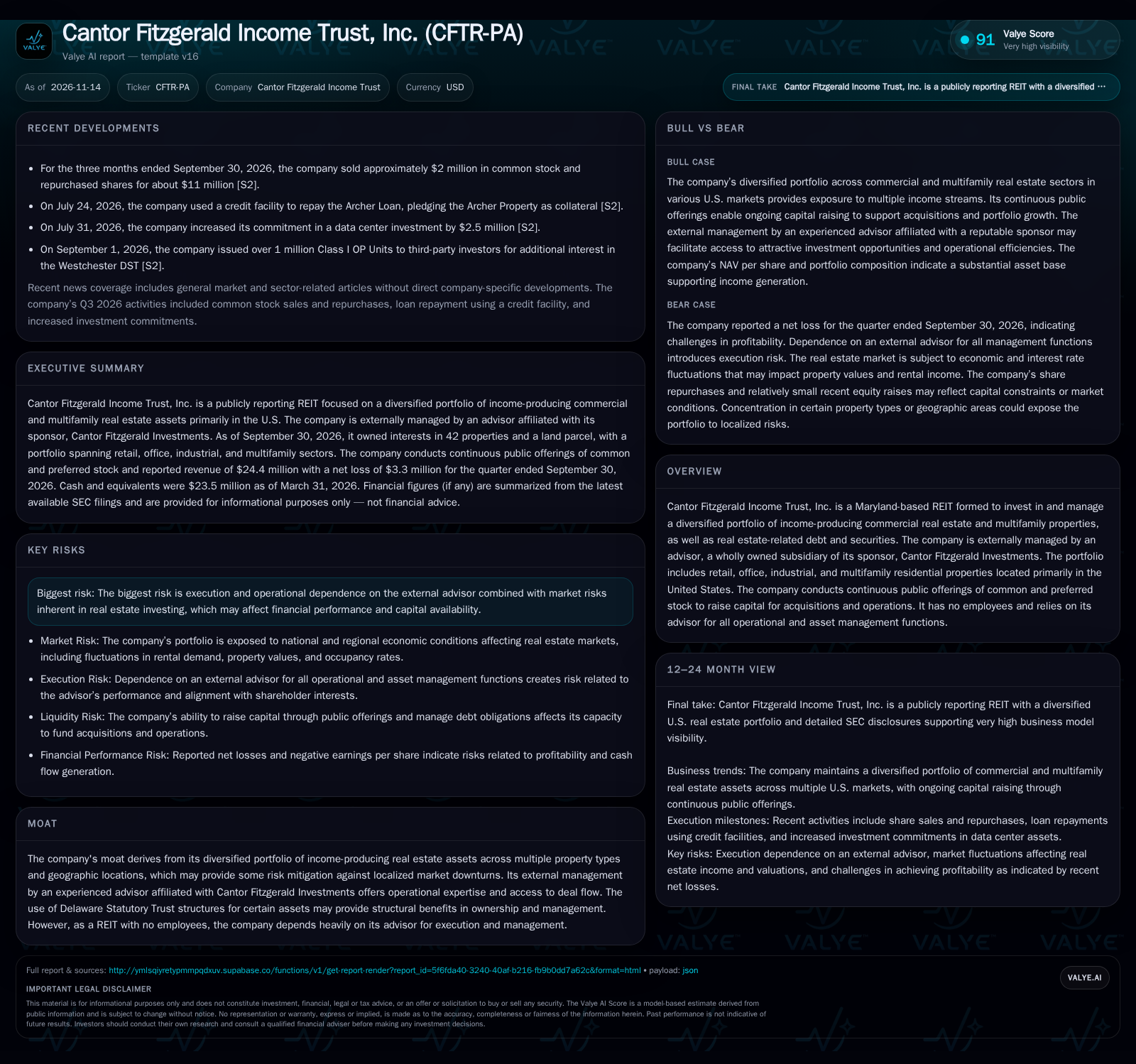
Cantor Fitzgerald Income Trust, Inc. is an externally advised REIT with a diversified U.S. portfolio spanning commercial, multifamily, and real estate-related debt. Recent facts show continued acquisitions, modest equity inflows, substantial share repurchases, and another quarterly net loss. The company’s external management structure enables operational leverage and deal access but creates potential cost and alignment risks. Key future drivers include the effectiveness of capital deployment, fee structure impact, and the ability to generate distributable income amid a challenging real estate environment. [S1] [S2]
Cantor Fitzgerald Income Trust, Inc. presents a case study in the trade-offs of external management and diversified real estate portfolios. While the REIT’s broad asset base and continuous capital raising model provide access to income streams across commercial, multifamily, and debt assets, persistent net losses and heavy reliance on an affiliated advisor highlight structural challenges. The company’s ability to convert its asset growth and capital inflows into sustainable distributable income, while managing fee drag and aligning advisor incentives, will be pivotal as real estate markets remain volatile and capital costs evolve.
Recent Portfolio Moves and Persistent Losses Shape Strategic Choices
As of September 30, 2026, Cantor Fitzgerald Income Trust owned interests in 42 real properties and a land parcel distributed across retail, office, industrial, and multifamily segments throughout the U.S. The company reported $24.4 million in revenue and a net loss of $3.3 million for the quarter, translating to a basic and diluted EPS of -$0.31. Net asset value per share stood at approximately $21.00. In the same quarter, $2 million worth of common stock was sold and $11 million of shares were repurchased, indicating a net capital outflow to shareholders. The company also increased its stake in a data center investment and refinanced property debt using its credit facility. These actions reflect an ongoing portfolio rebalancing while grappling with profitability challenges and capital allocation decisions. [S1] [S2]
How External Management and Capital Flows Define Operating Economics
Cantor Fitzgerald Income Trust’s economics are shaped by its externally managed REIT structure, continuous capital raising, and the fee arrangements with its advisor. The company generates income from rent, lease payments, and real estate-related debt investments, but all operational functions—including property management, leasing, construction, and dispositions—are handled by the advisor, which receives management fees and reimbursable expenses. This model creates an inherent cost drag and may dilute operating leverage, as a portion of gross income is allocated to advisory fees before reaching shareholders.
The company raises capital through continuous public offerings of common and preferred stock, using new proceeds to acquire properties or invest in real estate debt. This structure enables flexible scaling but exposes shareholders to dilution risk if capital is not deployed accretively. The reported net loss and negative EPS suggest that current revenues are insufficient to cover property-level expenses, debt service, and advisor fees, raising questions about the sustainability of distributions and long-term return on equity. The use of credit facilities for refinancing and investment commitments points to moderate leverage, but the balance between debt, equity inflows, and fee structure will determine the trajectory of distributable income.
Diversification, Deal Access, and Fee Drag in a Crowded REIT Landscape
Cantor Fitzgerald Income Trust competes with both publicly traded and non-traded REITs, as well as direct real estate investment vehicles and specialized funds. Its primary advantage lies in portfolio diversification across property types and geographies, which may buffer against localized downturns and sector-specific shocks. The affiliation with Cantor Fitzgerald Investments could provide access to proprietary deal flow and institutional-grade asset management expertise, potentially enabling opportunistic acquisitions or off-market transactions.
However, the externally advised model also introduces a competitive disadvantage: fee drag and potential misalignment of interests. Unlike internally managed peers, the company does not directly employ its management team, so its cost structure may be less flexible and more difficult to optimize during downturns. The ability to source attractive assets, manage them efficiently, and keep advisory fees in check will be critical for relative outperformance. In the absence of demonstrably superior asset selection or operational execution, the company risks being perceived as a higher-cost, less nimble alternative in the REIT universe.
What Could Unlock Shareholder Value: Accretive Deployments and Fee Discipline
A favorable trajectory would be catalyzed by the company’s ability to raise and deploy capital into high-yielding, resilient assets at a pace that outstrips fee growth and dilution. If Cantor Fitzgerald Income Trust can leverage its sponsor’s network to source off-market or value-add opportunities, particularly in sectors with strong rental growth or secular demand (e.g., data centers, last-mile logistics, or Sun Belt multifamily), distributable income could rise even as the portfolio expands. The company’s recent increased commitment to a data center investment hints at potential strategic pivoting toward higher-growth segments.
Confirmation of this scenario would come from a sustained reversal of net losses, improvement in core FFO (if disclosed), and evidence that incremental capital deployment yields NAV accretion and higher distributions per share. Reduced share repurchases coupled with robust new capital inflows would indicate market confidence and internal capital efficiency. If the advisor demonstrates fee discipline and alignment with shareholders—potentially through performance-based compensation or reduced base fees—the company could narrow the gap with internally managed peers and deliver attractive risk-adjusted returns.
Steady-State REIT Dynamics: Incremental Growth Offset by Fee and Dilution Frictions
The most plausible outcome is a continuation of current trends: measured portfolio growth through selective acquisitions, funded by ongoing capital raises and moderate leverage, with returns partially offset by advisory fees and recurring expenses. Rental income and debt investment yields are likely to remain pressured by market volatility, rising operating costs, and competition for high-quality assets. The company’s external management structure will continue to siphon off a portion of gross returns, making it difficult to achieve top-quartile profitability unless asset-level performance improves or fee structures are revisited.
Evidence supporting this scenario would include ongoing but modest NAV per share growth, persistent but narrowing net losses, and a stable pace of acquisitions and capital recycling. If the company can maintain occupancy and rental rates across its diversified portfolio and avoid significant credit losses on its debt investments, it may deliver mid-single-digit annualized returns, in line with many non-traded REITs but below the sector’s top performers. Any improvement in fee alignment or a shift toward higher-margin property types would be incremental rather than transformative.
Negative Leverage, Asset Impairments, and Advisor Conflicts Undermine Returns
The primary risk is that revenue growth fails to keep pace with rising costs, debt service, and advisory fees, leading to persistent or widening net losses. If rental income weakens due to economic downturns, oversupply in key markets, or tenant defaults, the company may face asset impairments and reduced NAV per share. The externally managed structure heightens vulnerability: if the advisor prioritizes asset growth (and associated fees) over per-share value, capital could be deployed into marginal deals, exacerbating dilution and eroding distributable income.
Confirmation of this scenario would include ongoing negative EPS, declining NAV per share, reduced or suspended distributions, and an increase in leverage or asset sales at below-book values. Share repurchases in excess of new capital inflows could further signal capital market skepticism or internal liquidity stress. Any sign of advisor turnover, fee escalation, or related-party conflicts would compound the downside risk, making it difficult to restore shareholder confidence or operational momentum.
Testing the Thesis: Portfolio Performance, Fee Alignment, and Capital Deployment
Trends in net income, core FFO (if disclosed), and NAV per share growth—persistent losses or NAV erosion would challenge the sustainability case.
The ratio of advisory fees and reimbursable expenses to gross income—a rising fee burden would signal structural drag on shareholder returns.
Capital raise versus share repurchase dynamics—net outflows or heavy buybacks could indicate market skepticism or inefficient capital allocation.
Occupancy rates, rent collections, and lease renewal activity across major property types—a useful set of metrics to gauge asset-level health.
Deployment pace and yield on new acquisitions, especially in targeted growth sectors like data centers or logistics—would help test the thesis on accretive capital allocation.
Leverage metrics (debt-to-assets, interest coverage), especially as refinancing needs arise amid changing credit conditions.
Any changes to advisor fee structures, incentive alignment, or disclosure of performance-based compensation arrangements.
Disclaimer: This is research-only, informational analysis and not investment advice. It may include AI-generated interpretation and general industry context. Always verify important details using primary sources.

Comments