
SUPA Consolidated’s Strategic Pivot: From Ridesharing Roots to Food Tech Aspirations Under Financial Duress
SUPA Consolidated Inc. has executed a dramatic sector shift, divesting its original transportation technology assets to pursue a new vision in food technology centered on commercial vending.
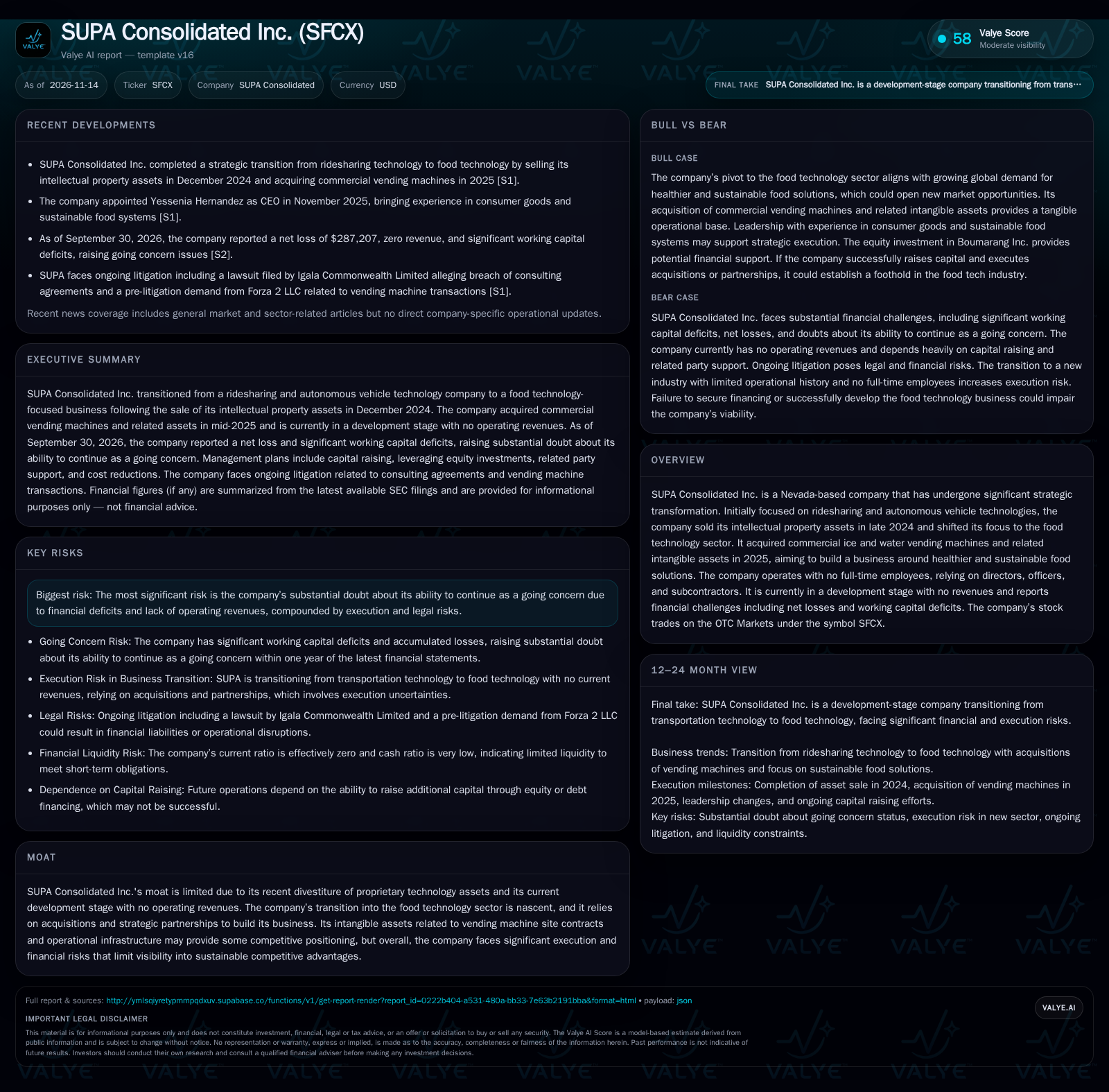
SUPA Consolidated Inc. has transitioned from ridesharing technology to food tech, acquiring vending machine assets but reporting no revenue and ongoing financial losses as of September 2026. The company faces serious going concern risks, depends on future capital raising, and is subject to unresolved litigation. Its path forward relies on successfully building a viable food tech business under new leadership and overcoming immediate funding and operational hurdles. [S1] [S2]
SUPA Consolidated Inc.’s recent history is defined by a high-stakes strategic overhaul: the company shed its original ridesharing and autonomous vehicle technology focus by selling its intellectual property assets in late 2024, then acquired commercial ice and water vending machines in 2025 to anchor a new food tech platform. However, as of Q3 2026, SUPA finds itself in a precarious position, with no revenue, continued net losses, and acute working capital deficits that cast substantial doubt on its ability to survive without fresh capital. The company’s prospects now depend on whether it can operationalize its new vending-centric business model, secure funding, and resolve outstanding legal disputes—all while building credibility in an unfamiliar sector. [S1] [S2]
Recent Developments Redefine SUPA’s Identity—and Its Risks
The most material recent fact is SUPA Consolidated’s complete strategic realignment: the company sold its ridesharing and autonomous vehicle intellectual property assets in December 2024, exiting its original sector. In 2025, it acquired commercial ice and water vending machines and related intangible assets to launch a new food technology business. [S1]
Financially, SUPA ended Q3 2026 with zero revenue and a net loss of $287,207, alongside significant working capital deficits. These conditions have triggered substantial doubt about the company’s ability to continue as a going concern. [S2]
The company’s operational structure remains minimal, with no full-time employees and reliance on directors, officers, and subcontractors. This lean setup may reduce fixed costs but introduces substantial execution risk in scaling or operating a new business. [S1]
SUPA is also navigating ongoing litigation, including a lawsuit from Igala Commonwealth Limited regarding consulting agreements and a pre-litigation demand from Forza 2 LLC over vending machine transactions, further complicating its near-term outlook. [S1]
How SUPA Could Generate Value in Food Tech: Vending Economics and Funding Needs
SUPA’s new business model centers on operating or deploying commercial ice and water vending machines—a capital-intensive but potentially scalable approach to food tech. In the vending industry, revenue typically flows from end-user purchases at machines, site rental or franchise fees, or partnerships with host locations. Margins are sensitive to location quality, machine uptime, operating cost structure, and maintenance efficiency.
Given the absence of full-time staff and reliance on subcontractors, SUPA may be aiming for a highly outsourced operational model. This could keep fixed costs low but may limit quality control, brand development, and rapid scaling. The capital required for machine acquisition, placement, and servicing is substantial, especially for a company with no current revenue or positive cash flow.
Operating leverage in vending is dictated by location density and utilization rates: high-traffic sites can drive strong gross margins once fixed costs are covered, but low utilization leads to rapid cash burn. Without disclosed details on site contracts, pricing structures, or machine rollout plans, it is unclear if SUPA’s asset base can achieve break-even economics.
The company’s ongoing working capital deficits and net losses highlight an immediate need for external funding. SUPA’s future business economics will be shaped by its ability to raise capital (likely equity or convertible debt), negotiate favorable site contracts, and achieve sufficient machine utilization to cover both fixed and variable costs.
Assessing SUPA’s Place in a Crowded Vending and Food Tech Landscape
SUPA enters the food technology sector at a time of heightened focus on health, sustainability, and convenience. The vending machine segment is mature and highly competitive, populated by established operators, regional franchises, and increasingly, digital-first entrants leveraging IoT and data analytics.
Potential advantages for SUPA could include novel machine technology, exclusive site contracts, or differentiated health-focused offerings. However, the company’s moat is currently limited: it recently divested its proprietary transportation technology, has no established brand in food tech, and faces execution risk due to its development-stage status and absence of full-time staff.
Substitutes for SUPA’s vending offerings include traditional retail, convenience stores, and competing vending operators, many of whom are experimenting with healthier product lines and digital payment systems. Partnerships with host locations or integration with digital platforms could help SUPA carve a niche, but these relationships are difficult to secure without an established operational track record or compelling value proposition.
Legal disputes and lack of operational history further erode competitive positioning, especially when trying to attract partners, customers, or investors in a sector that prizes reliability and consumer trust.
A Path to Viability: Capital Infusion, Strategic Partnerships, and Machine Utilization
The most optimistic scenario for SUPA involves several favorable developments: the company secures sufficient funding through equity or convertible debt, leverages its leadership’s background in consumer goods and sustainable food systems, and forges partnerships that enable rapid deployment of vending machines in high-traffic locations.
If SUPA can negotiate attractive site contracts and achieve high machine utilization, it may realize positive unit economics. This would likely require demonstrating reliability, health-oriented product differentiation, and perhaps integrating digital or subscription features to drive repeat usage.
Confirmation of this scenario would come from disclosed machine deployment milestones, signed site or distribution partnerships, initial revenue generation, and evidence of positive gross margins at pilot locations. Conversely, delays in capital raising, litigation setbacks, or continued absence of commercial traction would challenge this upside.
SUPA’s Most Likely Trajectory: Slow Ramp Amid Funding and Execution Hurdles
The most plausible near-term outcome is that SUPA remains in a prolonged development stage, struggling to raise sufficient capital to scale operations meaningfully. Progress may be incremental: a handful of machine deployments, pilot programs, or small partnerships—but with persistent uncertainty about achieving break-even economics.
Legal disputes could consume management attention and resources, further slowing operational progress. The lack of full-time employees and reliance on subcontractors may limit SUPA’s ability to build a strong operational backbone or respond quickly to market feedback.
Signs supporting this scenario would be continued reporting of net losses, minimal or no revenue, and repeated disclosures of working capital deficits. Any progress would likely be modest and contingent on episodic funding events or settlement of litigation.
If Funding and Execution Fail: The Risk of Stagnation or Dissolution
In a negative scenario, SUPA fails to raise additional capital or resolve its legal issues, resulting in further working capital erosion and the inability to deploy or maintain its vending machine assets. The company may face mounting liabilities from litigation, leading to asset sales under distress or, in the extreme, dissolution.
This outcome would be confirmed by continued or worsening going concern disclosures, legal judgments or settlements that exceed available resources, and possible delisting or shareholder communications indicating wind-down preparations. Prolonged absence of revenue or operational milestones would further support this scenario.
Milestones That Will Reveal SUPA’s Traction and Risks in Food Tech
Disclosure of vending machine deployment numbers and utilization rates—if disclosed—would help assess whether SUPA is achieving operational scale and positive unit economics.
Updates on capital raising activity, including successful equity or debt financings, will be critical to evaluating the company’s ability to fund ongoing operations and expansion.
Resolution or escalation of ongoing litigation, including the Igala Commonwealth Limited lawsuit and Forza 2 LLC demand, will materially affect financial outcomes and operational focus.
Initial revenue generation and gross margin data—if reported—will indicate whether the business model is gaining commercial traction.
Announcements of site or distribution partnerships, especially with reputable hosts, would demonstrate market acceptance and potential for scale.
Management changes, particularly the addition of experienced full-time operational leaders, would signal a shift toward more robust execution capability.
Any changes in working capital position or going concern disclosures in future filings will serve as a barometer of near-term financial health.
Disclaimer: This is research-only, informational analysis and not investment advice. It may include AI-generated interpretation and general industry context. Always verify important details using primary sources.

Comments