
AGCO Q2 2026: Restructuring Impacts and Leadership Changes Amid Operational Challenges
AGCO’s Q2 2026 earnings miss reflects restructuring and divestiture costs, while leadership shifts highlight a strategic focus on precision agriculture and operational efficiency.
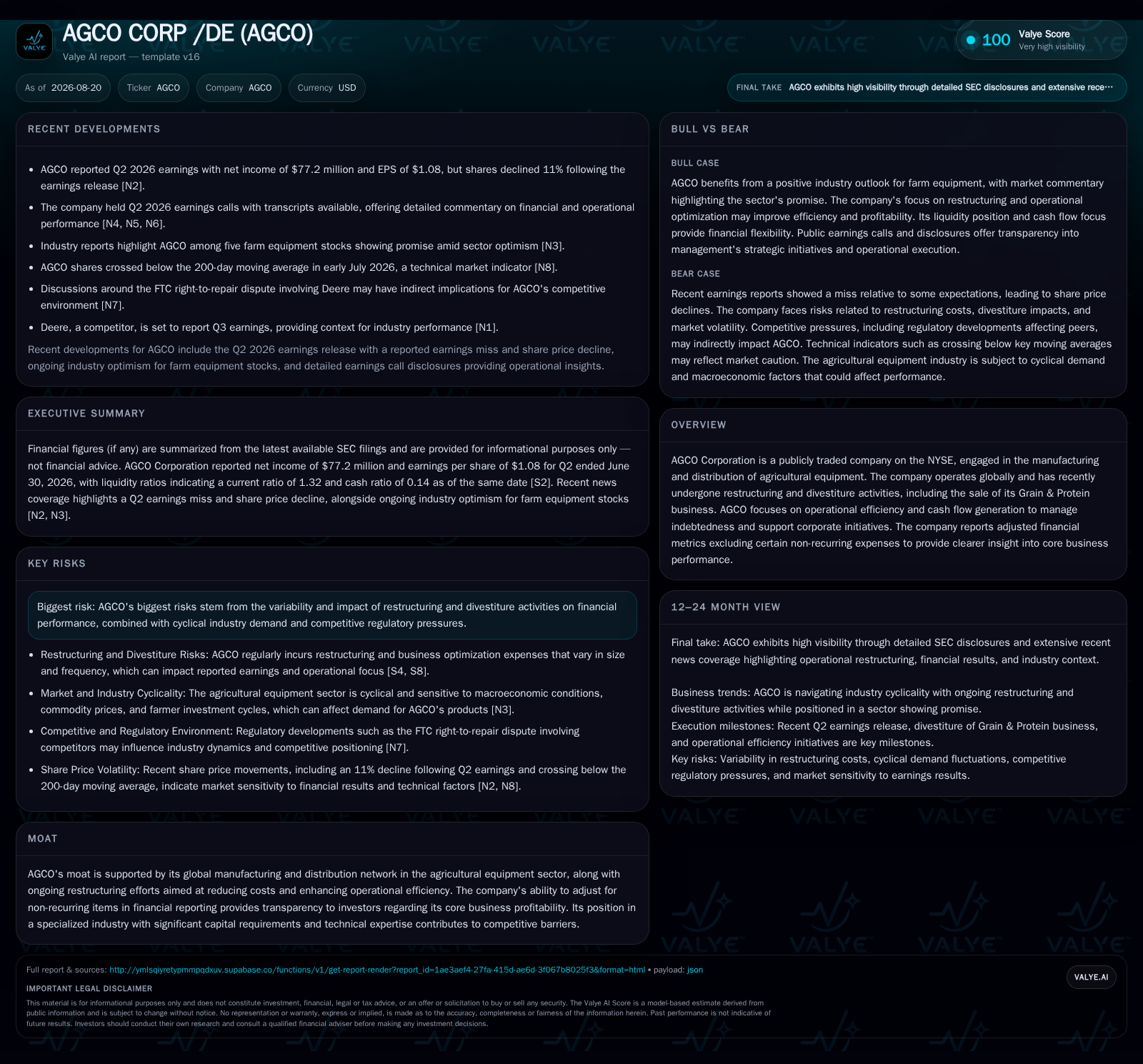
AGCO Corporation reported a Q2 2026 earnings shortfall primarily due to restructuring and divestiture-related expenses, including the completed sale of its Grain & Protein business. Concurrent executive leadership changes, notably the CFO transitioning to lead precision agriculture and corporate strategy, signal a strategic emphasis on growth and transformation. The company faces near-term margin pressure and cash flow challenges amid these transitions, with a net debt position of approximately $2.07 billion as of June 30, 2026. Operational efficiency and cash flow generation remain critical priorities to manage indebtedness and support corporate initiatives.
Q2 2026 Operating Performance and Restructuring Impact
AGCO Corporation’s second-quarter 2026 financial results reflected pressures from expenses related to ongoing restructuring and divestiture activities [S2]. These restructuring costs are non-recurring but have depressed near-term profitability and pressured cash flow generation, complicating the company’s financial performance in the quarter.
In the agricultural equipment manufacturing industry, operational efficiency and cost management are critical drivers of margin and cash flow stability [S1][S2]. AGCO’s restructuring efforts aim to reduce costs and streamline operations, but the transition phase has introduced temporary financial headwinds. The divestiture of the Grain & Protein segment narrows the company’s product portfolio, potentially allowing greater focus on core agricultural machinery and precision agriculture solutions, which may influence future revenue mix and margin profile.
Executive Leadership Changes and Strategic Implications
Effective August 1, 2026, AGCO announced key executive leadership changes, including Damon Audia’s transition from Senior Vice President and Chief Financial Officer to President of PTx and Corporate Strategy [S3]. This new role encompasses oversight of AGCO’s precision agriculture business alongside enterprise strategy and transformation teams.
This leadership realignment involves Damon Audia moving from CFO to President of Precision Agriculture and Corporate Strategy, a role that includes oversight of AGCO’s precision agriculture business and enterprise strategy and transformation teams. This change may indicate an increased emphasis on precision agriculture and corporate transformation initiatives, which could support efforts to improve operational efficiency and manage ongoing restructuring. While the direct impact of this leadership change remains to be seen, it reflects management’s focus on these areas [S3].
Balance Sheet and Liquidity Analysis
As of June 30, 2026, AGCO reported cash and cash equivalents of $573.4 million against total debt of $2.64 billion, resulting in a net debt position of approximately $2.07 billion [F1]
In the context of cyclical agricultural equipment demand and capital-intensive manufacturing, maintaining liquidity and managing leverage are vital [S2][S1]. AGCO’s focus on operational efficiency and cash flow generation is essential to support debt reduction efforts and sustain corporate initiatives during this transitional period. The restructuring expenses weigh on near-term cash flow, making effective execution of cost-saving measures and revenue stabilization critical.
Business Model and Industry Context
AGCO operates as a global manufacturer and distributor of agricultural equipment, serving agricultural producers and equipment dealers worldwide. Its product portfolio includes tractors, combines, hay tools, sprayers, forage equipment, seeding and tillage equipment, as well as precision agriculture solutions. Revenue is primarily transactional from equipment sales and supplemented by aftermarket parts and service contracts [S1]. The agricultural equipment manufacturing sector is cyclical and capital-intensive, with demand influenced by farm incomes, commodity prices, and government policies. Operational efficiency and product mix, including growth in precision agriculture, are key determinants of margins and cash flow [S1]. AGCO’s restructuring and divestiture activities reflect efforts to adapt its business model to these industry dynamics and enhance competitive positioning.
Investment Scenarios and Risks
One possible positive scenario is that AGCO’s restructuring successfully reduces costs and the precision agriculture segment grows under new leadership, leading to improved margins and cash flow [S2][S3]. This would support debt reduction and potentially enhance valuation. Confirmation of this scenario would come from improved quarterly margins, positive cash flow trends, and revenue growth in precision agriculture.
Conversely, if restructuring costs persist longer than anticipated and leadership changes disrupt strategic execution, AGCO may face prolonged margin pressure and cash flow constraints [S2][S3]. This could complicate debt management and elevate financial risk. Leadership changes focusing on precision agriculture and corporate strategy highlight a strategic emphasis on growth and operational transformation. The company’s liquidity and leverage position require careful management amid these challenges.
Investors and stakeholders should closely monitor upcoming quarterly revenue and margin trends to assess the effectiveness of restructuring efforts [S2][S3][F1]. Cash flow generation and net debt reduction progress will be critical to sustaining financial health. Additionally, the performance and expansion of the precision agriculture segment under new leadership will be a key indicator of AGCO’s strategic trajectory. Further leadership changes or strategic announcements could also materially influence the company’s outlook.
Disclaimer: This is research-only, informational analysis and not investment advice. It may include AI-generated interpretation and general industry context. Always verify important details using primary sources.

Comments