
Alaska Air Group Navigates Growth Amid Profit Pressures and Liquidity Challenges in 2026
A detailed look at how Alaska Air Group balances rising revenues with declining profits against the backdrop of tightening liquidity and market dynamics.
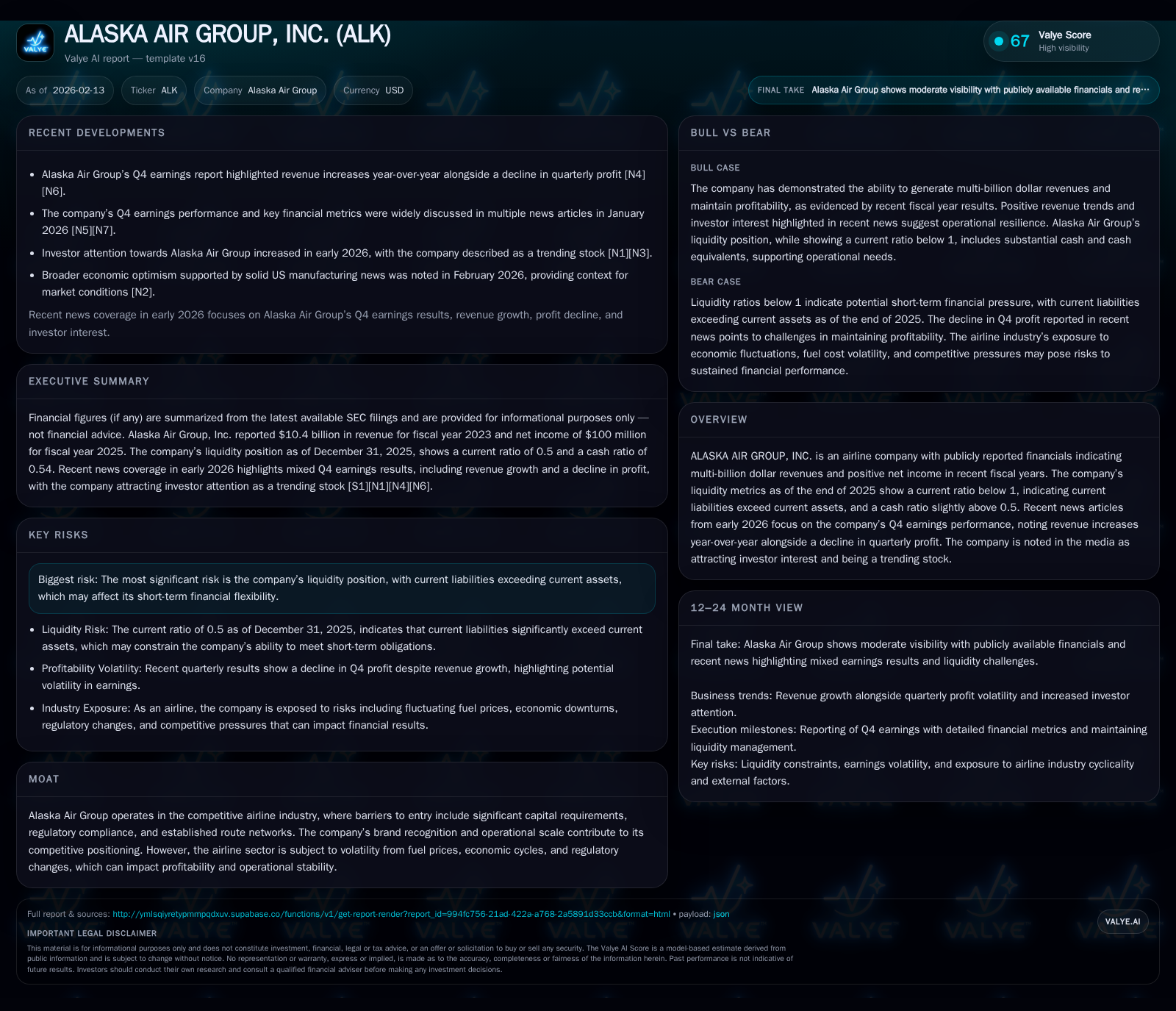
Alaska Air Group posted a notable revenue increase in Q4 2025 but saw a corresponding decline in net income, highlighting operational cost pressures. Liquidity metrics as of year-end show a current ratio under 1, raising questions around short-term financial flexibility. Despite sector volatility and rising costs, Alaska Air leverages brand strength and route networks to maintain competitive positioning. Investor interest has spiked, fueled by the tension between promising revenue growth and profitability challenges.
Q4 Earnings Beat vs Profit Decline: Decoding the Dichotomy
Alaska Air Group closed 2025 with an intriguing earnings narrative: revenues climbed notably year-over-year to over $10.4 billion (F1), surpassing consensus forecasts as noted in multiple early 2026 reports [N1][N3]. However, this positive top-line momentum was accompanied by a decline in net income to around $100 million for the fiscal year (F1), confirmed by various earnings analyses highlighting the dip in quarterly profit despite the strong revenue showing [N14]. The paradox here stems largely from rising operating costs, including labor expenses, fuel price headwinds, and inflationary pressures prevalent across the airline sector.
Operating margins contracted as Alaska Air absorbed higher input costs without fully offsetting these through pricing power or ancillary revenue gains, a commonly observed phenomenon across major carriers navigating an increasingly volatile cost environment. The company reported robust passenger demand recovery as pandemic-era travel indecision waned, but cost controls remained challenging, exerting downward pressure on profitability metrics highlighted during the Q4 earnings calls [N2]. Thus, while Alaska Air effectively grew its top line reflecting stronger ticket sales and network efficiency improvements, profit softness points to underlying margin deterioration still affecting the bottom line.
Liquidity Under the Microscope: Is Short-Term Financial Health Under Threat?
From a liquidity standpoint, Alaska Air’s position invites cautious scrutiny. The December 2025 balance sheet reveals current assets total approximately $3.3 billion against $6.6 billion in current liabilities (F1), translating into a current ratio near 0.5 — a level that typically flags potential short-term solvency concerns if left unmitigated.
Though cash and cash equivalents provide about $627 million of immediate liquidity (F1), this represents less than one-tenth of current obligations due within the near term. Company risk disclosures from recent SEC filings explicitly address these tensions, acknowledging how elevated short-term obligations might constrain operational nimbleness or necessitate external financing measures [S1][S2]. These filings emphasize the critical balance Alaska Air must strike between meeting debt maturities and investing in strategic growth initiatives amid uncertain economic conditions.
Moreover, optimizing working capital management will be pivotal given these liquidity constraints—the airline needs steady cash inflows from operations alongside disciplined capex to avoid exacerbating stress on its short-term balance sheet.
Competitive Moat in a Volatile Sky: Alaska Air’s Strategic Positioning
Operating within an industry characterized by steep barriers such as high capital intensity, regulatory hurdles, and entrenched route networks means Alaska Air benefits from meaningful moat elements despite fierce competition [valye_report_excerpt]. Its brand recognition bolstered by reliable service quality anchors customer loyalty especially in key West Coast markets where it maintains strong footholds.
However, volatility remains endemic—fluctuations in fuel prices can rapidly erode profitability given airlines’ significant energy dependencies; regulatory changes related to environmental policies or safety standards may impose incremental costs; and macroeconomic cycles shape discretionary travel demand considerably. Against this backdrop, Alaska Air’s operational scale affords some resilience though it must constantly innovate through fleet modernization and network optimization to fend off both large network carriers and disruptive low-cost entrants.
Investor Buzz and Market Sentiment: What’s Driving the ALK Stock Spike?
The tension between strong revenue figures versus squeezed profits appears to be a key driver behind heightened market interest [N8][N11]. Media coverage underscores Alaska Air as a trending ticker attracting increased retail and institutional attention amid speculative narratives around its recovery trajectory post-pandemic [N12]. Investors are parsing incremental data points closely—earnings beats have fueled optimism while profit declines temper enthusiasm, creating a dynamic dialogue about sustainable growth prospects.
Options activity further signals speculative positioning possibly linked to anticipated catalysts such as future guidance updates or broader industry rebounds [N12]. This duality mirrors broader thematic investor focus on airline stocks demonstrating resilient cash flow generation potential despite headwinds.
Risk Factors Deployed: Understanding Operational and Financial Vulnerabilities
Examining SEC filings offers granular insight into key risk vectors shaping Alaska Air’s outlook. Beyond liquidity concerns tied to current liabilities exceeding assets (S1)(S2), other outlined vulnerabilities include sensitivity to fluctuating jet fuel prices—a historically volatile expense element—and exposure to labor contract negotiations that could disrupt operations or raise costs.
Additionally, regulatory compliance demands impose ongoing expenditures while geopolitical uncertainties could alter international travel patterns adversely. The filings cautiously outline how external shocks may negatively impact profitability or force unplanned capital allocation shifts crucial for maintaining competitive relevance.
These disclosures paint a nuanced picture stressing that while growth opportunities exist, they are mitigated by tangible financial and operational hazards needing vigilant management.
Comparative Look: Alaska Air Amidst Industry Peers’ Earnings
Placing Alaska Air’s performance in an industry context reveals parallels with established competitors like Delta Air Lines. As per recent coverage focused on Delta’s own Q4 beats yet margin pressures [N5], airline operators broadly face similar headwinds—revenues growing with recovering travel demand even as inflationary cost inputs compress earnings power.
This synchronicity underscores systemic sector challenges rather than company-specific failings alone. Nonetheless, differences in scale, network diversity, and cost structures imply that Alaska must tailor strategic responses carefully to maintain or enhance its relative competitiveness.
Forecasting Forward: Strategic Moves and Market Expectations for 2026
Looking ahead into 2026, preview reports suggest analysts expect continued revenue growth tempered by margin pressures remaining unresolved without meaningful cost containment or pricing adjustments [N6][N7]. Strategic emphasis may focus on digital transformation initiatives for enhanced customer experience, deeper route network leveraging particularly on transcontinental routes, and selective capacity management aimed at balancing demand fluctuations without diluting unit economics excessively.
Capital allocation decisions will likely need prioritization toward preserving liquidity while selectively investing in fleet upgrades or sustainability programs aligning with evolving regulatory landscapes.
Investor expectations remain cautiously optimistic but acknowledge that concrete execution success is essential for sustaining confidence amidst ongoing market complexities.
Data-Driven Insights from SEC Filings and Financial Disclosures
The analytical foundation is anchored firmly by official SEC documentation corroborating financial metrics highlighted across media narratives. The firm’s latest annual report attests to $10.4 billion revenue alongside net income at around $100 million (F1)(S1), reinforcing the mixed financial complexion detailed throughout this memo.
Liquidity ratios derived from balance sheet aggregates using companyfacts data expose structural imbalances requiring attention; meanwhile risk factor disclosures elucidate broad industry-related threats along with company-specific exposures providing comprehensive transparency needed for informed evaluation.
In sum, data-driven evidence underpins a complex story of an airline grappling with simultaneous growth opportunities and persistent operational constraints amid a challenging macroeconomic environment.
This analysis presents factual findings anchored exclusively on publicly available financial data and credible news sources without imparting investment recommendations or price predictions. Readers should consider multiple perspectives alongside evolving market information when forming their own assessments regarding Alaska Air Group's business prospects.
Disclaimer: This is research-only, informational analysis and not investment advice. It may include AI-generated interpretation and general industry context. Always verify important details using primary sources.

Comments