
Prologis’ Global Logistics Real Estate: Scale, Innovation, and Risk Navigation in 2025
Prologis leverages its unmatched logistics footprint with integrated innovation and strategic capital to sustain growth amid economic uncertainties.
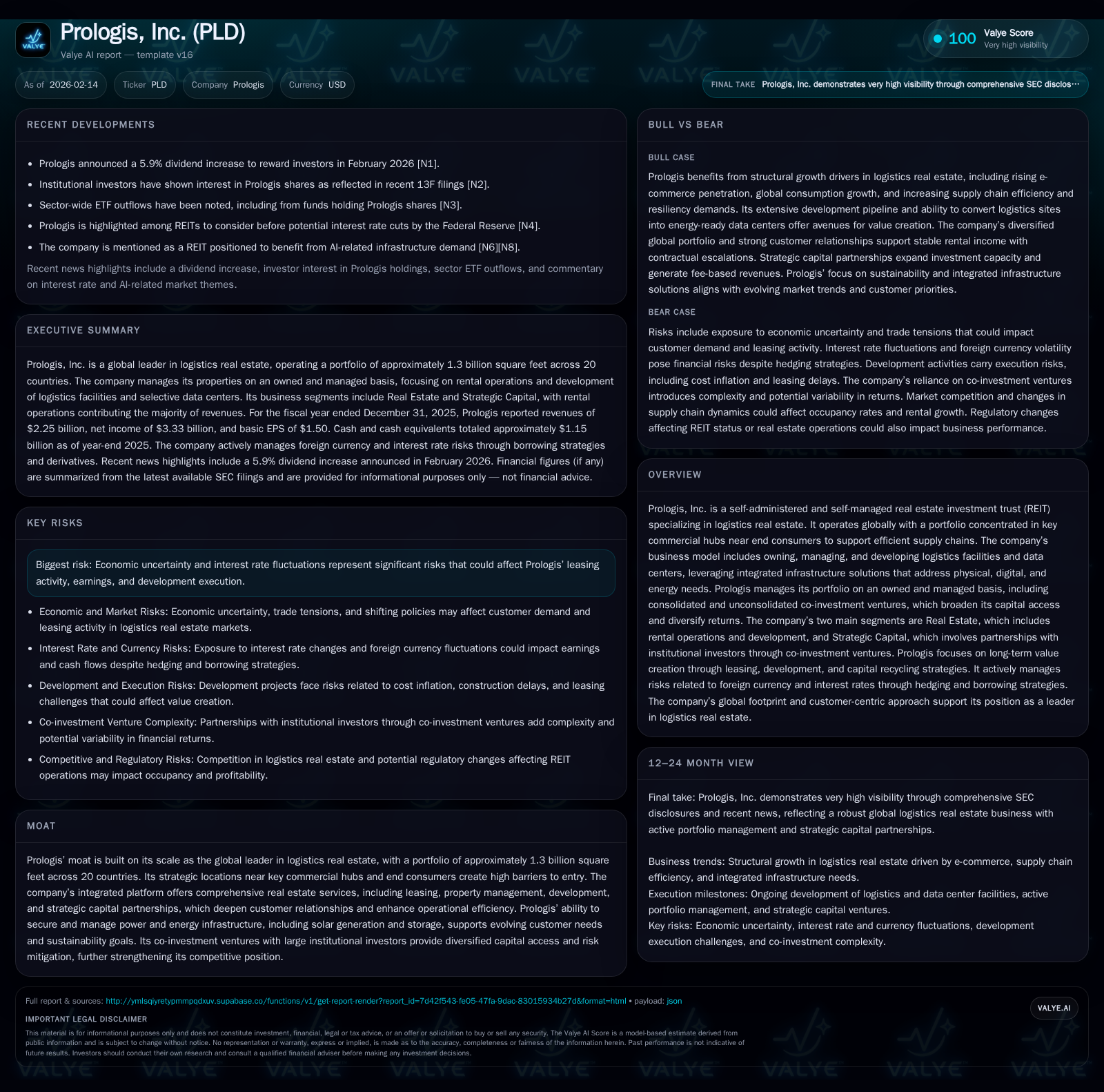
Prologis, Inc. stands as the undisputed global leader in logistics real estate, managing a vast portfolio of approximately 1.3 billion square feet across 20 countries. Its dual business lines—comprising real estate operations and strategic capital partnerships—offer diversified revenue streams and broaden institutional investor engagement. Despite macroeconomic headwinds such as tariff concerns and interest rate fluctuations, Prologis maintained robust leasing momentum in 2025, underpinning a recent dividend increase and strong cash liquidity. The company’s innovation in embedding digital infrastructure and energy solutions further strengthens its competitive position while prudent risk management shields exposure to currency and interest rate volatility.
Dominating the Logistics Real Estate Landscape: Scale as Moat
Prologis’ commanding presence in logistics real estate is best understood through its sheer scale — a globe-spanning portfolio of roughly 1.3 billion square feet distributed over 20 countries on four continents [valye_report_excerpt; S1; F1]. This immense footprint is not just a sign of size but a strategic moat forged through concentration near key commercial hubs close to end consumers. Such proximity accelerates supply chain velocity, a rising imperative in today’s commerce landscape where speed and efficiency dictate competitiveness.
Beyond geography, Prologis integrates ownership with active management and development capabilities, enabling operational consistency across diverse markets. This integrated model fosters deep customer relationships via full-spectrum services—leasing, property management, tailored development—that reinforce barriers to entry for competitors deprived of similar economies of scale [valye_report_excerpt]. The company’s ownership of critical energy infrastructure — solar generation paired with storage — uniquely prepares it for the electrification wave transforming warehouse operations.
The confluence of physical scale with digital and energy infrastructure integration positions Prologis not just as a landlord but as an essential partner shaping supply chains worldwide.
Unpacking Prologis’ Dual Engines: Real Estate Operations and Strategic Capital
Prologis' business model operates on two interlocking engines: its core real estate segment driving rental revenues and development activities, and its strategic capital ventures broadening capital access through partnerships with institutional investors [valye_report_excerpt; S1].
The real estate arm manages properties both consolidated on the balance sheet and unconsolidated co-investment ventures under management—a structure enabling operational control without absolute ownership. This approach diversifies return streams while mitigating risk concentration.
Strategic capital deployments, notably via co-investment funds, deepen market penetration efficiently by pooling resources with institutional partners who benefit from Prologis’ platform expertise. Such vehicles have been pivotal in recent initiatives like the China AMC Prologis Logistics REIT listing on the Shenzhen Stock Exchange—a landmark step reinforcing foothold in Asia’s logistics boom [S1].
This dual structure balances stable income generation from leases alongside flexible capital allocation opportunities aligned with global expansion objectives.
Financial Fortitude: Navigating 2025’s Leasing Growth and Debt Strategy
In 2025, Prologis demonstrated notable resilience amidst global uncertainties including tariff policy disruptions declared mid-year [S1]. Leasing activity impressively reached 112 million square feet on a consolidated basis (and even higher at 228 million square feet on an owned-and-managed basis), translating into an occupancy rate holding strong at 95.6%. Notably, rents on new leases surged to a net effective increase of 50.1%, reflecting continued demand strength despite pockets of slowing market rental growth elsewhere [S1; F1].
Financially, Prologis fortified its position with $7.6 billion in total available liquidity encompassing $6.5 billion of credit capacity plus $1.1 billion cash reserves—a safeguard against cyclical headwinds [S1]. Total debt stood at $35 billion characterized by a weighted average maturity of nine years at an effective interest rate of 3.2%, underscoring long-dated fixed-rate financing that cushions earnings from short-term rate volatility [S1; F1].
Refinancing maneuvers included amending global credit facilities extending maturity dates well past this decade’s end alongside establishing new commercial paper programs diversifying currency exposure [S1]. This deliberate capital structure affords operational funding agility while preserving conservative leverage metrics.
Innovation at the Crossroads: Digital and Energy Infrastructure Integration
As supply chains grow increasingly complex—embracing automation, AI-driven inventory systems, cold-chain technologies—Prologis has innovated beyond traditional warehousing fundamentals by embedding digital infrastructure within its facilities [valye_report_excerpt; S1].
Facilities are designed or retrofitted to support power-intensive applications including data centers co-located with logistics spaces enabling real-time analytics support essential for modern distribution networks.
Complementarily, clean energy adoption features prominently via solar generation assets integrated into properties accompanied by battery storage solutions—addressing corporate sustainability mandates while reducing operational cost volatility related to energy price spikes.
By marrying physical logistics capacity with digital backbone capabilities and reliable green energy sources, Prologis future-proofs its portfolio against emerging tenant demands rooted in technological adoption and ESG compliance.
Global Exposure and Currency Dynamics: Managing Foreign Risks
With nearly eight percent of consolidated revenues denominated in foreign currencies [$507 million], Prologis confronts inherent translation risks tied to multinational operations [S2]. Revenue streams span major regions including Europe (euro), Asia (yen), Canada (dollar), and the U.K. (pound sterling) creating potential earnings variability from exchange rate shifts.
The company's mitigation tactics are multi-layered: borrowing predominantly in local currencies establishes a natural hedge limiting net asset translation gaps; concurrently it deploys derivative instruments such as foreign currency forward contracts—with aggregate notional value around $1.6 billion—to offset fluctuations in international subsidiary earnings translation [S2]. Gains or losses from these derivatives feed through earnings to counterbalance currency-induced translation adjustments.
Scenario analysis suggests that while a hypothetical weakening of the U.S. dollar against these currencies could incur cash settlements (e.g., about $164 million for a 10% adverse move), such exposures are carefully managed within broader portfolio risk frameworks [S2].
Dividend Strategy: Rewarding Investors Amid Market Uncertainty
In February 2026, Prologis announced a substantive dividend increase of 5.9%, reaffirming confidence in recurring cash flow durability despite ongoing macroeconomic unpredictability [N4; F1; S1]. The raise comes on the back of a robust net income figure exceeding $3.3 billion for fiscal year 2025 bolstered by resilient occupancy levels and double-digit lease mark-to-market spreads [F1; S1].
This trajectory signals management’s commitment to shareholder returns anchored in sustainable earnings growth rather than transient market gyrations—the move was positively received within analyst circles highlighting the combination of growth potential with income stability as central investor attractions [N4].
Maintaining such dividend discipline while funding ambitious development pipelines reflects a balancing act aligning investor rewards with capex priorities.
Growth Horizons: Development Pipelines and Co-investment Ventures
Capitalizing on persistent tenant demand patterns favoring customized space solutions along key distribution arteries, Prologis initiated approximately $2.9 billion worth of new consolidated development starts during the year—with layout data showing nearly two-thirds dedicated to build-to-suit projects tailored specifically to customer requirements [S1]. This bespoke approach enhances customer stickiness and justifies premium pricing structures mitigating market rent softness elsewhere.
Strategically complementary are co-investment efforts exemplified by landmark milestones such as launching the China AMC Prologis C-REIT listed publicly on Shenzhen's exchange—through which Prologis retains majority ownership stakes exceeding twenty percent while leveraging local investment appetite for logistics real estate exposure [S1]. Such vehicles multiply capital sources underlying the firm’s expansion ambitions while sharing geographic risks across partners.
Together, organic development melded with financial partnerships frames Prologis’ growth strategy navigating fragmented global markets prudently yet ambitiously.
Risks Ahead: Economic Volatility and Interest Rate Sensitivity
Despite demonstrated resilience, material risks lurk as persistent economic uncertainty threatens leasing dynamics—particularly given ongoing tariff policy risks flagged mid-2025 that inject unpredictability into tenant capital expenditure plans affecting warehouse utilization intensity [S1; valye_report_excerpt]. Slowing GDP growth or manufacturing contractions could ripple negatively into renewal rates or new lease volumes.
Interest rate fluctuations represent another pivotal factor impacting cost of debt service especially if variable rates climb sharply; however, fixed-rate borrowing predominates ($34.6 billion fixed vs $1.3 billion variable debt) complemented by derivatives hedging instruments softening immediate cost shocks [S2]. Sensitivity analyses reveal that despite hedges there remains some exposure warranting attentive management oversight.
Currency exchange volatility also poses earnings translation challenges but diversified currency borrowings combined with derivative hedges provide meaningful buffers albeit imperfect ones requiring continuous monitoring [S2].
Collectively these factors underscore the importance for vigilant risk mitigation embedded within financial strategy maintaining optionality under shifting macroeconomic regimes.
Investor Interest & Market Flow: Analyzing Recent News and ETF Activity
Market sentiment toward Prologis recently showcases nuanced dynamics blending cautious macro views with enduring structural appreciation for logistics REIT fundamentals [N4; N6; N5; N7; N11]. Notably, ETF flows recorded intermittent net outflows signaling short-term reallocations amidst sector rotation pressures typical early in calendar cycles [N6], yet major institutional holders continue substantial weighted shares underpinning steady demand [N5].
Analyst commentaries highlight dividend growth as pivotal positive catalyst enhancing investor appeal alongside recognition that sustained e-commerce driven warehouse demand remains secular tailwind resistant to cyclical headwinds [N4; N11]. Discussions around Fed rate policies influence tactical positioning but generally reinforce favorability toward companies like Prologis exhibiting long-duration lease profiles providing revenue visibility amid rate transitions [N7].
In essence, market feedback encapsulates healthy interest anchored by fundamental strengths tempered prudently by macroeconomic vigilance.
This analysis reflects information current through early February 2026 derived from company disclosures (Form 10-K & Q), public filings, market commentary, and regulatory sources cited herein. It aims to elucidate thematic business underpinnings rather than serve as investment advice or recommendation.
Disclaimer: This is research-only, informational analysis and not investment advice. It may include AI-generated interpretation and general industry context. Always verify important details using primary sources.

Comments