
WEX Inc.: Navigating Earnings Growth and Liquidity in a Complex Financial Landscape
A detailed financial dissection of WEX’s impressive fiscal 2025 performance amidst subdued market reaction and evolving capital strategies.
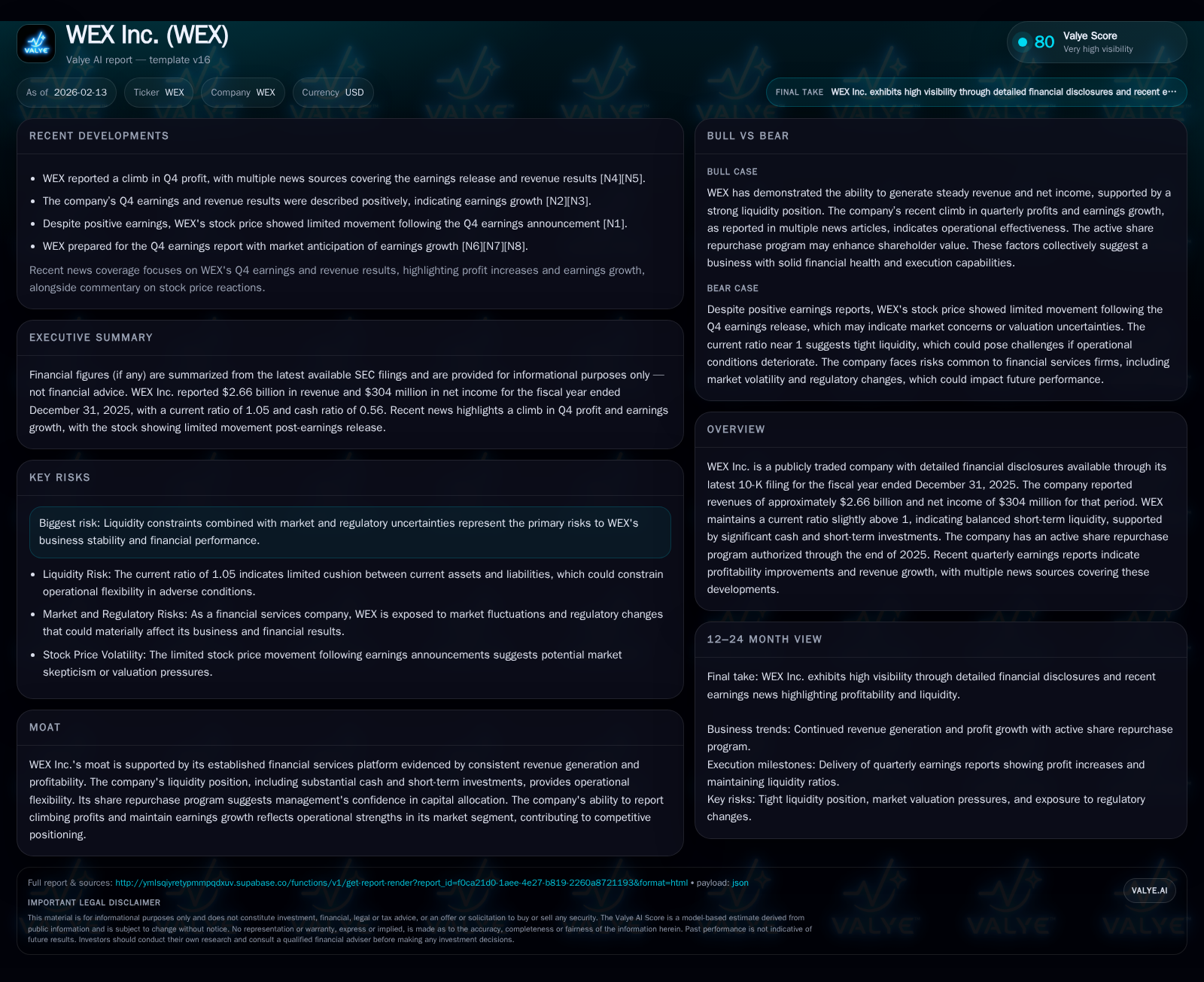
WEX Inc. reported a strong 2025 fiscal year with revenues hitting approximately $2.66 billion and net income of $304 million, demonstrating profitability gains that outpaced market expectations. Despite this solid financial footing, the stock experienced minimal movement following earnings releases, reflecting investor caution amid broader regulatory and liquidity uncertainties. Operationally, WEX maintains a balanced liquidity profile supported by substantial cash reserves and an active share repurchase authorization, although recent capital deployment has been measured. An examination of revenue breakdown, profitability drivers, and risk factors reveals a company confident yet prudently navigating structural challenges in its financial services niche.
Defying Market Noise: The Quiet Confidence of WEX’s Q4 Beat
WEX Inc.'s fourth-quarter earnings announcement in early February 2026 offered an intriguing paradox: the company surpassed revenue and earnings estimates comfortably yet the market barely registered the news with notable share price movement [N1][N3][N9]. Specifically, WEX reported a continuation of its positive momentum entering FY25's close, reflected in both top-line growth and profitability gains. Yet investor response was muted — arguably a symptom of broader market caution or concerns extending beyond headline numbers.
This disconnect invites a deeper inspection of the company’s fundamentals beyond surface metrics. The underlying factors may include regulatory complexities affecting share repurchases, prevailing economic uncertainties impacting valuation multiples, or perhaps skepticism around sustainability of profit margins amid competitive pressures. Whatever the reason, WEX’s Q4 performance speaks to operational strength that quietly defies amplified volatility in its trading patterns.
Revenue Streams Under the Microscope: Payment Processing and Beyond
Detailed disclosures from WEX's latest 10-K illuminate how revenue composition drives overall growth. The company generated approximately $2.66 billion in total revenues for fiscal 2025 [F1][S1], segmented primarily across three categories:
- Payment Processing Revenues: Representing the largest slice of total revenues, this segment benefits from expanded transaction volumes facilitated by WEX's extensive merchant networks and client contracts.
- Account Servicing Revenues: Steady contributions stem from recurring fees associated with managing client accounts — a reliable baseline income source.
- Finance Fee Revenues: Interest and finance-related charges complement other revenue streams as clients utilize credit-oriented payment solutions.
Each piece plays a role in cushioning against sector volatility while cumulatively fostering gradual top-line expansion. This diversified model affords some resilience amid shifting consumer payment behaviors or competitive entry points.
Liquidity and Balance Sheet Strength: Decoding the Current Ratio
WEX’s balance sheet reveals healthy short-term financial positioning underscored by a current ratio slightly above 1 (about 1.05) as of December 31, 2025 [F1]. This figure reflects near equivalence between current assets ($9.7 billion) and current liabilities ($9.3 billion), indicative of more than adequate liquidity to meet imminent obligations [S1].
Notably, cash and cash equivalents held around $906 million at year-end – a sizable buffer enhancing operational flexibility [F1]. This liquidity supports ongoing business activities including technological investments, servicing working capital needs, and potential strategic initiatives without over-reliance on external financing.
Such balance is particularly relevant given industry conditions where rapid funding shifts or credit market tightening can impose challenges. WEX's equilibrium between assets and liabilities conveys cautious but deliberate stewardship over financial resources.
Capital Allocation at a Crossroads: Share Repurchases in Focus
Management signaling emerges strongly via its capital return policies. As per disclosures through late 2025, WEX’s board authorized repurchases up to $2.05 billion in common stock to be executed through December 31, 2025 [S2]. However, interestingly no shares were repurchased during Q3 2025 despite availability under this program.
This restraint likely reflects regulatory influences detailed within filings — most notably the Inflation Reduction Act's imposition of a nondeductible one percent excise tax on net stock buybacks [S2]. This new cost consideration complicates traditional capital return calculus.
Additionally, insider trading arrangements governed by Rule 10b5-1 were modestly active but contained (e.g., Chief Accounting Officer Jennifer Kimball's limited share sales planned under these rules), signaling prudent corporate governance amidst changing market dynamics [S2].
Taken together, these factors depict management as cautious but optimistic — willing to maintain dry powder while navigating policy headwinds impacting efficient capital deployment.
Profitability Trajectory: Dissecting Earnings Growth Drivers
Achieving $304 million in net income for fiscal year 2025 marked another stepping stone upward for WEX’s profitability scale [F1][N9][S1]. Several internal levers appear responsible:
- Margin Expansion: Operational efficiencies through improved cost structures and technology platforms likely reduced overhead pressures.
- Revenue Mix Improvements: A favorable shift toward higher-margin segments within payment processing contributed positively.
- Expense Controls: Tactical expense management preserved profitability despite inflationary pressures elsewhere.
While the exact granular details require further disclosure analysis, the overall trend depicts disciplined cost governance coupled with growing revenue volume enabling steady bottom-line expansion.
Risk Factors in Perspective: Navigating Liquidity and Regulatory Headwinds
Despite these strengths, WEX explicitly flags certain risks that merit vigilance. The central concerns revolve around liquidity constraints in changing economic conditions compounded by evolving regulatory frameworks impacting core activities like stock repurchases [S2].
The Inflation Reduction Act introduced a one percent excise tax on net value of stock buybacks—a measure directly increasing costs associated with returning capital to shareholders [S2]. Such regulatory designs alter traditional incentives around buybacks versus dividends or reinvestment.
Furthermore, general market uncertainty—ranging from inflation dynamics to geopolitical tension—adds layers of unpredictability potentially influencing consumer spending patterns integral to payment processing volumes.
Acknowledging these risks centrally grounds any optimistic assessment and highlights an adaptive posture needed by management going forward.
Sector Positioning and Competitive Moat: What Sets WEX Apart?
WEX enjoys a defensible moat rooted principally in its broad-based financial services platform exhibiting consistent revenue generation combined with resilient profit streams and balanced liquidity reserves [valye_report_excerpt.moat]. This combination supports:
- Stable cash flow backed by established transaction ecosystems,
- Operational flexibility afforded by significant liquid assets,
- Confidence-enhancing capital return strategies such as selective share repurchases,
- Earnings growth evidence underscoring efficient execution within market niches.
These attributes contribute to durable competitive differentiation ensuring WEX remains well-poised amid fluctuating industry currents.
Wall Street’s Take: Analyst Sentiment and Neutral Recommendations
Investor perceptions add nuance to fundamental analysis. Cantor Fitzgerald initiated coverage with a neutral rating prior to year-end reports citing moderate expectations for sustained earnings growth aligned with sector trends [N11]. Similarly, other market commentaries reflect cautious optimism urging retention of shares based on stable operations yet tempered by recognition of emerging headwinds [N6][N12].
This balanced view indicates Wall Street neither dismisses the company's progress nor fully commits to bullish scenarios — reflecting inherent uncertainties alongside observable strength.
Conclusion: Balancing Optimism with Prudence in WEX's Outlook
Synthesizing these facets creates a portrait of WEX Inc. as an enterprise executing well within its defined strategic parameters while contending judiciously with external challenges shaping liquidity management and capital deployment decisions. Strong fiscal 2025 results bolster confidence; yet muted market reactions coupled with clear regulatory impacts counsel thoughtful analysis going forward.
Ultimately, WEX exemplifies a robust financial services operator maintaining steady profitability growth supported by diversified revenues and balance sheet discipline—earning its place as an adaptable participant within its sector ecosystem amid macroeconomic flux.
Disclaimer: This analysis is for informational purposes only and does not constitute investment advice or recommendations.
Disclaimer: This is research-only, informational analysis and not investment advice. It may include AI-generated interpretation and general industry context. Always verify important details using primary sources.

Comments