
Edesa Biotech Poised at Clinical and Strategic Inflection in Immuno-Inflammatory Innovation
Late-stage successes and strengthened financials put Edesa Biotech on a promising yet challenging path forward.
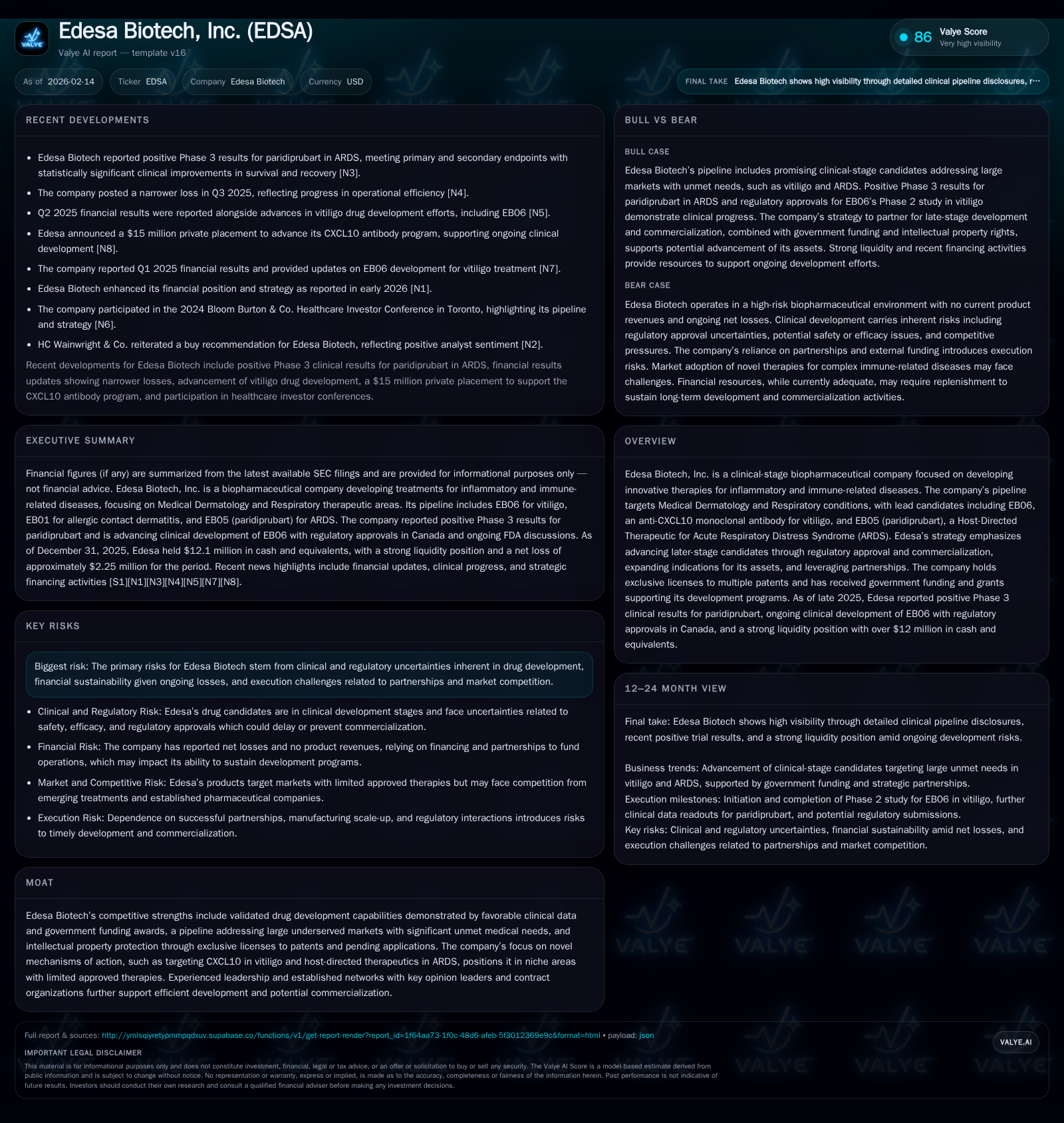
Edesa Biotech, a clinical-stage biopharma company addressing immune-inflammatory diseases, recently announced positive Phase 3 results for its respiratory asset paridiprubart and advanced regulatory discussions around its dermatology candidate EB06. Enhanced financial positioning including nearly $12 million in cash reserves underpins ongoing development programs targeting indications with significant unmet needs. While notable risks related to drug development, manufacturing, and market entry persist, Edesa’s patent-backed niche pipeline and government-supported collaborations create a distinctive platform navigating toward commercialization.
Edesa’s Strategic Leap: Financial Fortification & Focused Pipeline Progress
Edesa Biotech has recently sharpened its strategic posture fortified by enhanced financial resources as of early 2026. A Nasdaq report [N1] underscores this improved capital position alongside refined operational priorities focused sharply on advancing pivotal clinical trials. According to the latest quarterly SEC filing [S2], the company closed 2025 with approximately $12.1 million in cash and equivalents against minimal current liabilities, yielding a robust current ratio near 16.8, signaling strong liquidity readiness to meet near-term clinical development expenses.
This financial steadiness is opportune as Edesa moves aggressively toward critical mid-year enrollment targets for its lead Medical Dermatology candidate EB06 while consolidating prior successes behind EB05 in Respiratory indications. The company's dedication to stringent capital allocation coupled with pursuance of licensing deals reflect a disciplined approach aimed at bridging late-stage innovation into regulatory milestones.
Innovating Scarce Therapeutic Avenues: The Science Behind EB06 and EB05
Edesa’s pipeline is distinguished by pioneering therapies that address substantial unmet needs with limited approved treatments. EB06 targets CXCL10 — a chemokine implicated in the autoimmune destruction causing vitiligo’s characteristic depigmentation. Neutralization of CXCL10 offers both preventative and restorative therapeutic potential, supported by preclinical models demonstrating reversal of skin discoloration [S1]. The anti-CXCL10 monoclonal antibody not only benefits from mechanistic novelty but also from an emerging safety profile compatible with chronic dermatological application.
Similarly transformative is EB05 (paridiprubart), categorized as a Host-Directed Therapeutic (HDT). This represents a new therapeutic class designed to modulate host immune responses during severe infections such as Acute Respiratory Distress Syndrome (ARDS). The truncated Phase 3 study outcomes reported in late 2025 [S1] demonstrated statistically significant survival advantage along with accelerated recovery metrics — crucial endpoints validating the practical efficacy of host response modulation beyond mere pathogen targeting.
With no established HDTs currently approved for ARDS treatment, paridiprubart positions Edesa uniquely within a nascent therapeutic frontier blending immunology and critical care medicine. Both candidates exemplify the company’s philosophy: develop assets based on compelling scientific rationale where large populations remain unserved by existing pharmacotherapies.
From Clinical Promise to Market Reality: Navigating Regulatory Pathways
The transition from encouraging clinical data to commercial availability hinges on complex regulatory dynamics where Edesa is actively engaged. Health Canada’s acceptance of the Phase 2 proof-of-concept study for EB06 has enabled formal trial initiation plans by mid-2026 [S1]. Simultaneously, ongoing FDA discussions suggest coordinated efforts to align U.S. clinical regulatory requirements with those achieved internationally.
For paridiprubart, Phase 3 results serve as a catalyst propelling dialogue around expedited review mechanisms given ARDS’s severity and public health burden [N1]. Additionally, government sponsorship—particularly from BARDA—provides frameworks for adaptive protocols embedded within U.S. platform studies evaluating HDTs comprehensively.
Such multi-jurisdictional regulatory engagements underpin Edesa's strategic pathway calculus: leverage positive efficacy data while satisfying safety benchmarks necessary for marketing authorization submissions. Success entails meeting rigorous standards across safety, manufacturing quality controls, and demonstrating consistent reproducibility in larger patient populations.
Financial Health in Spotlight: Resilience Amidst Ongoing Losses
While the absence of commercial products translates into zero revenue as of the latest reported period ending September 2021 [F1], Edesa maintains a structurally sound balance sheet poised to fund advancing development activities into mid-term phases. Operating losses culminating near $2.25 million for fiscal year 2025 [F1] are characteristic of high-investment biotech ventures navigating research-intensive horizons prior to revenue generation.
The strategic infusion of grant capital totaling over C$37 million from multiple government sources [S1], as well as BARDA-led initiatives [N1], enhances non-dilutive funding available—a vital factor alleviating reliance on equity markets or debt financing under potentially volatile conditions. Prudent cash management translated into a substantial current ratio (>16) indicates neither imminent liquidity constraints nor excessive short-term obligations that could impair program continuity.
Nonetheless, sustaining sufficient funding through late-stage trials remains paramount; failure to maintain capital adequacy could necessitate project scaling back or reprioritization that would delay commercialization timelines significantly.
Partnering & Grant Support: De-Risking Development Through Collaboration
Edesa’s approach to mitigating drug development risk has incorporated broad governmental collaboration complemented by strategic third-party partnerships. Licensing exclusive rights across multiple proprietary patents fortifies intellectual property while enabling focused resource deployment on core assets such as EB06 and EB05 [S1].
Government grants exceeding C$37 million demonstrate institutional confidence—directly supporting R&D efforts and reimbursing specific costs like manufacturing scale-up for paridiprubart [S1]. Simultaneously, BARDA sponsorship integrates Edesa into expansive federal platforms designed to expedite countermeasure availability during infectious disease emergencies—a unique validation unavailable to most peers.
Partnerships extend beyond financing; relationships with contract research organizations (CROs), key opinion leaders (KOLs), and regulatory consultants streamline operational execution across complex trial landscapes. Collectively, these alliances underpin both technical progress and reputational capital vital for future negotiations involving potential commercialization partners or market entrants.
Manufacturing Complexities and the Road Ahead for Scalability
Monoclonal antibodies like EB06 necessitate intricate biomanufacturing processes involving living cell cultures requiring stringent environmental control, sophisticated purification steps, and validated formulation stability assessments [S1]. These factors escalate production costs substantially compared to small-molecule drugs extrinsic to biologics complexity.
EB05’s classification as an HDT adds further challenges due to specificity demands ensuring consistent immunomodulatory activity without off-target toxicity or batch variability issues inherent in biologic-derived products. Tech transfer activities from clinical-scale production sites toward commercial batch volumes entail considerable risk periods characterized by potential delays or process inefficiencies.
Such manufacturing hurdles impose bottlenecks capable of influencing supply chain robustness post-approval potentially delaying patient access or necessitating elevated pricing strategies offsetting elevated production expenditures—a recognized hurdle industry-wide for novel biologics aiming at broad populations.
Risk Landscape: Critical Bottlenecks Beyond the Lab
Clinical development inevitably confronts uncertainties including trial enrollment impediments, adverse event emergence, or deficient efficacy — any capable of arresting progress abruptly [S1][S2]. Regulatory pathways add layers of complexity; accelerated reviews often carry intensified scrutiny standards raising likelihoods of requests for additional studies or prolonged decision timelines.
Operationally, dependence on third-party vendors spanning manufacturing, CRO services, and IT infrastructure incorporates potential vulnerabilities especially amid cybersecurity threats detrimental to data integrity and timely communications [S1]. Competitive dynamics impose pressure; contemporaneous innovation pipelines targeting similar immuno-inflammatory indications may capture market share earlier if superior profiles manifest.
Furthermore, entering commercialization without established sales forces demands arrangements with third parties who might exhibit misaligned incentives or insufficient specialty expertise undermining launch success chances—a commonly underestimated post-approval obstacle reminiscent across emerging biotechs transitioning beyond bench into marketplace realities.
Competitive Terrain: Positioning in Immuno-Inflammatory Markets
Edesa occupies niche biochemical corridors characterized by patented targeted mechanisms—neutralizing CXCL10 in vitiligo or modulating host immunity during ARDS—that currently lack approved interventions [S1]. This exclusivity affords a defensible 'moat' mitigating generic competition while addressing sizeable patient populations worldwide suffering chronic dermatologic disfigurement or acute respiratory failure respectively.
However, such niches inherently attract emergent competitors emboldened by scientific advances or repurposed therapies necessitating continuous innovation to sustain differentiation. Commercial value extraction depends heavily on managed care acceptance policies under evolving healthcare reform environments potentially constraining pricing power despite favorable clinical outcomes.
In essence, Edesa’s challenge lies not only in satisfying safety-efficacy thresholds but also in crafting compelling value propositions acceptable across multi-stakeholder decision frameworks encompassing payors, physicians, patients, and regulators alike.
Leadership Credibility & Network Synergies Driving Execution
Integral to navigating these multifaceted challenges is Edesa’s seasoned management team possessing demonstrated expertise spearheading advanced drug development programs within immunology domains [S1]. Established connections with KOLs provide avenues for robust clinical trial advocacy facilitating patient recruitment efficiency alongside advisory input refining study designs aligned with regulatory expectations.
Contractual engagements extending to specialized CROs enable assemblage of agile operational infrastructures crucial during fast-paced clinical transitions typical at late stages where timing precision impacts cost containment critically. This organizational backbone reinforces Edesa’s ability to manage elaborate clinical portfolios concurrently while preserving focus upon high-potential projects driving corporate milestones forward.
This analysis synthesizes publicly available information without imparting investment advice or recommendations. Observations incorporate reported data points alongside contextual industry knowledge reflecting common developmental trajectories among late-stage biotech firms focused on immuno-inflammatory therapeutics. Potential investors should consider full disclosures and consult professional advisers before making decisions.
Disclaimer: This is research-only, informational analysis and not investment advice. It may include AI-generated interpretation and general industry context. Always verify important details using primary sources.

Comments