
Vertiv Holdings Co.: Scaling AI Digital Infrastructure Amid Operational and Financial Strains
Vertiv's substantial sales growth and record backlog highlight its central role in AI infrastructure, even as order fulfillment challenges and debt covenants temper outlooks.
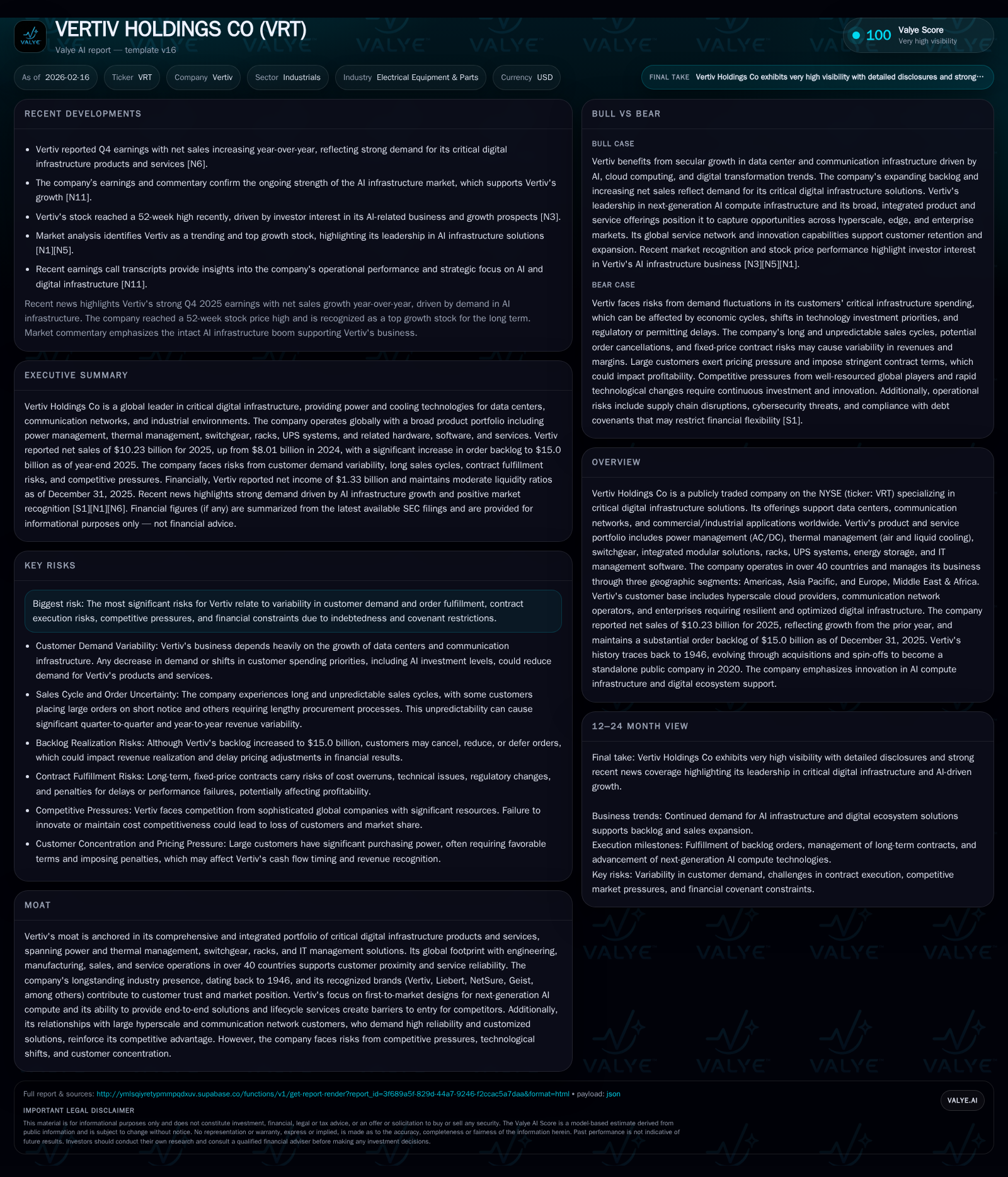
Vertiv Holdings Co. capitalizes on the surging demand for AI-driven data center infrastructure with robust revenue growth and a backlog doubling to $15 billion in 2025. The company’s deep legacy, combined with integrated power, thermal, and IT management solutions, underpins its competitive advantage globally across the Americas, Asia Pacific, and EMEA. However, operational complexity from backlog expansion and risks intrinsic to long contract cycles coexist with financial constraints imposed by restrictive debt covenants, fostering a cautiously optimistic yet scrutinized investor sentiment despite recent earnings beats. Vertiv’s sustained innovation focus targeting next-gen AI compute platforms aims to fortify its moat amid intensifying market competition.
Surging Demand: Vertiv's Role Powering AI-Driven Digital Infrastructure
Vertiv Holdings Co. enters 2026 buoyed by the momentum of an accelerating AI infrastructure boom that propelled its net sales to $10.23 billion in 2025—a significant leap from prior years underscored by a staggering $15 billion order backlog as of year-end [S1][N1]. This nearly twofold increase in backlog signals not only thriving customer demand but also a complex orchestration ahead to fulfill these orders against global supply chain pressures.
First-to-market initiatives focused on next-generation rack-scale artificial intelligence compute platforms have been instrumental in capturing new hyperscale cloud deployments and demanding communication network projects [S1][N3]. These advanced solutions position Vertiv at the vanguard of critical digital infrastructure innovation, aligning closely with hyperscalers’ urgency to stay multiple compute generations ahead in both performance and efficiency.
A Century-Strong Legacy Integrates Into Next-Gen Tech Leadership
Vertiv’s roots trace back to Ralph Liebert’s mid-20th century founding of pioneering computer room air conditioning technology—an early hallmark of thermal management expertise that remains a cornerstone of its portfolio today [S1][S7]. The subsequent Emerson acquisition integrated an expansive suite of critical infrastructure technologies under one Network Power umbrella beginning in 2000. Strategic acquisitions such as Avocent bolstered IT management software capabilities; meanwhile, facility enclosures from Knurr AG rounded out the systems approach.
The spin-off from Emerson in 2016 into an independent entity allowed for focused development on end-to-end digital infrastructure needs before publicly listing via SPAC in early 2020 [S1][S7][S8]. This lineage underpins Vertiv’s scale and product breadth today—spanning power delivery, thermal regulation, switchgear components, racks, UPS systems, energy storage solutions, and sophisticated software offering single-pane-of-glass infrastructure visibility. This historical depth lends credibility with customers navigating increasingly complex compute environments.
Order Backlog Surges to $15 Billion—Delivering Growth and Operational Complexity
Vertiv's order backlog swelling from $7.2 billion at the end of 2024 to approximately $15 billion by December 31, 2025 charts intense market engagement but exposes growing operational pressures [S1][S6]. The backlog predominantly consists of firm orders anticipated for fulfillment within the next 12 to 18 months. Yet customers retain rights—with penalties—to defer or terminate orders which injects unpredictability into revenue realization.
This surge elevates revenue visibility substantially but carries inherent risks associated with the timing of deliveries amidst complex manufacturing schedules, potential cancellations during economic shifts, pricing inertia against inflationary inputs, and integration challenges especially concerning recent acquisitions contributing varied contract terms [F1][S6]. Furthermore, extended sales cycles for new or turnkey solutions heighten lumpiness quarter-over-quarter—a dynamic that management acknowledges poses forecasting hurdles [S1].
Global Footprint Enables Customer Proximity Across Three Continents
Operating across more than 40 countries worldwide affords Vertiv vital proximity to hyperscale cloud operators, telecommunication network providers, edge computing ventures, and enterprise clients requiring mission-critical digital ecosystem support [S5][S6][S7]. For fiscal year 2025 revenues were distributed by geography as follows: Americas represented 62%, Asia Pacific 20%, and Europe/Middle East/Africa (EMEA) accounted for the remaining 18%—reflecting entrenched presence in primary data center investment regions alongside growing influence in emerging markets [S8].
Such diversified geographic exposure aids risk mitigation against localized economic downturns yet introduces complexities dealing with fluctuating foreign exchange rates, regulatory differences including permitting delays for hyperscale construction projects, geopolitical trade tensions impacting supply chains especially vis-à-vis tariffs or trade restrictions on key components [S16][S17].
Product and Service Portfolio: End-to-End Solutions for Critical Infrastructure
Vertiv offers arguably the most comprehensive critical digital infrastructure portfolio within electrical equipment manufacturing. Its core offerings span AC/DC power distribution units (PDU), uninterrupted power supplies (UPS), energy storage modules alongside air-cooled and liquid-cooled thermal management systems vital to preserving AI workload densities under tight power envelopes.
Complemented by medium/low voltage switchgear assemblies plus integrated modular solutions—the company provides tailored configurations enabling rapid deployment of turnkey data center environments suited for high-density compute operations [S1][S5][S7]. Furthermore, value-added services include lifecycle asset management supported by predictive analytics software (via acquisitions like Avocent), fostering deeper customer lock-in through continual optimization engagements rather than isolated hardware sales.
This tightly integrated hardware/software/service approach exemplifies Vertiv's strategy to create barriers to entry while supporting evolving digital workloads from edge nodes through hyperscale facilities.
Market Reliance and Risks: Navigating Volatile Customer Demand and Contractual Uncertainties
Despite robust demand drivers tied to AI compute expansion and cloud adoption trends, Vertiv faces meaningful volatility stemming from uneven customer procurement rhythms—especially large hyperscale contracts characterized by prolonged qualification processes paired with abrupt ordering adjustments or cancellations [S9][S13]. The company explicitly discloses susceptibility to macroeconomic factors influencing technology capex budgets including regulatory constraints around data center siting or unforeseen shifts in artificial intelligence spending focus which could reduce forecasted demand prematurely.
Additionally, market consolidation among customers enhances their purchasing leverage imposing pricing pressure risks along with more stringent performance warranties imposing schedule penalties that transfer project execution risk onto Vertiv [S24]. Challenges also arise from needing considerable bid-bond guarantees or performance guarantees mandated by clients often backed by financial institutions whose capacity may be constrained during periods of economic uncertainty potentially limiting bid competitiveness.
Financial Levers: Debt Covenants, Liquidity, and Capital Structure Constraints
Vertiv operates under significant contractual debt restrictions—including covenants embedded within senior secured credit facilities—which constrain its operational flexibility regarding investments or strategic initiatives such as acquisitions or dividend payments [S3][S4]. Compliance hinges on maintaining defined consolidated fixed charge coverage ratios; breaches could trigger lender defaults precipitating acceleration of debt obligations with adverse liquidity implications.
The company ended FY2025 with a current ratio approximating 1.55 alongside $1.73 billion cash equivalents balancing $4.41 billion current liabilities revealing some liquidity cushion but underscoring ongoing financial discipline necessity given large operating working capital needs accelerated by backlog fulfillment demands [F1]. Variable interest rate exposure further impacts net interest costs amid global rate volatility complicating financial forecasting accuracy.
These factors collectively moderate growth ambitions potentially restraining aggressive capital spending plans or timely responses to emergent opportunities should market conditions deteriorate unexpectedly.
Investor Sentiment Post-Q4 Earnings: Disconnect Between Results and Share Price Reaction
Following Q4 earnings reports that surpassed consensus estimates driving share prices briefly to a new 52-week high, market reaction remained tempered—reflecting investor wariness around persistent execution complexities underpinning volatile quarterly results despite clear revenue growth narratives linked to AI infrastructure tailwinds [N2][N3][N6]. Analysts highlight concerns regarding backlog conversion efficiency amid lengthening delivery cycles alongside cautious valuation perspectives limiting sustained upward momentum absent stronger margin improvements or clearer deleveraging paths.
This skepticism persists even though recent news sentiment emphasizes Vertiv's leadership status within this crucial industry inflection point—highlighting nuanced differentiation between appreciating growth potential versus practical execution risks that weigh on near-term stock price dynamics [N14].
Growth Catalysts and Moat Durability in the Face of Industry Competition
Vertiv’s competitive moat rests on a unified suite of products engineered specifically for next-generation AI computing environments coupled with service models extending beyond transactional hardware sales into full lifecycle management—a combination difficult for competitors lacking comparable breadth or integration capabilities to replicate swiftly [N10][N13].
The company’s proactive engineering culture that aligns future-ready rack-scale designs with hyperscalers’ escalating density requirements exemplifies innovation leadership crucial for winning large-scale contracts where tolerance for downtime or inefficiency is minimal.
Nevertheless industry peers such as Schneider Electric or Eaton maintain formidable resources requiring ongoing vigilance; continuous R&D investment; expanding solution depth; and strengthened client partnerships are imperative for sustaining this advantage amid consolidation trends reshaping market structure globally [S19].
Conclusion: Cautious Optimism Anchored in Execution Discipline Amid Industry Transformation
Vertiv Holdings Co stands at a pivotal juncture harnessing structural AI-driven digital transformation forces evidenced by exceptional revenue escalation paired with an extraordinary order backlog backlog that simultaneously shines light on fulfillment execution burden. Its rich legacy fuels technical authority while integrated hardware/software/service solutions craft a durable competitive edge against a backdrop of evolving customer expectations spanning hyperscale cloud operators down through edge deployments globally.
Yet material risks—both commercially rooted in volatile customer ordering behaviors compounded by lengthy project qualification cycles—and financially embedded in restrictive debt structures caution toward measured optimism among stakeholders balancing opportunity with operational pragmatism. Sustained success hinges upon adeptly converting this record backlog into profitable revenue streams without compromising cash flow amid tightening covenant boundaries while continuing breakthrough innovation relevant for rapidly densifying AI compute workloads.
This analysis synthesizes publicly available information from SEC filings and industry news reports without providing investment advice or endorsement.
Disclaimer: This is research-only, informational analysis and not investment advice. It may include AI-generated interpretation and general industry context. Always verify important details using primary sources.

Comments