
Deep Dive: Caterpillar Inc.'s Strategic Positioning and Industry Dynamics in 2026
Caterpillar navigates cyclical demand and innovation with a robust global footprint, advanced technology integration, and financing strengths.
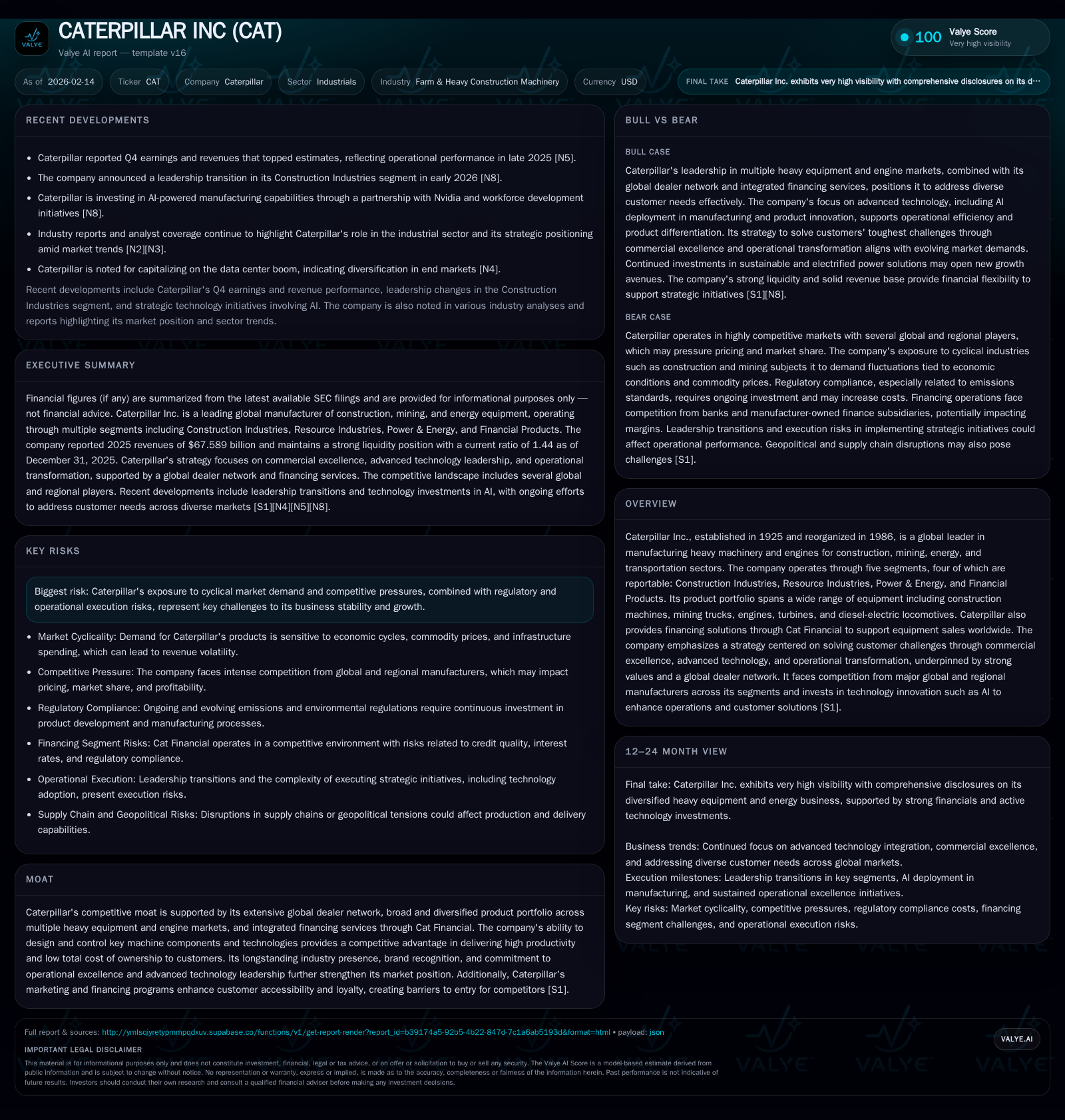
Caterpillar Inc., a dominant player in heavy machinery and engines since 1925, demonstrates resilience amid cyclical industrial demand through diversified operations and strategic initiatives. The company’s core segments—Construction Industries, Resource Industries, Power & Energy, and Financial Products—leverage an extensive dealer network and integrated financing to maintain competitive advantage. Facing macroeconomic volatility and intensifying competition, Caterpillar emphasizes commercial excellence, advanced technology adoption (notably AI), and operational transformation to sustain growth while managing restructuring costs. Its strong liquidity position supports ongoing investments in innovation and strategic growth areas.
Company Overview
Founded in 1925 and restructured under its current form in 1986, Caterpillar Inc. remains a cornerstone in the heavy machinery and engine manufacturing landscape. With a comprehensive product line that includes construction machinery, mining trucks, diesel and natural gas engines, industrial gas turbines, and diesel-electric locomotives, Caterpillar maintains leadership by addressing multiple industry verticals such as construction, mining, energy production, and transportation [S1].
In 2025, Caterpillar delivered revenues of approximately $67.6 billion—an indicator of its commanding presence across global capital-intensive sectors [F1]. This revenue figure underscores not just volume but the company's breadth of reach into geographically diverse markets.
Business Segments and Operations
Caterpillar organizes its operations into five segments; four are reportable publicly: Construction Industries; Resource Industries; Power & Energy; Financial Products; with Other segments encompassing insurance and ancillary activities. Each segment targets critical customer needs while enabling cross-segment synergies.
Construction Industries: Focused on infrastructure building machines used primarily in heavy/general construction, quarrying, aggregates, and rental markets. Product development here reflects regional differentiation—price-sensitive models tailored for emerging economies versus high-productivity machines for developed regions [S1].
Resource Industries: Supports mining operations with large-scale equipment optimized for productivity and durability in harsh extraction conditions.
Power & Energy: Provides engines for various applications including petroleum extraction support and industrial power generation.
Financial Products: Through Cat Financial Services Corporation (Cat Financial), the company offers tailored financing solutions to enable customer access to equipment leasing or purchase options globally.
This multi-segment approach positions Caterpillar to absorb economic variations across industries; for example, capital expenditure downturns in mining may partially offset by steady construction demand.
Competitive Moat Analysis
Caterpillar's enduring market moat is multifaceted:
Extensive Global Dealer Network: Over decades it has built one of the largest independent dealer networks worldwide. This network ensures localized sales support, product availability, service expertise, part distribution, creating high switching costs for customers.
Broad Product Portfolio: Diversification spans numerous machinery classes serving distinct but overlapping industries which mitigates reliance on any single market segment.
Integrated Financing: Offering financing solutions directly aligns Caterpillar’s interests with customers’ investment cycles while easing upfront capital burdens.
Technological Control: Proprietary design and manufacturing capabilities over key components allow them to engineer machines delivering higher productivity with lower total cost of ownership—a crucial buying criterion for industrial operators.
Brand Recognition & Operational Excellence: A century-long heritage underpins trustworthiness; ongoing commitment to quality control and lean manufacturing processes advances reliability claims further securing customer loyalty [S1].
Recent Strategic Developments
In 2025, Caterpillar unveiled a revised mission emphasizing problem-solving for customers coupled with sustainable world-building—a nod to evolving corporate social responsibilities. Three pillars define their profitable growth strategy:
- Commercial Excellence: Driving better customer engagement through enhanced sales effectiveness.
- Advanced Technology Leadership: Incorporating cutting-edge innovations including AI to improve machine design/manufacturing efficiency.
- Transform How We Work: Renewed focus on workforce development to manage complex technologies and improve operational agility.
For instance, partnership efforts with Nvidia have accelerated AI deployment within factories improving predictive maintenance capabilities and supply chain optimization [N6][N7]. Such technology adoption signals Caterpillar’s intention to not merely manufacture traditional heavy equipment but embed intelligence seamlessly across operations.
Market Environment & Industry Challenges
Caterpillar remains highly exposed to cyclical macroeconomic dynamics affecting end markets:
- Economic slowdowns directly reduce infrastructure investments diminishing demand for new machinery purchases.
- Commodity price volatility influences mining capital budgets unpredictably impacting resource industries segment revenues.
- Regulatory regimes related to emissions standards push ongoing R&D expenses towards cleaner engine technologies.
- Inflationary pressures may increase raw material costs impacting margins unless pricing power keeps pace.
Moreover, geopolitical tensions or supply chain disruptions may create production bottlenecks or elevated inventory costs. The company acknowledges these vulnerabilities explicitly as principal risk factors [S1].
Financial Performance & Outlook Highlights
The fiscal year ending 2025 closed with robust top-line performance; however underlying net income trends require contextualization partly due to significant restructuring provisions expected around $300–350 million in 2026 aimed at streamlining operations. Despite those outlays, anticipated cost savings could bolster gross margins going forward by roughly $40 million annually when fully realized [S1].
Cash reserves remain strong at nearly $10 billion providing Caterpillar flexibility to invest strategically or weather trough periods without liquidity strain [F1]. Its current ratio near 1.44 indicates sound short-term asset coverage over liabilities providing additional financial stability buffer.
Technological Innovation & Sustainability Efforts
Caterpillar is actively integrating digital transformation across its footprint—ranging from smart machine telematics data analytics used globally by operators for maintenance scheduling to factory floor AI deployments enhancing throughput quality metrics [N6][N7]. In parallel, sustainability has become integral not only in product development but also throughout their supply chain policies reflecting broader ESG considerations increasingly mandated by investors and regulators.
Electrification trends represent both opportunities and disruption risks as customers progressively demand lower emissions solutions—a potential pivot for traditional diesel-centric platforms now supported by investments into battery electric equipment lines being tested internally.
Competitive Landscape & External Pressures
The company's principal competitors include other global heavy equipment manufacturers such as Komatsu, Volvo CE, Hitachi Construction Machinery alongside emerging regional players challenging market share particularly in Asia-Pacific developing economies. Competitors often push aggressively on price or localized customization demanding continuous innovation from Caterpillar to maintain leadership margins.
Additionally cat Financial faces indirect credit risk as tighter lending conditions globally could impact customers' financing capacity leading to sales deferrals or increased credit losses.
Conclusion & Forward View
Caterpillar Inc.'s long-established foundation combined with proactive strategic pivots positions it well within the industrial machinery sector despite prevailing macroeconomic uncertainties. Their broad diversification across product lines and geographies coupled with integrated financial services provide resilience against volatile economic cycles common in capital goods sectors.
However execution risks tied to restructuring plans alongside escalating investments required for technological innovation bear watching. How effectively Caterpillar balances legacy business optimization while embracing new digital/sustainable paradigms will shape its medium-term trajectory amid intensifying global competition.
This analysis is based on public filings up to February 2026 and news reports available as of the same date. It is intended solely for informational purposes without recommending any investment actions.
Disclaimer: This is research-only, informational analysis and not investment advice. It may include AI-generated interpretation and general industry context. Always verify important details using primary sources.

Comments