
Caro Holdings Inc.: Ambitious AI Ventures in the Shadow of Financial Tightrope
A nuanced exploration of Caro Holdings’ expansive AI-driven product ambitions contrasted sharply with severe liquidity constraints and strategic niche focus.
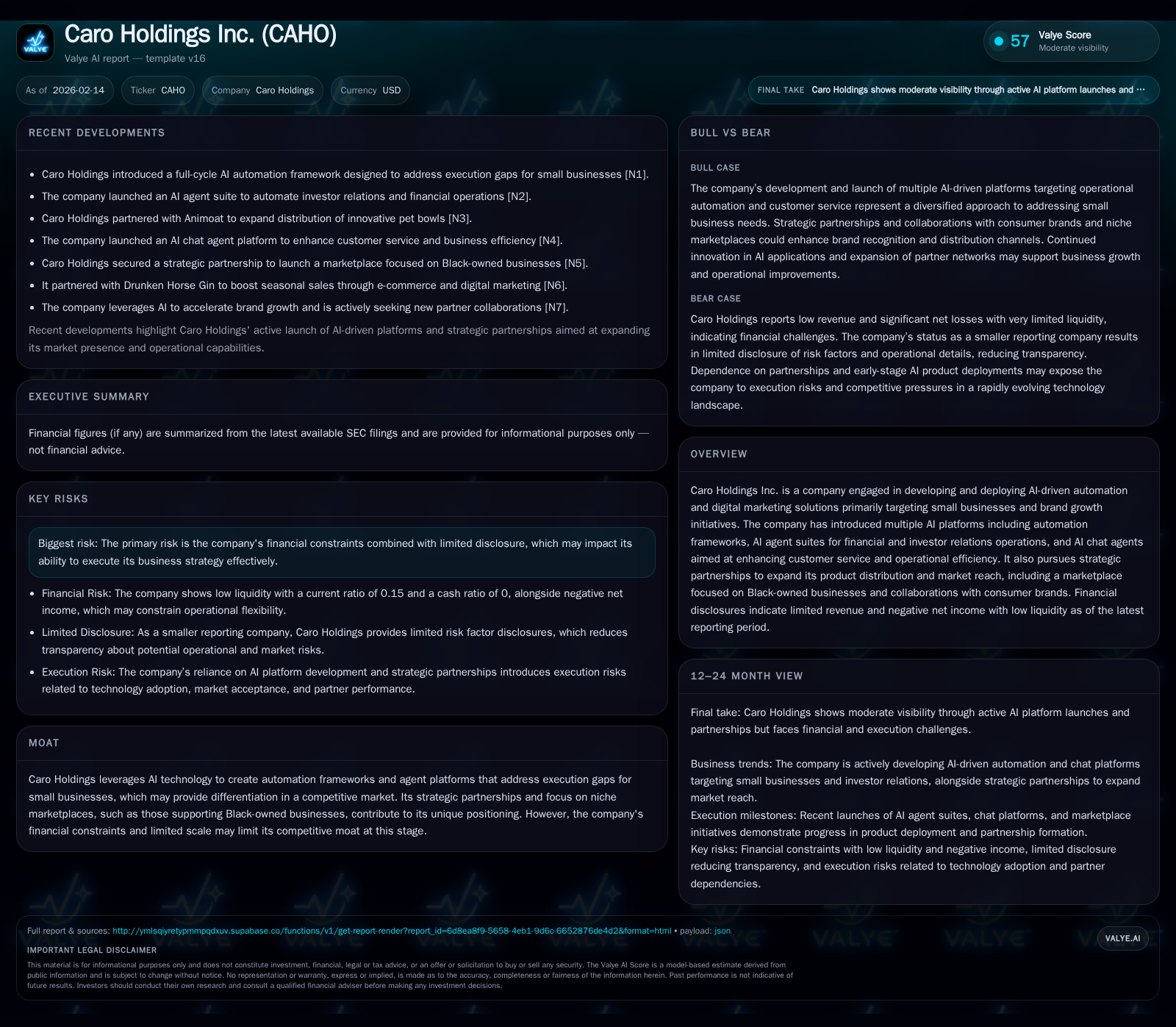
Caro Holdings Inc. is pursuing multifaceted AI automation and digital marketing tools geared mainly toward small businesses and community-focused marketplaces. While its technology platforms—including AI agents for investor relations, financial operations, and customer service—demonstrate breadth of vision, the company’s financial footing remains fragile with minimal revenue and a troubling current ratio. Strategic partnerships emphasizing support for Black-owned businesses underscore a socially conscious growth approach yet also reveal the challenge of scaling amid capital scarcity. These dynamics frame a story of pioneering innovation tempered by significant operational and disclosure risks.
Charting Caro Holdings’ Vision in AI-Powered Automation
Caro Holdings Inc. positions itself as a developer of AI-driven automation tools with a portfolio that spans digital marketing enhancements, automated operational frameworks, and specialized AI agent teams designed for small businesses. Its suite includes platforms tailored for investor relations workflows, financial operational efficiencies, and customer service chatbots—each intended to fill execution gaps frequently encountered by smaller-scale enterprises. This breadth underscores an ambitious strategy attempting to harness artificial intelligence across multiple facets of business operations, offering potential efficiency gains and scalability in sectors often underserved by larger software providers.
Underlying this multi-pronged approach is a clear focus on leveraging cutting-edge AI innovations not only to automate routine tasks but also to empower brand growth initiatives through digital marketing solutions. Additionally, CAHO integrates marketplace development into its agenda by fostering platforms that emphasize support for underrepresented demographics, notably Black-owned businesses. This dual-focus on technology sophistication combined with socially conscious market positioning delineates Caro’s unique business narrative.
However, the vision remains in an early developmental phase, reflecting a company striving for relevance in an intensely competitive landscape where other tech firms are aggressively deploying AI-powered solutions across various enterprise verticals.
Decoding the Financial Realities: A Deep Dive into Fiscal Health
While Caro Holdings paints a compelling picture of technological potential, its latest fiscal disclosures reveal stark challenges confronting the company’s sustainability. For the fiscal year ending December 31, 2025, revenue amounted to a mere $1,711—a figure dwarfed by expenses resulting in a net loss of approximately $63,547 [F1]. Such bleak top-line performance points toward limited commercial traction and raises concerns about operating viability.
Even more concerning is the liquidity snapshot: current assets stood at roughly $259,457 against current liabilities approaching $1.78 million, resulting in an alarmingly low current ratio near 0.15 [F1]. This imbalance signals significant short-term obligations that far exceed accessible liquid resources—a red flag for creditors and partners alike.
Notably absent from filings is any meaningful cash reserves data beyond early periods indicating zero cash equivalents as of March 31, 2022 [F1], suggesting prolonged strain on working capital. These metrics collectively paint a precarious picture of cash runway limitations that could impede ongoing product development and operational execution unless supplemented by fresh financing.
Strategic Partnerships and Niche Market Focus: Opportunities Amid Constraints
Amid these financial headwinds, Caro Holdings leverages strategic partnerships targeting niche marketplaces—most prominently those supporting Black-owned businesses—to expand reach and foster differentiation within crowded digital spaces [valye_report_excerpt]. By focusing on markets characterized by both social impact relevance and underserved business segments, CAHO attempts to create symbiotic engagement opportunities linking technology deployment with community-centric brand narratives.
Such partnerships not only potentially augment product distribution channels but also signal alignment with broader diversity empowerment trends increasingly valued by investors and consumers alike. In theory, these collaborations can provide branding uplift and customer loyalty benefits distinct from competitors pursuing more generalized mass-market strategies.
Nevertheless, reliance on niche positioning alone does not mitigate inherent fiscal vulnerabilities nor assure rapid scaling without intensified sales efforts or capital injections. The question remains whether these alliances can translate into sustainable revenue streams sufficient to offset deficits or if they primarily function as aspirational differentiators amidst constrained resources.
Tech Differentiators: The Moat in an Emerging Competitive Landscape
Caro stresses its development of proprietary AI automation frameworks designed specifically to resolve execution inefficiencies for small business operators—a segment often overlooked by larger players whose solutions cater predominantly to mid-size or enterprise clients [valye_report_excerpt]. This focus could represent a nascent economic moat if these tailored technologies prove sticky and materially enhance user productivity or cost structures.
Its array of AI agent applications that cover financial operations management alongside investor relations represents a thoughtful attempt at vertical integration within its platform ecosystem. Moreover, by embedding intelligent chat agents for customer service optimization, CAHO aims to converge multiple operational levers into cohesive value propositions.
However, skepticism is warranted given Caro’s embryonic scale; without critical mass adoption or demonstrable case studies showcasing tangible ROI or competitive barriers erected by proprietary technology IP, this moat characterization risks being aspirational rather than substantive. Industry incumbents with deeper pockets continuously invest heavily in AI research and platform expansion—pressuring smaller entrants like CAHO to validate defensibility through rapid innovation cycles or securing exclusive marketplace niches.
Risk Factors Under the Microscope: What Limited Disclosures Mean
A notable opacity surrounds Caro Holdings’ risk landscape due to its designation as a “smaller reporting company,” which relaxes compliance obligations including detailed risk factor disclosures [S1][S2]. Consequently, filings lack granular commentary on specific operational risks beyond boilerplate statements common amongst microcap peers.
This deficiency diminishes investor insight into critical vulnerabilities such as intellectual property security measures, dependency on key personnel or partners, regulatory compliance exposures especially around emerging AI governance frameworks, or cybersecurity risk mitigation strategies. Without comprehensive transparency, stakeholders confront amplified uncertainty during due diligence processes.
Moreover, absence of explicit discussion regarding contingency plans for capital shortfalls or detailed market competition analyses complicates assessment of Caro’s resilience facing macroeconomic fluctuations or sector-specific disruptions. Thus, while the limited disclosure status alleviates regulatory burdens for CAHO administratively, it simultaneously elevates informational asymmetry challenges fundamental to prudent evaluation.
The Road Ahead: Growth Trajectories Versus Execution Risks
Looking forward, Caro stands at an inflection point where successful transformation hinges on reconciling high-concept AI products with pragmatic realities surrounding capital access and operational scalability [valye_report_excerpt][F1]. The innovative nature of their automation toolsets offers potential pathways toward capturing underserved small business markets hungry for affordable intelligent automation.
Yet absent clear evidence of expanded revenues or improved liquidity profiles soon after their last reporting period casts doubt on viability without significant external resource infusion—be it venture capital backing or strategic investment partnerships.
Execution risks loom particularly large given the multifaceted nature of their technology developments requiring cross-functional expertise spanning software engineering, machine learning application refinement, customer acquisition strategies, and marketplace ecosystem integration. Failure in any critical dimension threatens erosion of first-mover advantages vis-à-vis better-funded competitors accelerating cloud-based SaaS deployments targeting similar client bases.
Success scenarios likely necessitate aggressive prioritization efforts whereby Caro optimizes limited funds toward highest impact product lines backed by proven demand signals while leveraging partnerships creatively to extend market footprint without proportionate cost burdens.
Investor Takeaway: Balancing Promise With Prudence
To encapsulate Caro Holdings’ current posture requires balancing appreciation for pioneering spirit against palpable financial fragility [valye_report_excerpt][F1][S2]. The company's ambition to fuse advanced AI automation into small business operations allied with targeted social impact initiatives through niche marketplaces imbues it with distinctive strategic appeal.
Conversely, shallow revenue generation compounded by precarious liquidity ratios demands stringent scrutiny regarding sustainability absent further financing or dramatic operational turnaround. Transparency shortfalls related to limited mandatory disclosures further cloud complete understanding of underlying risks shaping performance outlooks.
For investors contemplating exposure here — particularly those intrigued by early-stage artificial intelligence ventures entwined with community-enriching themes — measured caution incorporating scenario stress testing around cash sufficiency coupled with tracking partner engagement evolution will be critical components in discerning realistic opportunity windows versus speculative pitfalls.
Disclaimer: This analysis is provided solely for informational purposes without investment recommendation or endorsement. It reflects data available as of February 14, 2026 and is subject to change based on future disclosures or market developments.
Disclaimer: This is research-only, informational analysis and not investment advice. It may include AI-generated interpretation and general industry context. Always verify important details using primary sources.

Comments