
JPMorgan Chase in 2026: Navigating Scale, Innovation, and Regulatory Complexity
A deep dive into JPMorgan Chase's diversified business model and strategic initiatives amid intensifying challenges and competitive pressures.
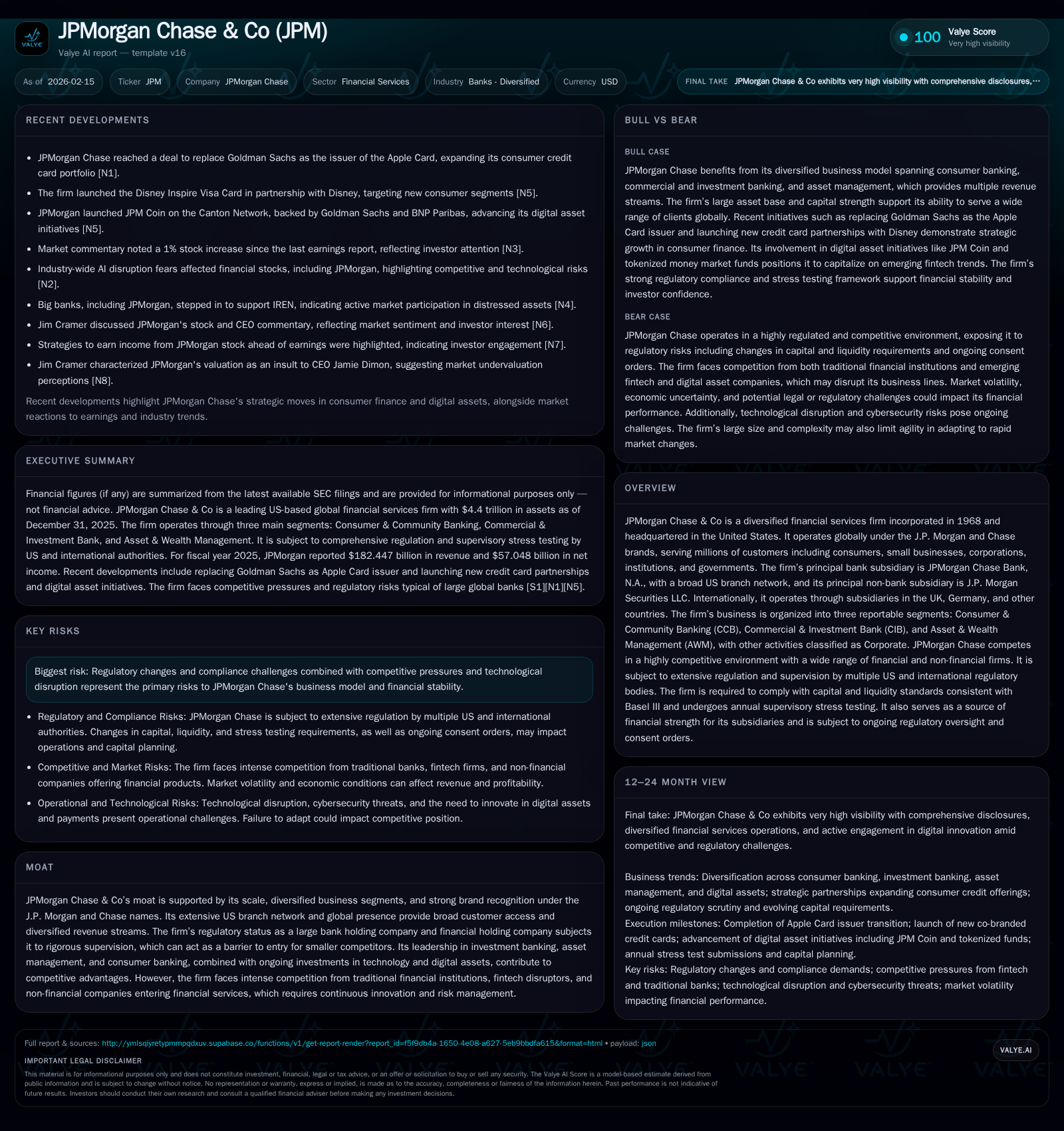
JPMorgan Chase & Co remains a dominant force in financial services through its scale, diversified segments, and strong brand presence. Its latest earnings reflected steady growth in core areas but elicited mixed analyst views reflecting debate over valuation and risk. The bank continues to innovate with new digital payment partnerships and AI integration while balancing stringent regulatory oversight and mounting fintech competition. Capital strength and broad liquidity undergird the firm, though political, operational and reputation risks merit careful monitoring as 2026 progresses.
Market Pulse: Navigating Mixed Signals After Q4 Earnings
JPMorgan Chase's recent fourth-quarter earnings announcement reverberated across market watchers with a blend of optimism and caution. The company's stock experienced a modest 1% uptick in response to its earnings release [N1], signaling general investor approval of reported results. However, this positive momentum was tempered by Wolfe Research's downgrade ahead of the report, highlighting growing investor concerns about elevated valuation multiples amid an environment of heightened macroeconomic uncertainty [N3]. Jim Cramer notably characterized JPMorgan's multiples as an 'insult' to CEO Jamie Dimon, reflecting skepticism regarding whether current valuations adequately price in looming risks [N10]. These divergent perspectives underscore a nuanced market view where bullish growth narratives contend vigorously with apprehensions about risk adjustment.
JPM’s Tri-Segment Strength: Consumer, Investment, and Wealth Management Synergies
At the heart of JPMorgan Chase’s robust financial architecture lies a tri-segment business model enabling diversified revenue streams that reinforce its competitive advantage:
Consumer & Community Banking (CCB) operates an extensive US branch network providing consumer deposits, loans including credit cards through Card Services, auto leases, and other personal financial services. In recent quarters, CCB posted strong net interest income growth driven by higher deposit margins partly reflecting Funds Transfer Pricing adjustments and increased revolving credit balances [S6][S8]. Auto operating lease income expanded notably due to volume growth supporting fee generation [S6][S13].
Commercial & Investment Bank (CIB) delivers investment banking advisory services, debt and equity underwriting, fixed income trading, cash management solutions for corporations and institutions globally. This segment benefited from elevated advisory fees tied to successfully closing large transactions alongside bolstered underwriting activity especially follow-ons and IPOs [S22]. Fixed Income Markets also contributed positively with strength in Rates and Commodities revenue despite some moderation elsewhere [S23].
Asset & Wealth Management (AWM) manages client assets encompassing private banking, wealth advisory services, mutual funds and custody solutions. Net inflows combined with higher asset levels fueled asset management fees which rose noticeably during the period [S6][S12]. Incremental deposit-related fees from newly acquired accounts further augmented revenue under this segment.
Together these segments generated $182 billion in annual revenue with overall net income reaching $57 billion for 2025 per the latest company facts data [F1], supporting the bank’s broad moat through diversified customer exposure and complementary profit centers.
Regulatory Terrain: The Double-Edged Sword of Oversight and Compliance
JPMorgan Chase’s stature as a large bank holding company subjects it to an inherently complex regulatory framework spanning multiple jurisdictions. As outlined extensively in its 2025 Form 10-K filing [S1], the regulatory environment imposes rigorous compliance obligations ranging from capital adequacy requirements to operational conduct standards. On one hand, this heavy supervision constitutes a formidable barrier to entry for smaller institutions lacking comparable resources or scale. On the other hand, it introduces substantial costs that can affect profitability or limit strategic flexibility amid rapidly shifting market conditions.
Noteworthy are risks stemming from disparate regulatory interpretations across regions potentially disadvantaging JPM relative to competitors with different footprints. Moreover, evolving legislative or enforcement actions continue to represent significant sources of uncertainty requiring vigilant governance oversight. Importantly, while regulation enforces systemic resilience post-financial crisis reforms, it also mandates substantial investments in compliance infrastructure increasingly challenged by emergent technological vectors.
Innovation at the Forefront: From Apple Card Takeover to AI Disruption
Innovation sits prominently within JPMorgan’s strategic playbook as it strives to sustain industry leadership:
The recent launch of the Chase Disney Visa card exemplifies an extension into lifestyle-driven co-brand partnerships aimed at enhancing consumer engagement and transaction volume via affinity programs [N7]. Such collaboration leverages brand synergy to capture discretionary spend.
Equally consequential is JPM's agreement to replace Goldman Sachs as the issuer of the Apple Card starting in 2026—a move likely to expand its footprint within digital payments alongside established credit card operations [N8]. This transaction also signals confidence in JPM’s technology stack capable of underpinning high-profile fintech products.
Technological disruption is double-edged; AI advancements have catalyzed fears of upheaval within asset management sectors as highlighted by recent negative price reactions among firms like Schwab [N9]. For JPM’s wealth subsidiaries operating at the intersection of investment advisory and technology integration, managing AI-driven market volatility or displacement risk presents a delicate balancing act.
Through continuous upgrades in digital infrastructure coupled with selective alliances targeting new consumer segments, JPM actively positions itself defensively against nimble fintech rivals while extracting efficiencies internally.
Capital and Liquidity Health: Fortress or Pressure Cooker?
A critical underpinning of JPMorgan’s operating model remains its resilient balance sheet supported by deep liquidity pools and regulatory capital buffers:
As per SEC filings [S17][S19] complemented by FactSet data [F1], the firm reported healthy liquidity reserves alongside solid capital ratios consistent with Basel III standards.
Net interest income trends reflect favorable loan portfolio growth combined with improved deposit pricing strategies facilitated through FTP updates impacting CCB positively [S6][S11].
Credit quality metrics show manageable net charge-offs particularly within Card Services albeit rising provisions signal cautious stance towards credit risk given macroeconomic variables [S10].
Notwithstanding these strengths, rising noninterest expenses related to compensation increases—primarily front-office staff expansion—and marketing investments highlight potential margin pressures if revenue momentum slows or funding costs escalate amid changing rate environments [S14]. This dynamic requires vigilant capital allocation decisions balancing growth initiatives versus cost discipline.
Competitive Landscape: Traditional Rivals Versus Fintech Encroachment
JPMorgan competes inside a dense web of legacy peers such as Goldman Sachs—which has demonstrated notable share appreciation recently exceeding 37% annually—and nascent fintech challengers innovating rapidly across payments, lending, wealth platforms, algorithmic trading or blockchain applications [valye_report_excerpt][N14].
Goldman Sachs’ outperformance reflects strong execution in advisory mandates along with ongoing expansion into consumer lending sectors that overlap directly with JPM’s lines of business. Meanwhile fintech entrants capitalizing on superior user experiences challenge traditional banks’ customer loyalty especially among younger demographics wary of legacy complexity.
Moreover, artificial intelligence developments threaten disruption across wealth management product delivery requiring incumbents like JPM to invest heavily in tech adoption lest they lose share or suffer margin compression due to automated competitors offering lower-cost alternatives.
Hence jockeying for position involves simultaneously defending entrenched relationships via trusted brands while accelerating technology-driven transformation calibrated carefully against stringent regulatory norms.
Risks Amplified: Political, Strategic, and Reputation Challenges in Focus
JPMorgan’s comprehensive risk profile encapsulates multi-dimensional exposures documented meticulously in regulatory filings [S1]:
- Legal/regulatory risks: include uncertainties arising from interpretation shifts or enforcement actions which could trigger material penalties affecting earnings or capital.
- Political risks: economic unpredictability linked to geopolitical tensions potentially disrupt markets or client activities globally.
- Operational risks: cybersecurity threats remain salient given JPM’s reliance on complex IT systems; any breach could entail significant financial loss plus reputational damage.
- Strategic risks: ineffective adaptation to competitive forces may erode franchise value while climate change poses emerging challenges influencing credit assessments or investment mandates.
- Conduct/reputation risks: employee misconduct or failure managing conflicts could materially impair trust embedded in client relationships.
This layered risk constellation demands constant vigilance across governance frameworks ensuring resilience without stifling innovation appetite crucial for growth preservation.
Investment Thesis Revisiting: Valuation in Light of Growth Prospects and Industry Dynamics
Investor discourse observed around JPM reflects tension between recognition of its durable moat underpinned by scale, brand strength and diversified operations against skepticism over whether current valuations fully accommodate prospective regulatory costs plus intensified tech competition risks. Dividend-focused analyses emphasize the dependable income stream offered by JPM shares set against varieties of uncertainties including slowing loan growth or rising expense burdens potentially constraining net margin expansion [N2][N10][F1].
While earnings momentum showcased robust top-line metrics for 2025 supported by prudent credit risk controls suggests solid near-term fundamentals; the imperative remains for adaptive strategy execution blending rigorous cost control with targeted innovation investments. Upholding capital flexibility amidst tightening global regulatory standards will be critical alongside navigating volatile geopolitical landscapes affecting client confidence globally.
In essence, JPMorgan Chase’s story heading further into 2026 is one of balancing steadfast franchise advantages driven by tri-segment synergies against evolving challenges presented by relentless regulatory scrutiny plus quicksilver fintech disruptions altering financial ecosystem contours rapidly.
This analysis is based on available public information as of February 2026 and does not constitute investment advice nor recommendations regarding securities transactions. Readers should consider multiple sources before making any financial decisions.
Disclaimer: This is research-only, informational analysis and not investment advice. It may include AI-generated interpretation and general industry context. Always verify important details using primary sources.

Comments