
Pinterest's Growth Journey: Balancing User Expansion and Advertising Monetization in a Shifting AI Landscape
Pinterest continues to grow its global user base while navigating the complexities of advertising revenue amid evolving AI capabilities and regulatory challenges.
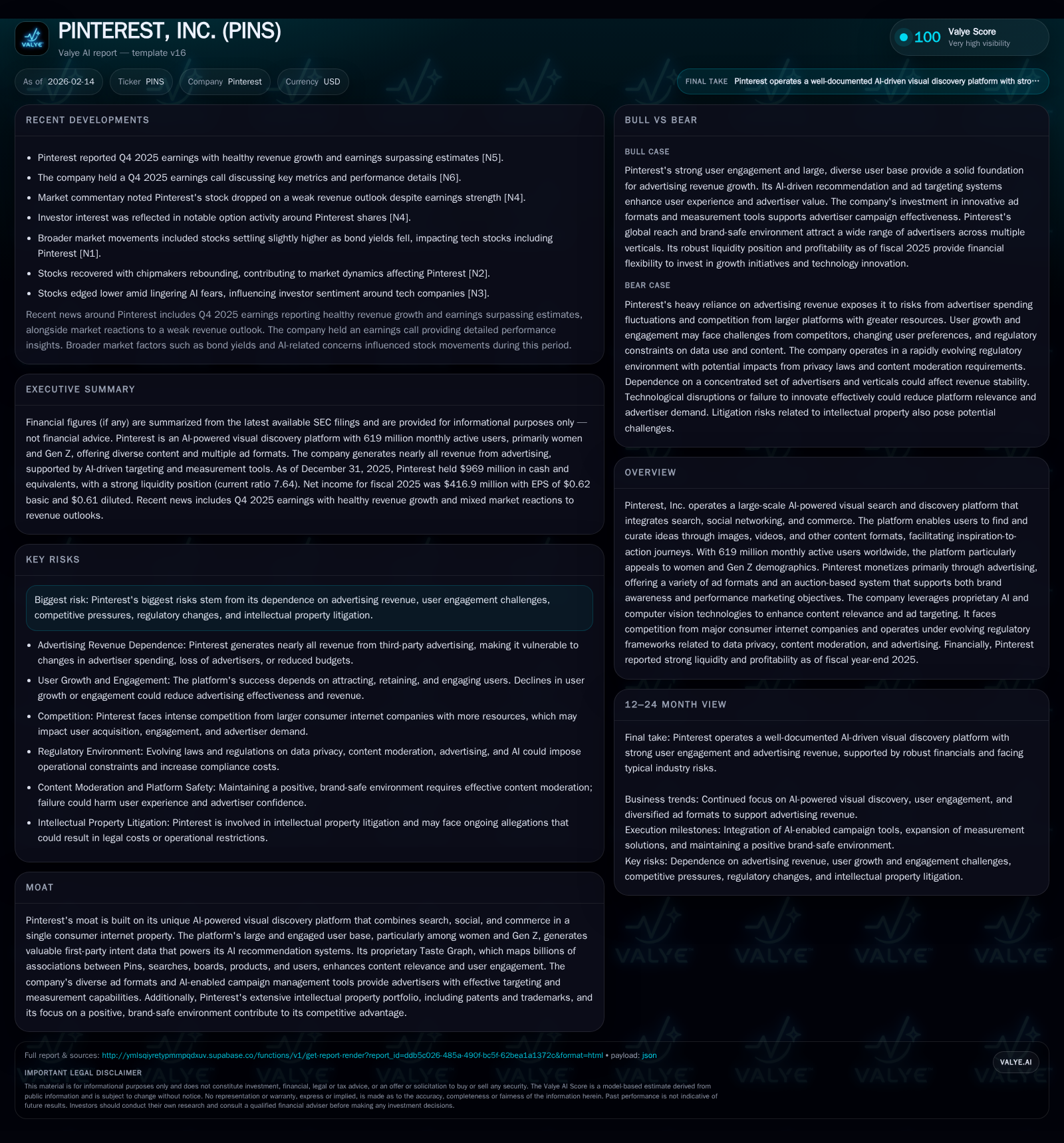
Pinterest, Inc. has demonstrated robust growth in monthly active users (MAUs), reaching 619 million as of year-end 2025, driven largely by its appeal to women and Gen Z demographics. The company’s unique AI-powered visual discovery platform, anchored by its proprietary Taste Graph, differentiates it in the consumer internet space by seamlessly blending search, social networking, and commerce. While Q4 2025 results beat estimates with solid revenue growth, a tempered outlook on advertising revenue has unsettled market sentiment, reflecting challenges in monetizing a diverse global audience. Pinterest’s competitive moat rests on advanced AI systems and a brand-safe environment, but reliance on advertising revenue, engagement trends, and regulatory risks remain key considerations. Financially, the company shows strong cash flow and balance sheet resilience supporting ongoing innovation and sales expansion initiatives.
Pinterest’s Unique AI-Driven Visual Discovery: Reinventing Inspiration-to-Action
Pinterest stands apart as an AI-powered visual search and discovery platform that integrates search functionalities with social networking and commerce. Unlike traditional social media or search engines that rely primarily on text-based queries or user connections alone, Pinterest leverages its proprietary Taste Graph — a sophisticated AI system mapping billions of associations among Pins, boards, products, searches, and users — to power dynamic multi-session journeys where users discover inspiration and translate it into action [S1]. This graph-based intelligence enables content personalization rooted in first-party intent data derived from actual user behaviors rather than inferred interest.
Visual content lies at the core. With billions of predominantly visual queries monthly — including images, videos, collages, and product catalogs — Pinterest supports users who often find it difficult to articulate their needs in words but readily recognize ideas when seen [S1]. The platform’s AI continually refines recommendations based on evolving tastes captured through saves (‘Pins’) and searches.
This blend creates an elevated experience bridging discovery to purchase decisions within a single immersive property. Moreover, the integration of advanced computer vision technology helps augment ad targeting capabilities for advertisers seeking measurable ROI within this inspiration-to-action funnel [S1].
User Base Momentum: Delving Into Growth Dynamics Among Women and Gen Z
Pinterest’s user base reached 619 million MAUs worldwide by December 31, 2025 — a solid 12% increase year-over-year fueled by ongoing investments in relevance algorithms and personalization improvements [S1]. Notably, the demographic mix is distinctive: approximately two-thirds of users are women who engage deeply with lifestyle content categories such as fashion, home décor, recipes, and wellness. Simultaneously, Gen Z accounts for over half the platform's population — highlighting Pinterest's resonance with younger audiences attuned to visual storytelling [S1].
Weekly active users consistently represent about 62% of total MAUs—a marker of sustained engagement across diverse geographies [S1]. This demographic composition translates into highly valuable first-party intent signals advertisers find increasingly compelling since they reflect actual discovery processes rather than passive consumption.
Geographically speaking, while North America (U.S. & Canada) remains Pinterest’s strongest market regarding revenue per user due to mature digital ad ecosystems ($30.84 ARPU annually), Europe exhibits rapid ARPU growth (+21% in 2025), signaling rising monetization potential beyond domestic borders [S1]. Emerging international regions show lower absolute ARPUs but impressive percentage gains (+40%), underscoring longer-term runway opportunities.[S1]
Monetizing a Global Audience: The Complexities Behind Advertiser Revenue
Advertising underpins nearly all of Pinterest’s revenue stream. In fiscal year 2025 alone, the company recorded $4.22 billion in revenue—a 16% increase year-on-year—predominantly from auction-based ads designed to meet both brand awareness and direct response objectives across various formats [S1]. However, the monetization landscape is nuanced.
The bulk of revenue still flows from U.S. & Canada where advertisers allocate significant budgets amidst intense competition for consumer attention; Europe follows as secondary but fast-growing market share [S1]. Rest-of-world geographies contribute modest ARPUs reflecting earlier stage monetization efforts coupled with generally lower digital advertising maturity.
Advertisers hail largely from retail and consumer packaged goods sectors—categories naturally aligned with Pinterest's product discovery journey—while others span travel, technology brands, publishing houses, and more [S1],[N2]. Yet the absence of long-term contracts poses challenges in budget predictability as many spend relatively small portions of their overall marketing allocations on Pinterest.
This inherent variability contributed to a disconnect during Q4 earnings wherein reported results beat expectations but subsequent guidance lowered optimism on revenue growth amid cautious advertiser spend behavior [N2],[N1]. These dynamics illustrate the delicate balance between capturing new advertiser demand globally versus retaining existing clients facing alternative budget priorities amidst macroeconomic uncertainty.
Q4 Earnings Reality Check: Beating Estimates but Tempering Outlook
In February 2026 release cycles around Q4 earnings calls exposed conflicting market signals for Pinterest [N2],[N3],[N4]. On one hand, quarterly results surpassed analyst consensus driven by healthy year-end revenue growth (exceeding $1 billion quarterly revenue) reflecting effective AI targeting enhancements and ad format diversification [N2],[N5]. Net income rose appreciably compared to prior periods.
However—and crucially—the company issued conservative guidance projecting slower growth rates ahead due to observed softening in advertiser spending patterns globally against a backdrop of economic headwinds [N1]. Investor reaction was swift leading to share price declines despite underlying fundamental progress.
Management commentary highlighted sustainability concerns regarding scaling revenues outside established core markets as well as challenges faced innovating measurement tools that sufficiently prove incremental ROIs demanded by cautious advertisers [N3],[N4]. This dichotomy embodies common industry tensions where solid execution grapples with evolving external conditions impacting near-term financial visibility.
The Moat: AI, Taste Graph, and Brand-Safe Environment as Competitive Shields
Pinterest’s defensibility rests heavily on its technology advantages combined with an intentional platform ethos fostering positivity admired by users and trusted by brands alike [S1],[F1]. The proprietary Taste Graph is particularly pivotal — serving as the backbone enabling nuanced recommendation algorithms that drive deep content relevance unattainable by competitors relying solely on follower graphs or keyword matching.
Complementing this technical foundation is a suite of diverse advertisement products augmented by AI-enabled campaign management tools delivering precision targeting coupled with transparent measurement metrics. This technological arsenal helps anchor advertiser loyalty even amid fierce competition from large consumer Internet titans such as Meta Platforms or TikTok.
Additionally, Pinterest’s commitment to maintaining a brand-safe environment through rigorous content policies creates differentiated value amidst ongoing industry debates around misinformation or controversial content prevalent elsewhere. This curation enhances advertiser confidence reducing reputational risks tied to ad placements—which indirectly contributes to sustainable monetization potential.
Moreover, intellectual property holdings including patents relating to visual search technologies create legal barriers further entrenching competitive positioning.
Risks in Focus: Advertising Dependency, Engagement Trends, and Regulatory Headwinds
Notwithstanding strengths noted above Pinterest faces salient risks primarily emanating from its singular reliance on third-party advertising dollars lacking binding long-term commitments [S1]. Fluctuations in advertiser behavior—including shifting budgets toward competitor platforms or faster-moving ad formats—can materially alter revenue trajectories.
User engagement metrics also warrant close scrutiny; while MAUs continue an upward trajectory supported by recommender system enhancements (12% YoY growth), subtle declines or stagnation in weekly activity rates could hinder ad impression volumes impacting pricing leverage [S1]. Furthermore technological disruptions or emergent competitors pursuing similar inspiration-to-action models could dilute uniqueness over time.
From a regulatory standpoint Pinterest operates under increasingly complex frameworks governing data privacy (e.g., GDPR extensions), content moderation responsibilities protecting brand safety standards yet avoiding censorship concerns—and transparency obligations related to political or sensitive category ads [S1]. Non-compliance risks carry financial penalties alongside reputational damage potential.
Intellectual property litigation exposure remains relevant given active patent portfolios though at present no material ongoing disputes are publicly noted.
Financial Health Deep Dive: Cash Flow, Profitability, and Balance Sheet Resilience
Examining underlying financial robustness affirms Pinterest’s capacity to invest aggressively while managing operational efficiency tradeoffs. Fiscal year 2025 culminated with net income rising meaningfully to approximately $417 million alongside Adjusted EBITDA surpassing $1.27 billion—a sign of improved profitability after years focused on scaling [F1],[S1].
Operating cash flow stood robust at $1.28 billion enabling free cash flow generation close to $1.25 billion—metrics reflecting strong operational cash conversion favorable for reinvestment strategies or weathering downturns without liquidity stress [F1],[S1].
The balance sheet presents additional comfort: cash plus equivalents ticked near $970 million while current assets exceed current liabilities substantially yielding a very healthy current ratio around 7.64 [F1], offering ample cushion for short-term obligations or unexpected contingencies.
That said share-based compensation expenses remain material (~$880 million annually), diluting GAAP profitability somewhat despite being non-cash — indicative of ongoing talent investment essential for sustaining innovation leadership but requiring attention from margin perspectives [S1].
Strategies for Sustained Growth: Product Innovation and Expanding Advertising Toolbox
Looking forward Pinterest aims to escape sole dependence on mature core markets through geographic expansion coupled with relentless product innovation aimed at broadening advertiser options beyond standard auction-based placements [S1],[N3]. Initiatives include rollout of new ad formats blending video shoppable experiences designed to capture consumers deeper into conversion funnels along with enhanced creative tools facilitating seamless content creation tailored for the platform’s visual nature.
Sales force expansion particularly across high-growth international territories targets merchant verticals less penetrated historically aiming at diversifying advertiser base composition.[S1] Meanwhile continuous improvement in AI algorithms seeks not only improved user experience but also better campaign attribution models finally answering persistent demand from advertisers for clear efficacy proofs.[N3]
Emerging measurement frameworks integrating offline impact data confirm effectiveness claims helping alleviate lingering skepticism especially among large brand advertisers accustomed to traditional media analytics standards.
This "growth by innovation" doctrine is critical for mitigating concentrated client risk inherent in current portfolio structures dominated by retail/CPG customers while establishing more resilient commercial foundations over time.
Disclaimer: This report is prepared solely for informational purposes based on available public disclosures up to February 14th, 2026. It does not contain investment advice nor recommendations regarding securities of Pinterest Inc. Investors should conduct independent analyses before making any decisions.
Disclaimer: This is research-only, informational analysis and not investment advice. It may include AI-generated interpretation and general industry context. Always verify important details using primary sources.

Comments