
M/I Homes Inc.: Strategic Resilience Amidst 2025’s Housing Market Headwinds
Analyzing how M/I Homes’ geographic diversification, operational scale, and capital strategies navigate a cooling U.S. residential construction market in 2025.
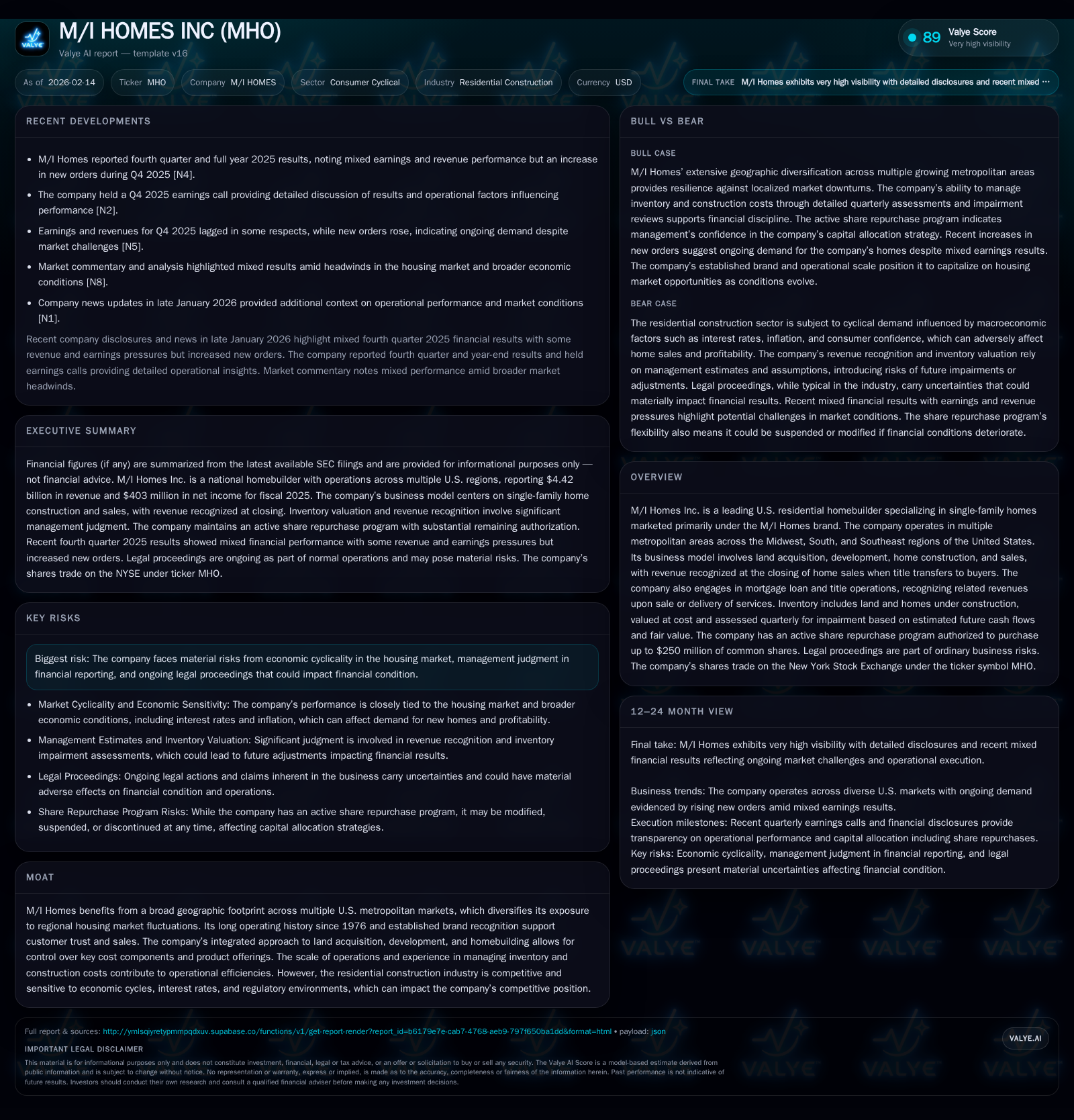
In 2025, M/I Homes Inc. confronted significant macroeconomic and housing demand challenges, including elevated mortgage rates and inflationary pressures that contributed to declines in revenue and new contracts. The company’s broad geographic footprint across multiple U.S. regions offers a natural hedge against localized market softness, supporting relative operational stability. Despite margin compression and warranty reserve stresses, M/I Homes maintained strong liquidity, improved capital structure, and pursued an aggressive share repurchase program. Forward-looking efforts emphasize community growth and prudent inventory management amid ongoing legal contingencies.
Navigating a Turbulent 2025: Market Dynamics and Demand Pressures
The U.S. residential construction landscape experienced notable headwinds throughout 2025 with M/I Homes Inc. exemplifying sector-wide cyclical vulnerabilities. Elevated mortgage interest rates sustained above historically low levels constrained affordability at a time when inflation kept building material and labor costs pressured. Amid this tightening affordability environment and broader economic uncertainty, M/I Homes reported a modest but meaningful revenue decline of approximately 2% year-over-year to $4.4 billion alongside a commensurate drop in new contracts by 4% to just over 8,000 units [S1],[N1],[N3]. New-home absorption rates — a critical demand gauge — decelerated from roughly 3.3 homes per community monthly in the prior year to about 3.0 in 2025 [S1]. While these results signal moderation rather than steep deterioration, they underscore the challenging market conditions impacting consumer willingness and capacity to transact.
Operational Footprint and Geographic Diversification: A Competitive Moat
M/I Homes’ longstanding presence since its founding in 1976 is buttressed by an extensive geographic footprint spanning multiple metropolitan areas primarily across the Midwest, South, and Southeast United States. This broad distribution dilutes exposure to idiosyncratic downturns or regulatory changes concentrated in any single market zone, providing a form of natural portfolio diversification within the inherently cyclical residential construction industry [valye_report_excerpt], [S1]. The company’s integrated land acquisition through development and building process supports operational control over product mix and cost elements that amplify economies of scale advantages.
This geographic breadth enables strategic agility; for instance, while certain Florida communities faced warranty-related headwinds (detailed below), other regions sustained relatively stable absorption levels that helped offset localized softness. Nevertheless, macroeconomic headwinds such as national interest rate policies inevitably permeate all markets over time.
Financial Performance Deep Dive: Margin Compression Despite Scale
Despite the robust operational scale delivering nearly 9,000 homes in 2025 (a slight decrease of about 1%), M/I Homes' gross margin fell significantly — contracting approximately by 360 basis points to land near a mid-20s percentage range at around 23% [S1],[F1],[N2]. This compression reflects acute pressure from inflationary increases impacting construction inputs such as lumber prices and skilled labor wages compounded by limited flexibility on average sales price reductions amid competitive market conditions.
Net income suffered more pronounced declines — dropping nearly 29% year-over-year to roughly $403 million — signaling that cost absorbency reached structural limits despite scale efficiencies and operational controls [F1],[N10]. Thus, while revenues dipped modestly, the disproportionate impact on margins highlights tightening profitability windows common across the sector during slowing demand phases.
Balance Sheet Strength and Shareholder Returns: Managing Leverage and Repurchases
On the liquidity front, M/I Homes demonstrated considerable financial discipline with a homebuilding-related debt-to-capital ratio reported at about 18%, reflecting comparatively low leverage for the industry during this phase of the housing cycle [S1],[N3]. Shareholders' equity set a new all-time record at approximately $3.2 billion with book value per common share reaching $123—a signal of strong retained earnings accumulation despite earnings volatility [S1],[N9].
Capital allocation priorities manifested clearly through an aggressive refreshment of share repurchase capacity; the board authorized up to $250 million of stock buybacks in early 2025 replacing prior authorizations with lower remaining availability [S1]. Quarterly purchases during Q4 included acquiring nearly 400,000 shares at average prices around $129–137 per share—indicative of management’s confidence prioritizing shareholder returns even amid broader market uncertainty.
Warranty Reserves and Quality Control: Legacy Challenges and Risk Management
Warranty reserves represent an area where latent risks have emerged notably in select Florida communities encountering attic ventilation issues necessitating remediation expenses beyond standard projections. The company's methodology for establishing reserves involves actuarial analyses eyeballing historical payment trends adjusted by geographic nuance and evolving quality improvements [S1].
These elevated warranty costs weighed on margins locally while necessitating increases in aggregate reserve balances—underscoring ongoing quality assurance complexities inherent for builders operating across varied climates and regulatory regimes. Although management expresses confidence in current reserve sufficiency levels based on historical data models, such areas remain potential profit volatility sources subject to claim developments or legal interpretations.
Legal Proceedings and Their Implications: Contingency Preparedness
M/I Homes' disclosures confirm engagement in multiple routine legal proceedings customary within homebuilding operations including litigation tied to construction defects, contractual disputes, or regulatory reviews [S1]. The company candidly acknowledges inherent outcome uncertainties with potential for material adverse effects contingent on case resolutions.
While no single proceeding is publicly highlighted as individually transformative currently, the aggregate nature of these contingencies continues requiring vigilant risk management oversight given possible financial or reputational impacts under adverse verdicts or settlements.
Forward Strategy: Product Offering, Community Growth, and Inventory Management
A distinctive highlight amid softening demand is M/I Homes’ ability to grow its average active community count by approximately six percent reaching over 230 communities operating at year-end; an effort intended to reinforce local supply options aligned with diversified buyer preferences even amid slower sales absorption pace [S1],[N7].
Inventory valuation practices remain conservative—land holdings plus homes under construction are measured primarily at cost with quarterly impairment tests sensitive to fair value estimates grounded in future cash flow considerations reflective of market realities [S1]. This approach underscores measured prudence balancing readiness for eventual demand rebounds without excessive capital tie-up or write-down risks.
Valuation Considerations Amid Industry Headwinds
From a valuation context perspective, despite posting earnings surpassing consensus forecasts moderately during Q4 earnings releases—and sustaining premium book value per share levels—M/I Homes’ share price experienced downward pressure mirroring wider sector investor caution brought on by cyclical softness and macroeconomic unease [S1],[N13],[N14],[F1].
This divergence suggests that market sentiment may be discounting forward uncertainty or emphasizing downside risks more than underlying balance sheet strength or cash flow visibility might warrant under normalized conditions.
Investor Sentiment: Reconciling Recent Share Price Movements with Fundamentals
Investor trading volumes surged sharply post-earnings release reports reflecting conflicting views; some participants interrogated margin headwinds while others noted cash flow robustness and balance sheet improvements as mitigating factors [N11],[N12],[N14]. Such mixed reactions illustrate common behavioral patterns during transitional industry phases when short-term results disappoint but structural narratives remain intact.
Market skepticism appears rooted in apprehension regarding sustained high interest rates dampening demand recovery timelines alongside latent warranty/legal exposures overshadowing near-term outlook clarity despite methodical corporate responses.
Disclaimer:
This report presents comprehensive analysis based on public filings, conference calls transcripts, and available news sources as of February 2026 without offering investment advice or recommendations. All data cited adhere strictly to disclosed information without speculative extrapolation. Readers should consider broader macroeconomic factors alongside company-specific disclosures when forming views on future performance dynamics.
Disclaimer: This is research-only, informational analysis and not investment advice. It may include AI-generated interpretation and general industry context. Always verify important details using primary sources.

Comments