
Comprehensive Analysis of Seaboard Corp: Diversification, Commodity Cyclicality, and Strategic Resilience
Seaboard Corp operates a diversified portfolio across agribusiness and transportation, balancing commodity risks with strategic capital allocation.
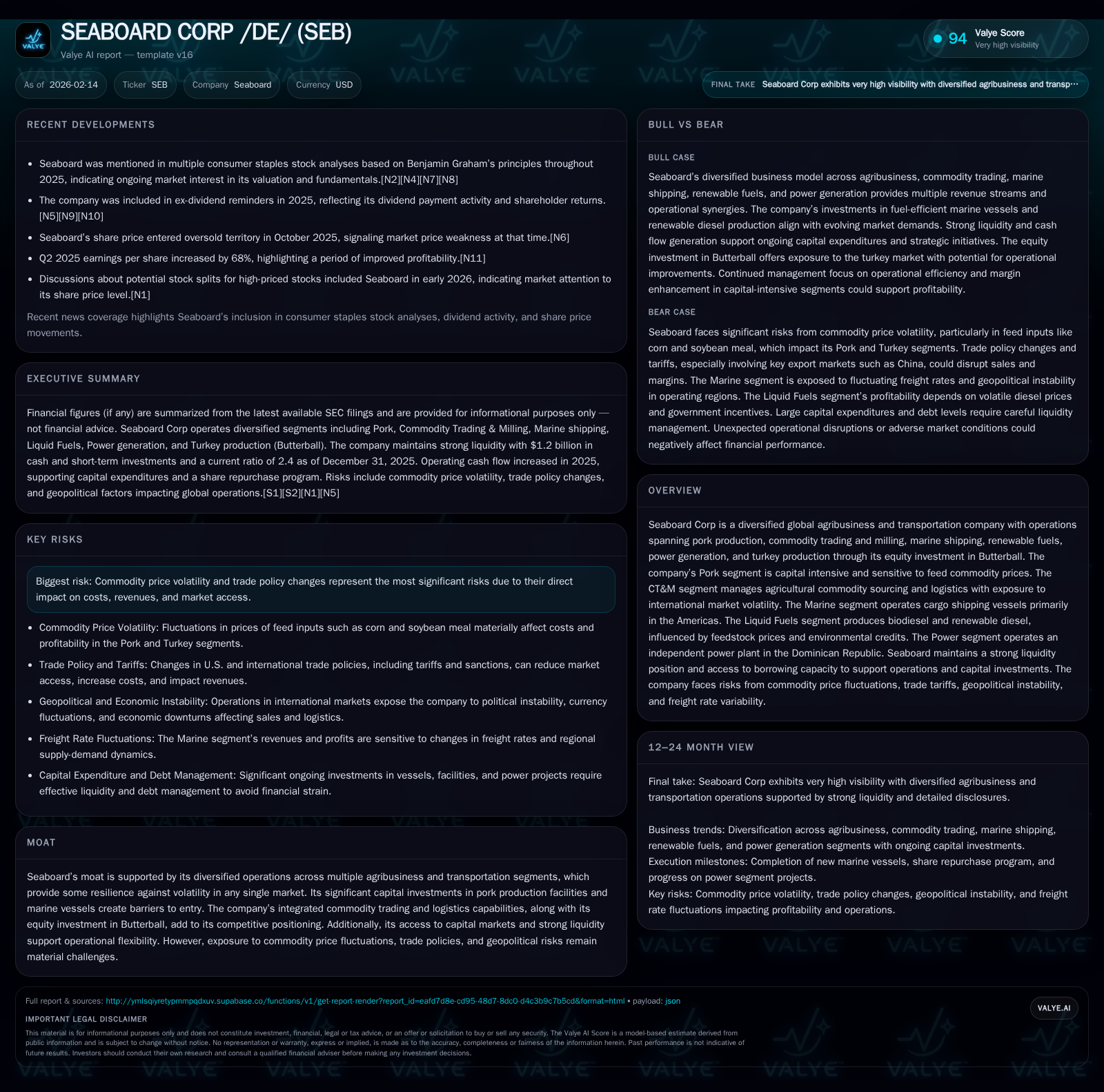
Seaboard Corp is a multifaceted agribusiness and transportation company with segments spanning pork production, commodity trading and milling, marine shipping, liquid biofuels, power generation, and turkey production via an equity stake in Butterball. Its operations inherently grapple with commodity price volatility and geopolitical trade risks but benefit from diversification and strong liquidity. Capital intensity in pork production anchors the company's asset base, while integrated logistics through its CT&M segment reinforce operational flexibility. Despite exposure to fluctuating feedstock and fuel prices, Seaboard's robust balance sheet and risk management practices underpin resilience amid global market uncertainties.
Overview of Seaboard Corp's Business Model
Seaboard Corp stands out as a diversified multinational enterprise straddling multiple sectors within agribusiness and transportation. The firm's portfolio encompasses pork production—which is highly capital intensive—agricultural commodity trading and logistics (CT&M), marine shipping operations primarily concentrated in the Americas, production of renewable biodiesel fuels under the liquid fuels segment, independent power generation focused on the Dominican Republic grid, and an influential equity investment in Butterball for turkey products.
This expansive operational footprint enables Seaboard to participate across key nodes of global food supply chains as well as complementary energy and transport infrastructure markets. However, this breadth also exposes the firm to complex risk layers including commodity pricing fluctuations, geopolitical trade tensions with potential tariff impacts as noted throughout recent years, currency volatility in less developed markets where grain milling facilities operate,[S1][S2] and seasonal or environmental factors affecting production consistency.
Segment Deep Dive
Pork Segment
The pork division remains Seaboard’s cornerstone operation from both an asset base and inventory standpoint—housing roughly 41% of total fixed assets and 37% of inventories at the close of 2025[S1]. This segment produces hogs for U.S. domestic consumption and international export markets. Feed constitutes its largest input cost, tightly linked to corn and soybean meal prices that have historically exhibited pronounced volatility.
The company has been focused on enhancing throughput efficiency since its processing plants generally run near full capacity. Additionally, it pursues margin expansion by introducing higher value-added pork products beyond standard commodity cuts, reflecting a strategic shift towards product differentiation. Ancillary efforts include developing swine-derived renewable natural gas capabilities; although currently at an early operational stage with modest sales contribution thus far.
Operational risks in this division stem from input feed cost fluctuations compounded by external price pressure from third-party hog purchases. Weather variability impacting lagoon maturation—crucial for biogas processes—and pig health dynamics introduce production uncertainty.
Commodity Trading & Milling (CT&M) Segment
Seaboard’s CT&M arm performs integrated sourcing, processing, storage, and shipment functions for critical agricultural commodities like wheat, corn, and soybean meal sourced globally.[S1] The long transaction cycles combined with high intra-period price volatility expose this segment to fluctuating working capital needs and earnings variability.
Importantly, risk mitigation frameworks involve derivative contracts and other hedging mechanisms aimed at stabilizing margins amidst market turbulence. The segment operates milling facilities predominantly located in less developed countries where external factors such as political unrest or local regulatory changes can unpredictably influence performance.
Inventory composition here similarly comprises around 37% of total company inventories highlighting the magnitude of commodities held within this operational wedge.
Marine Segment
The marine division concentrates on ocean cargo services primarily within the Caribbean basin as well central and South American trade routes.[S1] The time charter model subjects revenues directly to prevailing freight market rates which naturally wax and wane according to demand-supply imbalances exacerbated by macroeconomic shifts or localized political instability.
Economic downturns in these regions or systemic disruptions could impair volume throughput or push freight pricing downward thereby pressuring margins.
Liquid Fuels Segment
A relatively newer addition reflecting Seaboard’s pivot towards sustainability initiatives involves production of biodiesel and renewable diesel fuels from animal fats—such as pork fat—and vegetable oils.[S1] Earnings here are intricately tied not only to conventional diesel pricing globally but also regulatory incentives like low carbon fuel standards (LCFS) credits, renewable identification numbers (RINs), plus tax credits which fluctuate according to policy environments.
Feedstock cost inflation can materially erode profitability if not counterbalanced by environmental credit gains or government subsidies.
Power Generation Segment
Operating an independent power plant situated in the Dominican Republic affords Seaboard diversification outside pure commodity cycles.[S1] While fuel expense represents its primary cost driver subject to market swings —the company reportedly manages to pass most increases through customer pricing ensuring operational break-even stability.
Turkey Segment (Butterball Equity Investment)
Seaboard holds a significant non-controlling interest (52.5%) in Butterball Inc., a vertically integrated turkey producer.[S1] This partnership influences consolidated results via equity accounting rather than full consolidation; however remains relevant given Turkey’s sensitivity similar to pork toward protein demand dynamics plus feed ingredient cost shifts.
Financial Position & Liquidity Considerations
As of December 31st, 2025, Seaboard maintained cash plus short-term investments totaling approximately $1.2 billion as per disclosure.[S1][F1] Alongside working capital exceeding $890 million,[S1] these figures underscore a robust liquidity runway adequate to support day-to-day operations plus tactical capital expenditures across segments.
Capital deployment remains principally directed towards sustaining plant capacities—especially within its Pork segment’s highly capital-heavy footprint—as well as growth initiatives where strategic value creation aligns.
Risk Profile Analysis
The dominant overarching risks permeate from commodity pricing volatility that directly impacts cost structures (feed inputs primarily), sales realizations (protein product pricing), along with multi-month contract cycles inherent within trading activities resulting in working capital swings.[S1]
Trade policy uncertainties feature prominently given ongoing tariff adjustments between major trading partners including tit-for-tat retaliatory measures that can constrict export destinations or increase import costs.[S2] For instance, China historically accounted for roughly 3% of Pork segment overseas sales but retaliatory tariffs have dampened this channel causing margin pressure or rerouting challenges.[S2]
Forex fluctuations further complicate results from foreign milling operations often situated in unstable jurisdictions with various local geopolitical exposures.[S1]
Additional operational challenges include biological risk factors affecting hog health pivotal for consistent livestock supply plus technical hurdles delaying ramp-up of renewable natural gas output from swine waste lagoons due to variable methane-producing microbe activity tied closely to environmental conditions.
Competitive Moat Considerations
Seaboard’s competitive advantages emanate chiefly from its diversified operability shielding it somewhat against singular market downturns—a critical buffer given inherently cyclical commodity exposure.[valye_report_excerpt]
Capital intensity inherent to pork production facilities raises entry barriers deterring new competitors. Equally significant is the vertical integration spanning commodity procurement through finished product distribution augmented by proprietary logistics competencies knit throughout CT&M segments; these unique capabilities enable efficient supply chain control that newer entrants lack.
Ownership stake in Butterball expands product portfolio breadth indirectly enhancing brand presence within animal protein markets without necessitating full operational ownership risk exposure.
Nonetheless, vulnerabilities associated with macroeconomic shifts globally remain material - particularly the unpredictability over trade relationships between the U.S. and key export partners threatening market access continuity.
Strategic Outlook & Industry Context (Analysis)
Looking ahead into mid-decade conditions contextually shaped by fluctuating agricultural input costs globally coupled with evolving clean energy mandates powering biofuel demand growth,[analysis] Seaboard appears positioned to capitalize selectively on synergies between its food protein offerings alongside expanding liquid biofuel initiatives—potentially bridging agribusiness with emerging decarbonization trends within transportation fuels.[analysis]
Investment into operational efficiencies especially within the pork processing plants reflects sensible pragmatism balancing capacity constraints against margin amelioration efforts amidst competitive pressures.
Continued vigilance over tariff policy changes remains imperative—with nimble supply chain adaptations required—to maintain market penetration given rapid shifts possible without prior notice especially amid strained global trade relations.[S2]
Overall liquidity buffers provide financial flexibility allowing resilience through volatile periods enabling reinvestment where advantageous without jeopardizing core stability.
This analysis aims solely to provide informational insights based on publicly available data without endorsing any investment actions regarding Seaboard Corp. Market conditions are fluid; readers should consider multiple perspectives when evaluating company prospects.
Disclaimer: This is research-only, informational analysis and not investment advice. It may include AI-generated interpretation and general industry context. Always verify important details using primary sources.

Comments