
Franklin Wireless Corp’s Strategic Edge in Bridging the Digital Divide
Franklin Wireless leverages integrated 5G/4G technologies and its strategic subsidiaries to drive growth while managing supply chain and market demand challenges.
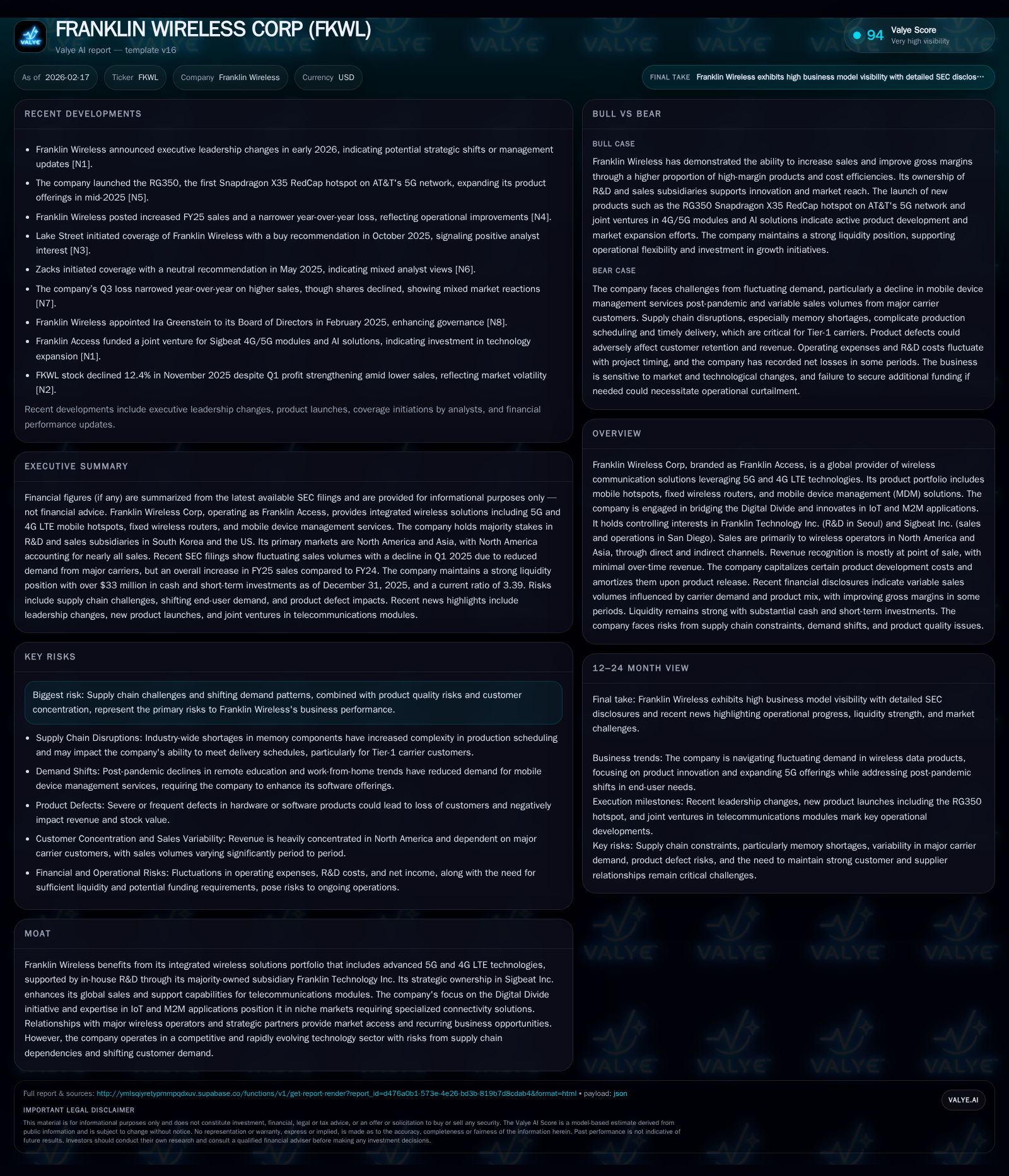
Franklin Wireless Corp operates at the intersection of advanced wireless solutions and social impact by addressing connectivity gaps globally through its Digital Divide initiative. Its integrated portfolio—including mobile hotspots, fixed wireless routers, and MDM services—is underpinned by substantial R&D in Seoul and sales operations in San Diego, facilitating innovation in IoT and M2M applications. The company has experienced marked revenue growth driven by North American carrier demand but faces volatility tied to shifting wireless usage patterns and semiconductor supply constraints. Franklin Wireless maintains strong liquidity and a robust current ratio, positioning it to navigate competitive pressures and invest in future technology developments.
Franklin Wireless: Business Model and Market Focus
Franklin Wireless Corporation operates as a global provider of wireless communication products branded under "Franklin Access," specializing in integrated solutions harnessing both the latest 5G and mature 4G LTE standards. Its core product lines encompass mobile hotspots designed as network edge devices, fixed wireless routers optimized for carrier aggregation scenarios, and mobile device management (MDM) software that supports seamless fleet control across wireless deployments [S1][S2]. The company prominently aligns itself with governmental and commercial efforts to bridge the Digital Divide—aiming to connect underserved populations lacking reliable broadband access—through tailored connectivity technologies embedded into its product programs.
Geographically, Franklin Wireless’s revenue is concentrated heavily in North America (approximately 99.9% as of mid-2025), selling predominantly via long-term contracts with large wireless operators supplemented by partner distributors [S4][S21]. Sales into Asia remain marginal but strategically important for innovation spillovers through its subsidiaries. The company recognizes revenue primarily at point of sale once products ship to customers and has minimal over-time service revenue exposure. It capitalizes certain development costs which are amortized upon product release, aligning with ASC 606 revenue recognition standards [S1][S23].
Leveraging Subsidiaries for R&D and Global Sales Reach
Central to Franklin Wireless’s competitive positioning is its controlling stake (66.3%) in Franklin Technology Inc. (FTI), an R&D-focused entity based in Seoul responsible for design-in of proprietary wireless modules suitable for IoT and machine-to-machine (M2M) use cases [S1][S2]. This tight integration between product engineering and firmware/software development facilitates accelerated innovation cycles essential amid evolving carrier standards such as dynamic spectrum sharing and advanced modulation schemes.
Complementing this is a majority interest (60%) in Sigbeat Inc., headquartered in San Diego, which directs worldwide sales, marketing, customer support, and operational logistics efforts related to communication modules. Sigbeat's presence provides local proximity to key operator clients in North America while delivering technical assistance that mitigates module design-in risks common in telecom hardware sourcing [S1][S2]. This dual-subsidiary model enhances global reach while maintaining nimble response capabilities.
Financial Trajectory: Revenue Growth and Profitability Trends
Over the fiscal year ending June 30, 2025, Franklin Wireless reported net sales totaling $46.1 million—a robust increase of nearly 50% versus prior year—driven mainly by escalated orders from major North American carriers [S4]. Despite a downturn in small Asian revenue streams largely due to variability at FTI’s material sales level [S16], the North American customer base remains the primary driver underpinning growth.
Gross profit expanded substantially by over 125%, improving margin ratios from approximately 11.4% to 17.2% during the same period [S4]. This margin expansion benefits from a shift towards higher-margin hardware products combined with efficiency improvements lowering unit production costs; these reflect better procurement terms alongside manufacturing scale efficiencies [S9]. Operating expenses rose moderately owing to increased payroll expenses associated with research activities but were partly offset by reductions in legal costs.
Responding to Market Demand Cycles and Product Mix Evolution
Post-pandemic behavioral shifts have notably influenced end-user demand for wireless data products—especially contributing to decreased interest in Mobile Device Management solutions as remote work and education normalize [S1][S2]. This transition mandates product lifecycle management agility as Franklin Wireless adapts its software offerings toward next-generation connectivity service models.
Hardware defect rates remain a critical variable impacting recurring orders from operators since elevated failures could accelerate churn or delay renewals [S1][S13]. Maintaining low defect ratios through rigorous testing protocols is vital amid competitive pressures.
Supply Chain Dynamics and Operational Resilience
Industry-wide semiconductor memory shortages have complicated Franklin Wireless's production scheduling due to prolonged lead times on critical components [S2]. These bottlenecks require sophisticated supplier relationship management strategies emphasizing multi-vendor sourcing parallelism while safeguarding inventory buffers—a hallmark of resilient telecom hardware supply chains.
The company's capacity to adapt production output dynamically plays into reducing customer backlogs when carrier demand fluctuates sharply [S13]. However, sustained component scarcity continues presenting operational risks.
Executive Leadership Changes Impacting Strategic Direction
In February 2026, Franklin Wireless announced key executive leadership changes potentially affecting corporate strategy execution regarding innovation investment priorities and go-to-market tactics [N1]. While no immediate operational impacts are reported, such governance transitions merit monitoring as alignment shifts within leadership teams can recalibrate R&D focus or channel approaches.
Capital Structure, Liquidity, and Funding Outlook
The company maintains solid liquidity standing with combined cash equivalents plus short-term investments exceeding $33 million as of December 31, 2025, supporting a healthy current ratio near 3.4x [F1][S8]. This financial flexibility ensures sufficient runway for ongoing R&D commitments alongside operating expenditures amidst sector cyclicality.
Net cash flows from operations turned negative during H1 FY26 driven largely by accounts receivable buildup but are expected to normalize as order fulfillment stabilizes [S8][S25]. Capital spending remains moderate focused on intangible asset investments primarily consisting of capitalized product development costs.
Risks from Customer Concentration and Industry Volatility
Franklin Wireless depends disproportionately on several major wireless operators—primarily located in North America—for the bulk of its revenues [S1][S23]. This high customer concentration presents inherent risks: fluctuations in any single operator’s order volume or contractual terms could materially affect topline performance.
Additionally, any significant increase in defect rates among hardware or software components could disrupt customer relationships impacting brand reputation [S13]. External factors including rapid technological shifts requiring continuous module redesigns pose ongoing volatility challenges common to the fast-evolving telecom equipment sector.
Future Innovation Pipeline and IoT/M2M Opportunity
Looking forward, Franklin Wireless’s embedded expertise via FTI positions it advantageously within niche segments emphasizing scalable IoT and M2M connectivity platforms—fields growing alongside smart infrastructure deployment globally [S1][S2]. The integrated solution portfolio combining edge network devices with flexible device lifecycle management creates opportunities for differentiated module design-in favorability.
Balancing competition intensity against its proprietary innovations will be key to sustaining sustainable revenue contributions from these emerging verticals without eroding gross margins over time.
Disclaimer: This analysis is intended solely for informational purposes without constituting investment advice or recommendations. Readers should consider independently verifying all statements referenced herein using official filings available through SEC databases prior to making any financial decisions related to Franklin Wireless Corp or its affiliated entities.
Disclaimer: This is research-only, informational analysis and not investment advice. It may include AI-generated interpretation and general industry context. Always verify important details using primary sources.

Comments