
Airship AI's Edge Data Platform Confronts High Customer Concentration and Supply Chain Risks
Airship AI Holdings delivers integrated AI-driven edge data solutions, balancing rapid deployment with dependency on a few key customers and geopolitical supply constraints.
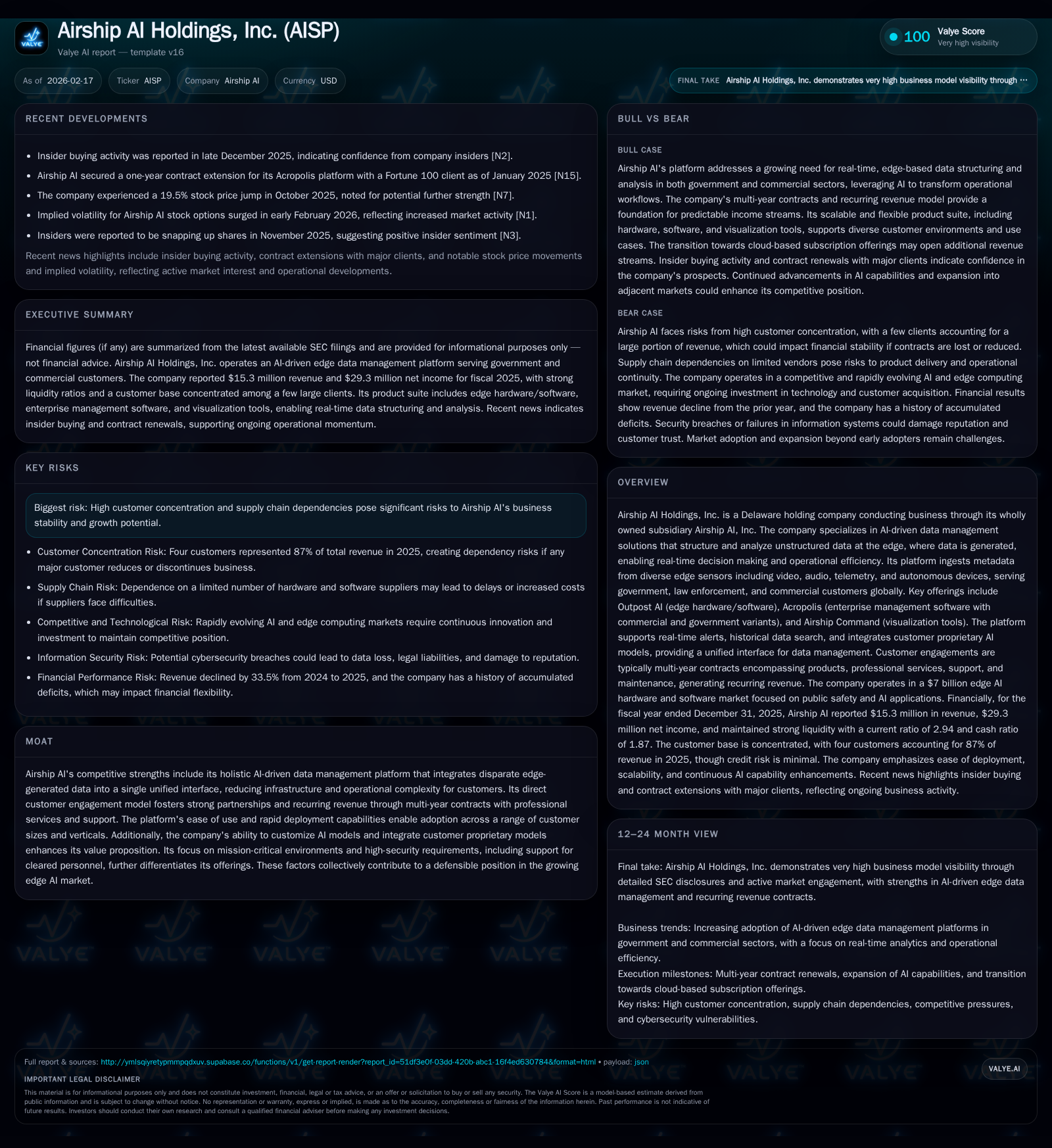
Airship AI Holdings, Inc. operates a unified platform combining hardware and software to structure and analyze unstructured data at the edge for government and commercial clients. The company's strengths lie in its holistic approach, scalable architecture, and strong direct customer relationships, primarily anchored in mission-critical government environments that demand high security and real-time analytics. However, Airship AI faces significant risks from customer concentration—with four customers driving nearly 87% of its 2025 revenue—and supply chain vulnerabilities linked to Taiwan-based components. Its current reliance on bundled hardware/software sales limits margin expansion, though efforts to shift toward cloud-based subscription software are underway. The company’s success hinges on navigating these operational risks while expanding market adoption in a nascent but evolving edge AI landscape.
Company Overview
Airship AI Holdings, Inc., incorporated in Delaware, conducts operations through its wholly owned subsidiary Airship AI, Inc., which has evolved from a bootstrapped company to a publicly traded entity via merger and NASDAQ listing in late 2023 [S1][S3]. The company focuses on AI-driven edge data management—ingesting unstructured metadata including video, audio, telemetry, seismic data from sensors operating at the perimeter of IT networks where data originates.
The platform comprises three core offerings: Outpost AI, which integrates edge hardware with proprietary AI software; Acropolis, a federated enterprise management system available in both commercial and government-specific variants; and Airship Command, a visualization layer providing unified situational awareness [S22].
Market Positioning and Product Suite
Airship AI's core value proposition is its ability to unify disparate sensor data into a "single pane of glass" dashboard that supports near real-time alerts, historical query capabilities, and integration of bespoke customer AI models. This enables clients—primarily mission-critical users like federal agencies, law enforcement bodies, military units, as well as large commercial enterprises such as casinos or logistics operators—to operationalize their sprawling sensor estates efficiently.
Acropolis Commercial targets small to medium businesses up to enterprises managing hundreds of cameras or devices with complex operational workflows. Meanwhile, Acropolis Law caters specifically to government requirements including security clearances up to Top Secret level [S22][S5].
Financial Performance and Operational Metrics
For the year ended December 31, 2025, Airship AI reported revenues of approximately $15.3 million—a decline of 33.5% compared to $23 million in the prior year—while gross profit dropped by almost 27% [F1][S14]. Cost of goods sold remained substantial due largely to hardware components embedded in bundled product offerings.
Notably, net income for fiscal 2025 was reported at $29.3 million; however, this figure is heavily influenced by sizable noncash gains arising from changes in warrant liabilities and earnout adjustments totaling over $36 million combined—a hallmark of volatile accounting treatments attendant to warrant exercises post-merger [S13][S24]. Operationally, cash flow from operations remains negative ($8 million outflow) reflecting ongoing investment phase characteristic for emerging tech companies [S13].
Research & development expenditures rose modestly year-over-year to approximately $3.1 million as the company continues platform enhancements including limited pilot projects integrating robotics for autonomous edge functions—though these pilots are not expected to contribute materially yet [S8][S26].
Customer Concentration Risk
Customer concentration is a palpable risk factor for Airship AI: four customers accounted for an outsized 87% of total revenue in 2025 [S4][S11]. Among these, three customers alone represent over 84% of accounts receivable outstanding balances. While payment histories have been timely reducing credit risk concerns short term, such reliance exposes Airship to significant revenue volatility should any major contract not renew or downscale.
In prior years the concentration was even higher due to a large one-time order dominating revenue mix [S4]. Much of the business comes under multi-year contracts inclusive of professional services and maintenance support aimed at recurring revenue streams. Government contracts often require participation through prime vendors or bidding processes which prolong sales cycles but deepen customer penetration once secured [S4][S28].
Supply Chain Vulnerabilities and Geo-Political Concerns
A pronounced risk relates to the supply chain sourcing of critical components for their Taiwan-based suppliers delivering server-grade hardware integral for the Outpost AI platform [S20]. Although many COVID-era disruptions have eased industry-wide, escalating geopolitical tensions between China and Taiwan present unpredictability regarding timely deliveries.
Supply delays could create cascading effects impacting project fulfillment schedules—a critical factor given contractual performance obligations outlined by Airship AI—in turn potentially affecting customer satisfaction and revenue recognition timing [S20][S25].
Inventory levels are minimal with just-in-time procurement matching customer demand reducing carrying costs but limiting buffer against supplier disruptions [S7].
Competitive Strengths and Moat Considerations
Airship emphasizes its holistic platform integrating varied sensor modalities into a singular user experience designed for rapid deployment (setup within roughly one hour) without extensive client engagement or training overhead—supporting scalability from dozen-device engagements up through tens of thousands of endpoints [S17]. This simplicity is touted as a key competitive differentiator along with deep customization capabilities including support for proprietary client AI modules.
Their direct customer engagement model fosters lasting partnerships generating expansion opportunities within existing accounts across organizational silos by breaking down traditional data silos—a critical pain point among enterprise clients seeking unified analytics frameworks .
Strategically focused on high-security cleared environments further differentiates them as few competitors adequately address requirements needed by defense or intelligence agencies—an advantage helping justify premium contract terms though potentially limiting broader commercial uptake.
Growth Strategy and Market Outlook
Though currently hardware-intensive with lower margin profiles resulting from bundled sales focus so far (covering both physical servers plus software delivery), management signals intent to accelerate cloud-based software subscription offerings enhancing recurring revenues higher up the margin curve [S5][S20]. This aligns with industry trends towards SaaS and hybrid deployments that drive stickiness.
With an estimated market size around $7 billion combining their governmental/public safety and commercial verticals around edge AI hardware/software solutions, substantial runway remains especially given ongoing digital transformation pushing increasingly complex sensor deployments at network edges commensurate with wider adoption of 5G networking enabling real-time distributed analytics .
Recent contract awards include nearly $4.7 million collectively from Department of Homeland Security events planning for national security exercise support alongside large commercial client technology refresh projects—all contributing backlog around $3.3 million as of late 2025 signaling improving sales pipeline momentum following merger-related transition periods [S26].[N1]
Risks Summary
- Customer concentration: Heavy dependency on four customers heightens revenue risk if contracts do not renew or scale down.
- Supply chain constraints: Geopolitical factors threaten timely receipt of critical components essential for hardware platform deployment.
- Market adoption obstacles: Edge AI remains emergent leading to potential market stagnation or slower-than-anticipated uptake.
- Technology evolution: Rapid innovation demands ongoing R&D investment; failure may impair competitiveness.
- Security vulnerabilities: Operating in sensitive environments exposes Airship to cybersecurity risks posing reputational damage potential if breached.
- Financial volatility: High non-cash accounting gains obscure underlying cash profitability metrics requiring careful analysis.
- Intellectual property exposure: Lack of patents means defense against infringement claims may be costly or disruptive.
Conclusion
Airship AI Holdings occupies an intriguing niche at the intersection of advanced edge computing hardware/software integration tailored primarily towards mission-critical governmental use cases but extending into commercial enterprise domains requiring real-time multi-sensor data consolidation capabilities.
Its strengths derive from platform comprehensiveness, rapid installability, strong customer relationships emphasizing recurring service revenue streams supported by professional services. However long-term viability depends crucially on diversifying its customer base beyond a few dominant accounts while mitigating fragile supply chains compounded by geo-political uncertainties.
Navigating these tradeoffs will determine if Airship can gain meaningful traction transitioning from capital-intensive bundled product sales into more scalable subscription offerings while maintaining technological leadership amid a competitive emerging edge AI marketplace undergoing accelerated transformation driven by IoT proliferation and distributed intelligence needs.
This analysis synthesizes publicly available filings and market data solely for informational purposes without constituting any form of investment advice.
Disclaimer: This is research-only, informational analysis and not investment advice. It may include AI-generated interpretation and general industry context. Always verify important details using primary sources.

Comments