
Allegion’s Strategic Balancing of Acquisition-Fueled Growth and Rising Inflationary Pressures
Allegion navigates growth through acquisitions and innovation while managing supply-chain and cost challenges in a dynamic security market.
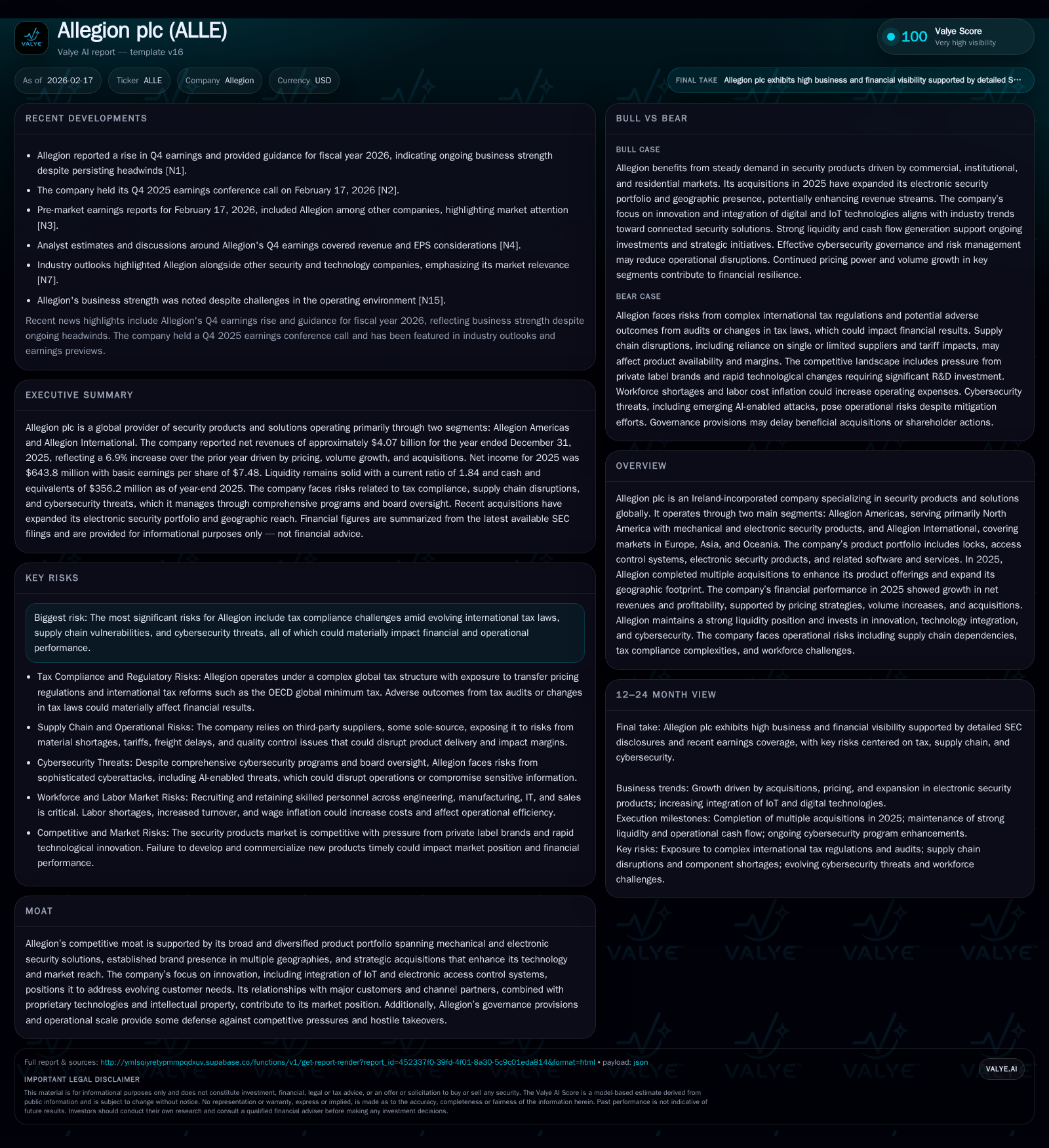
Allegion plc, a global leader in mechanical and electronic security products, leveraged a series of acquisitions in 2025 to expand its geographic reach and product portfolio, reinforcing its competitive moat with diversified offerings in both Americas and International segments. Despite facing cyclical pressures in the construction markets and inflation-driven cost headwinds, the company reported revenue and operating margin expansion, supported by pricing power and volume growth. Capital structure adjustments, including amending the revolving credit facility, enhanced liquidity amid ongoing investments in technology integration and cybersecurity. Key risks remain around tax compliance complexities, supply chain vulnerabilities, and increasing cybersecurity threats.
Company Overview
Allegion plc is an Irish-incorporated multinational specializing in security products and solutions across two primary operating segments: Allegion Americas and Allegion International [S1][S17]. The Americas segment primarily serves North America with a broad suite of mechanical locks to advanced electronic access control systems. Meanwhile, the International segment spans Europe, Asia, and Oceania with similar offerings adjusted for regional market nuances.
In the fiscal year ended December 31, 2025, Allegion reported strong net revenue growth fueled significantly by pricing strategies (3.6%), volume improvements (1.6%), complemented by acquisitions contributing an additional 1.8% uplift in revenues within the Americas segment [S17]. This multi-pronged approach reflects management's emphasis on expanding market share while mitigating cyclicality inherent in institutional and commercial construction sectors.
Most notably, electronic security products—including IoT-enabled locks and integrated access control suites—expanded their revenue contribution through low-double-digit percentage growth over the prior year [S17]. These products are central to Allegion's long-term strategy emphasizing technology integration into traditionally mechanical product lines.
Financial Performance and Unit Economics
Operating margin rose modestly to 21.1% for full-year 2025 from 20.7% in 2024 despite significant inflationary pressures [S6]. The drivers behind this included solid volume/product mix benefits and synergy realization from recent acquisitions that partially offset rising material costs, labor inflation, energy prices, and increased investment spending aimed at future offerings and channel development.
Inflation outpaced productivity gains leading to approximately a half percentage point margin erosion which was somewhat offset by price increases negotiated with customers [S6][S16]. Allegion's approach utilizes annual pricing contracts where possible to reduce raw materials cost volatility but is exposed to geopolitical factors such as tariffs affecting inputs from Mexico (~20-25% of COGS) and China (<5%) [S18].
Capital Structure & Liquidity Position
A critical financial development during 2025 was the amendment of Allegion’s unsecured revolving credit facility increasing commitments from $750 million to $1 billion with an extended maturity date pushed out to May 2030 [S4][S7][S14]. This facility supports working capital needs alongside a portfolio of senior notes totaling nearly $2 billion across maturities extending into the early 2030s.
Approximately 90% of Allegion’s outstanding debt carries fixed interest rates protecting against rising variable-rate exposure; however, $190 million remained borrowed under the revolver at year-end accruing interest at SOFR plus margin (~4.9%) [S4][S7][S14].
Cash flow from operations improved substantially to nearly $784 million driven by higher net earnings and favorable working capital management [S8]. Conversely, investing activities use rose sharply due to increased M&A activity bolstering product breadth as well as organic capital expenditures supporting infrastructure expansions [S8]. Financing cash flow trends indicate reduced share repurchases alongside higher dividend payments consistent with capital allocation discipline.
Strategic Moat & Market Positioning
Allegion’s competitive strength stems from its extensive product range covering mechanical locks through cutting-edge electronic access controls combined with strong brand equity exemplified by legacy names such as Schlage and Von Duprin [S17]. The incorporation of software solutions alongside hardware creates recurring service opportunities reinforcing customer stickiness.
Partnerships with large commercial contractors and institutional clients diversify revenue streams across educational institutions, healthcare facilities, government agencies, hospitality chains, retail outlets, office buildings as well as residential units [S17]. The company's scale provides leverage over suppliers yet exposes it to certain sole-sourcing risks requiring vigilant supply chain management.
Innovation focus includes IoT-enabled security systems capable of real-time monitoring with cybersecurity safeguards addressing increasing digital threats—a critical differentiator amidst rising cyber incidents targeting physical security infrastructures [S29].
Key Risks & Challenges
Several operative risks are salient:
- Tax Compliance: Complex global tax structures expose Allegion to transfer pricing controversies potentially triggering significant tax liabilities or penalties if challenged by authorities; evolving international tax frameworks add unpredictability [S1][S29].
- Supply Chain Vulnerabilities: Dependence on select suppliers for key electronic components or raw materials risks production delays especially amidst geopolitical uncertainties or logistics disruptions [S19].
- Inflation & Tariffs: Persistent cost inflation pressures erode margins despite proactive pricing; tariffs imposed on imports introduce cost uncertainties that may not be fully pass-throughable without demand erosion risks [S18].
- Cybersecurity Threats: As more products incorporate networked functionality, vulnerabilities could lead to reputational damage or litigation if security breaches occur impacting customers' safety or data privacy [S29].
- Environmental & Regulatory: Compliance costs related to environmental remediation efforts persist along with heightened ESG scrutiny impacting operational practices globally [S20].
- Legal Risks: Intellectual property infringement claims pose potential costly litigations that could restrain marketing or require licensing expenditures; brand protection remains ongoing concerns [S15].
Industry Context & Outlook (Analysis)
The global security products industry is undergoing accelerated integration of electronics with traditional mechanical solutions. Market demand increasingly favors smart access controls interconnected via IoT networks enabling remote management capabilities. Allegion’s investments align with this macro trend enhancing its appeal particularly in commercial segments where cybersecurity standards are tightening.
However, industry cyclicality linked closely to construction activity remains an underlying constraint with economic downturns historically triggering deferrals or cancellations of projects impacting order volumes. Supply chain bottlenecks—especially for semiconductors—have heightened cost and delivery uncertainties requiring agile inventory strategies.
Capital intensity remains moderate relative to returns; manufacturing automation combined with lean production methodologies provide incremental productivity opportunities but inflationary dynamics could compress margins absent effective price management.
Conclusion
Allegion stands out within its sector for blending robust legacy mechanical security capabilities with progressive electronic access innovations backed by tangible acquisition-driven growth. The firm has demonstrated resilience managing supply disruptions while strategically extending liquidity horizons through credit facility enhancements.
Maintaining profitability amid inflation pressures reflects disciplined cost controls coupled with nuanced pricing strategies calibrated not to undermine volume gains markedly. Nonetheless, risks notably from tax compliance complexity, supplier dependencies, tariffs exposure, cybersecurity challenges, environmental liabilities alongside legal contingencies warrant continuous vigilance.
The interplay between organic innovation investments and external acquisition integration will remain central to sustaining competitive advantage across diversified global markets highly sensitive to economic cycles.
Disclaimer: This analysis is for informational purposes only based on publicly available data as of February 17, 2026. It does not constitute investment advice or recommendations concerning securities mentioned herein.
Disclaimer: This is research-only, informational analysis and not investment advice. It may include AI-generated interpretation and general industry context. Always verify important details using primary sources.

Comments