
Portland General Electric’s $1.9 Billion Acquisition Tests Regulatory and Integration Capacities
Portland General Electric (PGE) is expanding its footprint through the acquisition of PacifiCorp’s Washington operations, highlighting regulatory hurdles and capital financing dynamics.
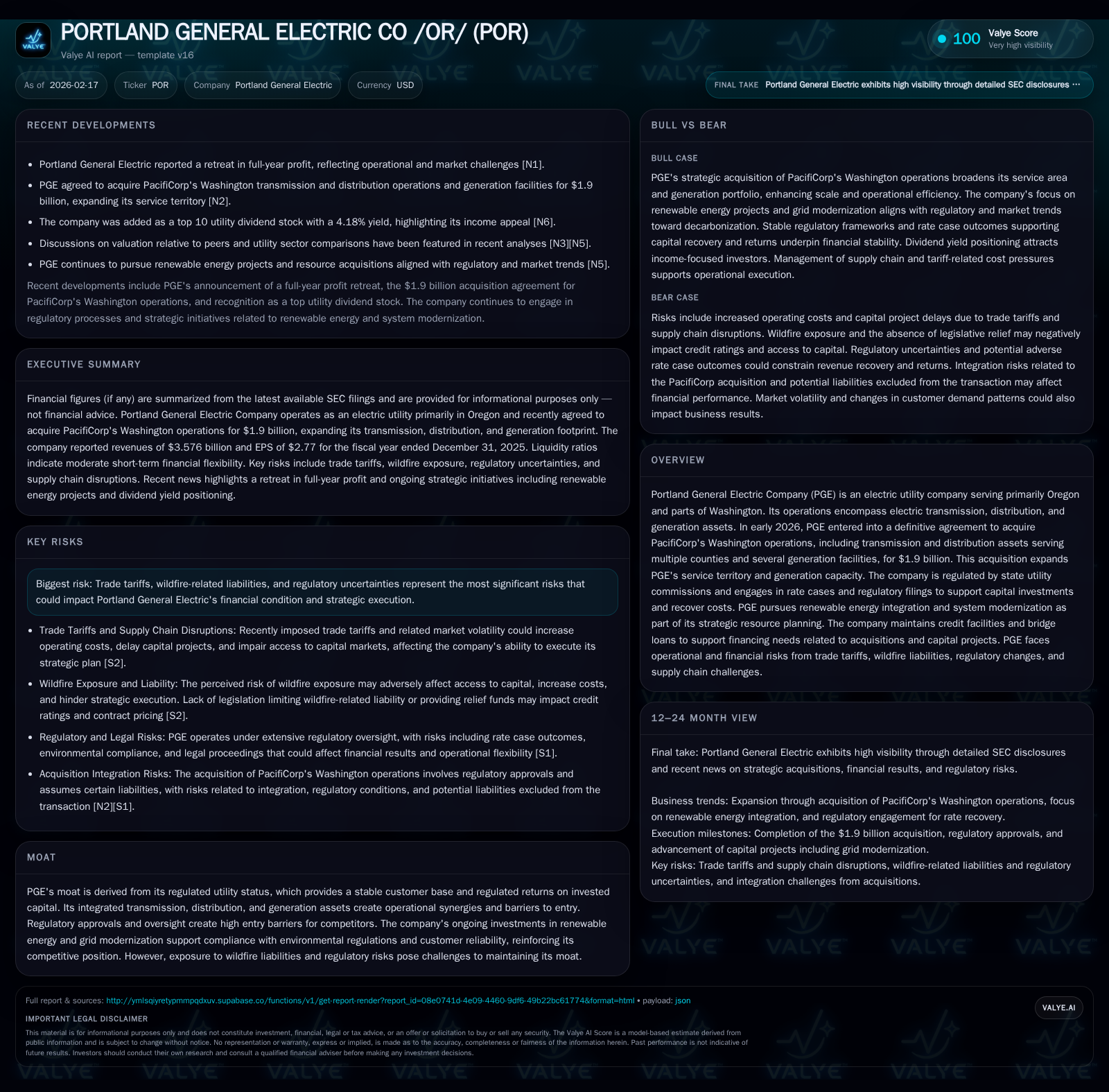
In early 2026, Portland General Electric agreed to acquire PacifiCorp’s electric transmission, distribution assets, and generation facilities in Washington for $1.9 billion, substantially expanding its service territory. This strategic move hinges on securing multiple state and federal regulatory approvals while navigating material wildfire liability exposures and trade tariff-driven cost pressures on capital projects. PGE’s moat derives from its regulated utility status, but it faces risks related to wildfire liabilities and market uncertainties. Ongoing renewable integration and grid modernization efforts continue alongside robust capital structure management involving bridge financing and equity partnerships.
Overview of Portland General Electric
Portland General Electric Company (PGE) is an Oregon-based electric utility primarily serving customers in Oregon with a presence extending to parts of Washington. It operates an integrated platform consisting of electric generation assets—both fossil fuel and renewable—transmission infrastructure, and distribution networks. As of late 2025 and early 2026 filings [S1][S3], PGE reported revenues near $3.58 billion (F1) reflecting the scale of its operations.
The $1.9 Billion PacifiCorp Asset Acquisition
In February 2026, PGE entered into a definitive agreement to acquire PacifiCorp's Washington operations in a transformative transaction valued at $1.9 billion cash consideration plus adjustments [N4][S3]. The deal transfers ownership of extensive transmission and distribution assets servicing multiple counties (Lewis, Yakima, Walla Walla, Columbia, Garfield & Benton), alongside generation plants including the Chehalis combined cycle gas turbine facility and several wind farms (Goodnoe Hills Wind; Marengo I & II) [N4][S18].
This acquisition significantly expands PGE's footprint northwards across state lines.
Regulatory Milestones & Conditions
The transaction is subject to exhaustive regulatory scrutiny with required approvals from the Federal Energy Regulatory Commission (FERC), Washington Utilities & Transportation Commission (WUTC), Oregon Public Utility Commission (OPUC), Idaho Public Utilities Commission (IPUC), Utah Public Service Commission (UPSC), California Public Utilities Commission (CPUC), Wyoming Public Service Commission (WPSC), as well as Hart-Scott-Rodino Antitrust clearances [S18][S26]. Of note:
- There must be no "Burdensome Condition" imposed that would adversely affect the financial viability or operational aspects.
- Transfer or issuance of key business permits to the buyer entity is mandatory.
- No ongoing wildfire casualty event exceeding $35 million post-insurance can persist at closing.
These rigorous conditions reinforce entry barriers tied to both multi-jurisdictional oversight and environmental risk exposure unique to utilities with wildfire-related liabilities.
Financing Structure & Capital Management
To fund this sizable acquisition along with related fees:
- PGE secured a 364-day senior unsecured bridge loan credit facility for up to $1.9 billion from Barclays Bank PLC and JPMorgan Chase Bank N.A., conditioned on timely deal closure [S9].
- Concurrently arranged is a delayed draw term loan facility targeting approximately $681 million with portions committed upfront.
- Equity contributions involve Manulife Infrastructure Fund III acting as a joint venture partner with PGE deploying roughly $600 million equity alongside debt proceeds.
This layered capital approach balances leverage with partnership investments ensuring financial flexibility while tackling near-term funding needs.
Regulatory Environment Impacting Capital Recovery
Rate cases remain pivotal for PGE’s return on invested capital (ROIC) sustainability. Recent Oregon Public Utility Commission decisions granted a 9.34% ROE underpinning recovery mechanisms for standalone projects like the Seaside Battery Energy Storage System approved with a ~$220 million rate base addition [S21][N8]. Likewise, the company’s Distribution System Plan Alternative Recovery Mechanism stipulates another ~ $218 million rate base increase securing revenue requirement hikes aligned with investments supporting network modernization and clean energy integration [S23].
The earnings test applied at authorized ROE curtails excessive returns ensuring consumer fairness but also condenses margins available for reinvestment.
Strategic Resource Planning & Renewable Integration
PGE is actively advancing decarbonization through solicitations such as the 2023 All-Source Request for Proposal (RFP) targeting non-emitting dispatchable capacity alongside renewables [S24]. An updated shortlist includes solar + battery hybrid projects totaling over 600 MW combined capacity plus standalone battery storage additions nearing 400 MW—a reflection of sector-wide trends in hybridization for enhanced grid flexibility.
This multi-faceted procurement framework mitigates risks around price volatility following recent trade tariffs impacting equipment costs while honoring statutory net-zero mandates.
Operational & Market Risks: Wildfire Liability and Tariffs
Trade tariffs applying to imported capital goods could escalate supply costs affecting project timelines or cause delays due to supply chain disruptions [S2][S8], imperiling PGE’s ambitious capital program rollout.
More critically, wildfire liabilities linger as nonlinear risk vectors potentially limiting access to low-cost capital if unresolved through legislation or insurance mechanisms [S2][S4]. While wildfire exposure extends beyond Oregon into acquired territories excluding some liabilities retained by seller PacifiCorp, mediated risk remains a cautionary factor influencing counterparties’ willingness to engage in long-term contracts or pricing concessions.
Integration Challenges Post-Acquisition
With assets spread across multiple states with divergent regulatory regimes, harmonizing operations presents considerable complexity. Differences in compliance standards, tariff structures, and stakeholder expectations may delay synergy realization or augment integration costs beyond initial estimates [S28].
Successful management will require meticulous coordination between legal teams, regulators, system operators, and local stakeholders.
Financial Position & Liquidity Metrics
At year-end 2025, PGE exhibits a current ratio slightly above one (~1.08), indicating working capital adequacy amidst expanded balance sheet size due to growing CAPEX commitments [F1]. Maintaining credit ratings depends heavily on regulatory outcomes around rate cases, wildfire litigation exposure mitigation strategies, liquidity facilities utilization efficiencies and prudent debt load controls.
Outlook & Industry Contextual Considerations
PGE operates within the broader U.S. electric utility sector grappling simultaneously with: integrating intermittent renewable resources; transitioning away from coal-fired generation; hardening grids against climate-driven physical risks; aligning with evolving environmental regulations; and navigating ratepayer affordability pressures amid rising interest rates impacting weighted average cost of capital calculations.
The company's asset acquisition signals confidence in strategic consolidation yet underscores the precarious balance of regulated returns versus infrastructure needs amid external challenges.
Conclusion
Portland General Electric's sizeable acquisition marks an inflection point enlarging scale but intensifying regulatory navigation complexity alongside significant financing undertakings. Its durable regulated utility moat benefits from integrated ownership models but must continuously manage external cost drivers including trade-related inflationary pressures and wildfire financial exposures that remain systemic constraints within western U.S. utilities.
The company's ongoing investment in grid modernization coupled with renewable deployments aligns well with state-led decarbonization goals though successful execution hinges on smooth regulatory engagements across diverse jurisdictions.
Investors should broadly view PGE's developments within the frame of tight industry margins determined by authorized ROE bands juxtaposed against escalating operational risks incentivizing diversification through alliances like the Manulife joint venture.
Disclaimer: This analysis is based solely on publicly available information as of February 2026 gathered from SEC filings, company disclosures, industry reports, and news sources without offering investment advice or forecasts.
Disclaimer: This is research-only, informational analysis and not investment advice. It may include AI-generated interpretation and general industry context. Always verify important details using primary sources.

Comments