
New Century Logistics’ Quest to Turn Global Air Freight Losses into Gains
Examining how New Century Logistics strives to convert its global air freight operational scale and partnerships into sustained profitability despite recent financial setbacks.
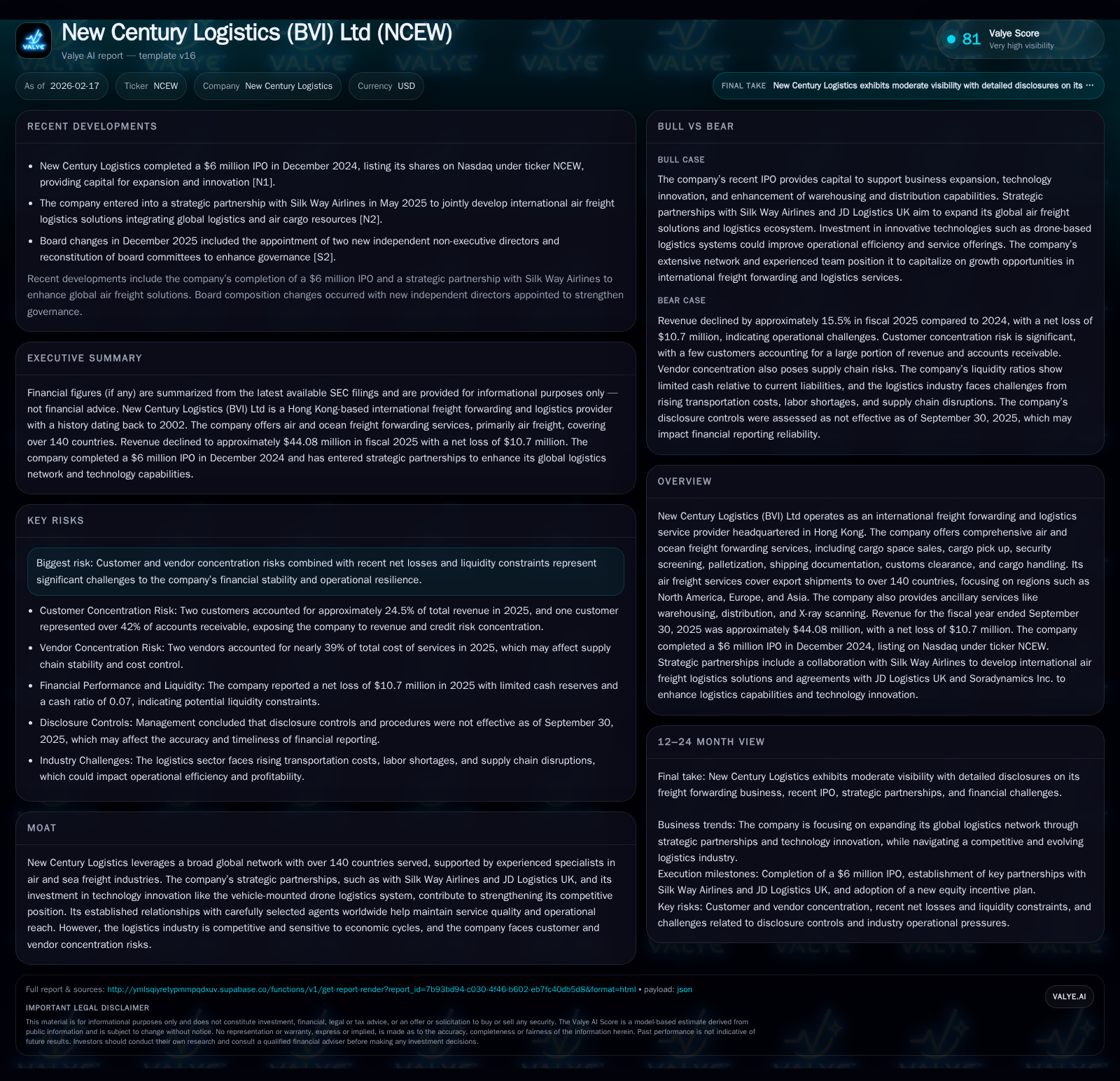
New Century Logistics (BVI) Ltd, a Hong Kong-based international freight forwarder, completed a $6 million Nasdaq IPO in late 2024 but posted a substantial net loss of $10.7 million for fiscal 2025 amid shrinking revenues and margin compression. Air freight dominates its revenue streams, comprising over 95%, serviced via a network spanning more than 140 countries supported by strategic agent relationships. The company faces acute customer concentration risks and liquidity constraints while navigating volatile economic conditions in Greater China and global trade. Emerging innovations like vehicle-mounted drone logistics and alliances with major partners such as Silk Way Airlines and JD Logistics UK underpin efforts to rebuild competitive advantage. Recent board changes reflect corporate governance recalibration aimed at financial discipline as NCEW seeks to leverage IPO proceeds for growth in a challenging global freight forwarding landscape.
IPO Milestones and Market Debut
New Century Logistics (BVI) Ltd marked a notable milestone by completing its initial public offering on the Nasdaq exchange in December 2024, raising approximately $6 million [N1]. This move into public markets provides fresh capital intended to support operational resilience and expansion initiatives amid an increasingly competitive global logistical environment [S2]. Regulatory filings indicate compliance regained with Nasdaq listing rules by late 2025, enhancing investor confidence [S2]. However, market debut follows a period marked by tightening financial dynamics.
Service Portfolio Rigour: Air Freight at the Core
The company’s service mix is heavily weighted toward air freight, which accounted for over 95% of its total revenues of $44.08 million in fiscal year ended September 30, 2025, up from about 92% in prior years [S1][F1]. These services encompass export shipments serving more than 140 countries across key trade corridors including North America, Europe, and Asia. Operational workflows cover cargo space sales, off-airport air cargo security screening, palletization, documentation preparation, customs clearance arrangements, and cargo handling at ports [S1]. Ancillary offerings extend to warehousing, X-ray scanning, gate charges, and distribution services that complement core freight forwarding.
Global Reach Backed by Strategic Agent Networks
NCEW’s extensive footprint leverages a carefully curated network of international agents ensuring inbound and outbound freight coordination across continents [S1]. This agent framework underpins service consistency essential for handling complex cross-border logistics. The company boasts longstanding experience within Hong Kong's air and sea freight sectors but relies heavily on these external partnerships elsewhere, presenting operational challenges related to quality control and alignment of customer service standards across jurisdictions.
Revenue Streams vs. Profitability Challenges
Revenues declined substantially by about 15.5%, dropping from $52.18 million in FY2024 to $44.08 million in FY2025 mainly due to reduced orders from major customers affected by their own downturns [S5][F1]. Despite this volume contraction, cost of sales remained elevated, resulting in gross profit plummeting by over 96%, with margins shrinking from over 8% previously to below 0.4% in FY2025 [S11]. Key cost drivers include air freight charge volatility—reflecting fluctuating airline cargo space fees—and labor plus warehousing costs that have limited pricing power amid intense competition [S20]. Reduced yields highlight fragile unit economics where volume declines severely erode the operating leverage required for profitability.
Liquidity Strains Amid Working Capital Pressures
Balance sheet analysis reveals liquidity challenges as current assets totaled roughly $13.2 million against current liabilities nearing $9 million at fiscal year-end, yielding a current ratio around 1.47—a level illustrating constrained but positive short-term coverage [F1][S9]. Bank loan obligations approaching $2 million are due within one year adding debt servicing pressure [S3][S8]. Accounts receivable management shows extended payment terms granted particularly to large customers to maintain business continuity but heightens credit risk exposure—one customer alone represents over 40% of receivables [S4][S21]. The absence of off-balance sheet financing underscores reliance on conventional debt instruments amidst operational cash-flow volatility.
Industry-Specific Risks: Economic Sensitivities and Customer Concentration
Operating out of Hong Kong places NCEW’s fortunes closely tied to the economic health of both Hong Kong and Mainland China markets where GDP fluctuations directly influence trade volumes [S1]. Trade policy shifts may instantaneously alter demand patterns for import-export forwarding services. Seasonality affects revenue rhythm notably with strong Q4 peaks aligned with Western holidays contrasted by predictable troughs around Lunar New Year when manufacturing activity slows considerably [S22]. Customer concentration risk remains acute with two customers comprising almost one-quarter of total revenues, intensifying dependency concerns should client-specific downturns persist or payment behaviors deteriorate [S4][S6]. Supplier concentration also heightens vulnerability given two principal vendors comprise roughly 38% of cost structures.
Innovation and Partnerships Powering Competitive Moat
New Century Logistics harnesses strategic alliances such as that with Silk Way Airlines enabling enhanced international route capacity and operational synergies critical for sustained network differentiation . The collaboration reportedly optimizes cargo space acquisition on select high-demand routes aiding competitive pricing leverage. Technology adoption exemplified by investment into vehicle-mounted drone logistics systems attempts to address last-mile delivery challenges prevalent in congested urban centers where speed and flexibility determine client satisfaction . Cross-border partnerships including those with JD Logistics UK provide access avenues into European e-commerce supply chains potentially widening the firm’s addressable market.
Governance Shift: Boardroom Changes Signaling Corporate Refocus
In December 2025, NCEW revamped its board composition replacing two independent non-executive directors with professionals possessing deep expertise in corporate finance and regulatory compliance [N2]. Appointees like Mr. Mak Tsz Yeung bring credentials spanning CFA designation and legal qualifications addressing pressing needs around financial discipline post-IPO. This board refreshment aligns with increased scrutiny from shareholders on capital stewardship as the company navigates through losses towards stabilization.
Outlook: Navigating Cyclical Demand and Growth Investments
Going forward, the company's trajectory hinges on balancing cyclical demand patterns reflective of global trade cycles while deploying IPO proceeds strategically—particularly towards technological platforms enhancing operational efficiency and service differentiation [S1]. Retaining earnings policy signals intent to reinvest all available resources rather than distribute dividends reflecting capital-light nature intrinsic to freight forwarding businesses reliant primarily on intangible assets such as agent networks and contracts rather than heavy infrastructural capex investments.
However, mitigating customer concentration risks remains paramount alongside improving cash flow conversion metrics given stretched receivable cycles. Continuing macroeconomic uncertainties associated with Sino-global trade relations inject further unpredictability into volume forecasts making aggressive expansion strategies higher risk without parallel margin normalization initiatives.
This analysis summarizes information extracted from publicly available regulatory filings as of February 17, 2026, incorporating contextual industry insights strictly based on disclosed data without forward-looking assessments or investment advice.
Disclaimer: This is research-only, informational analysis and not investment advice. It may include AI-generated interpretation and general industry context. Always verify important details using primary sources.

Comments