
Herc Holdings Strengthens Market Reach Following H&E Acquisition Integration
Herc Holdings expands its fleet and geographic footprint through the H&E acquisition while addressing high leverage and cyclical market headwinds.
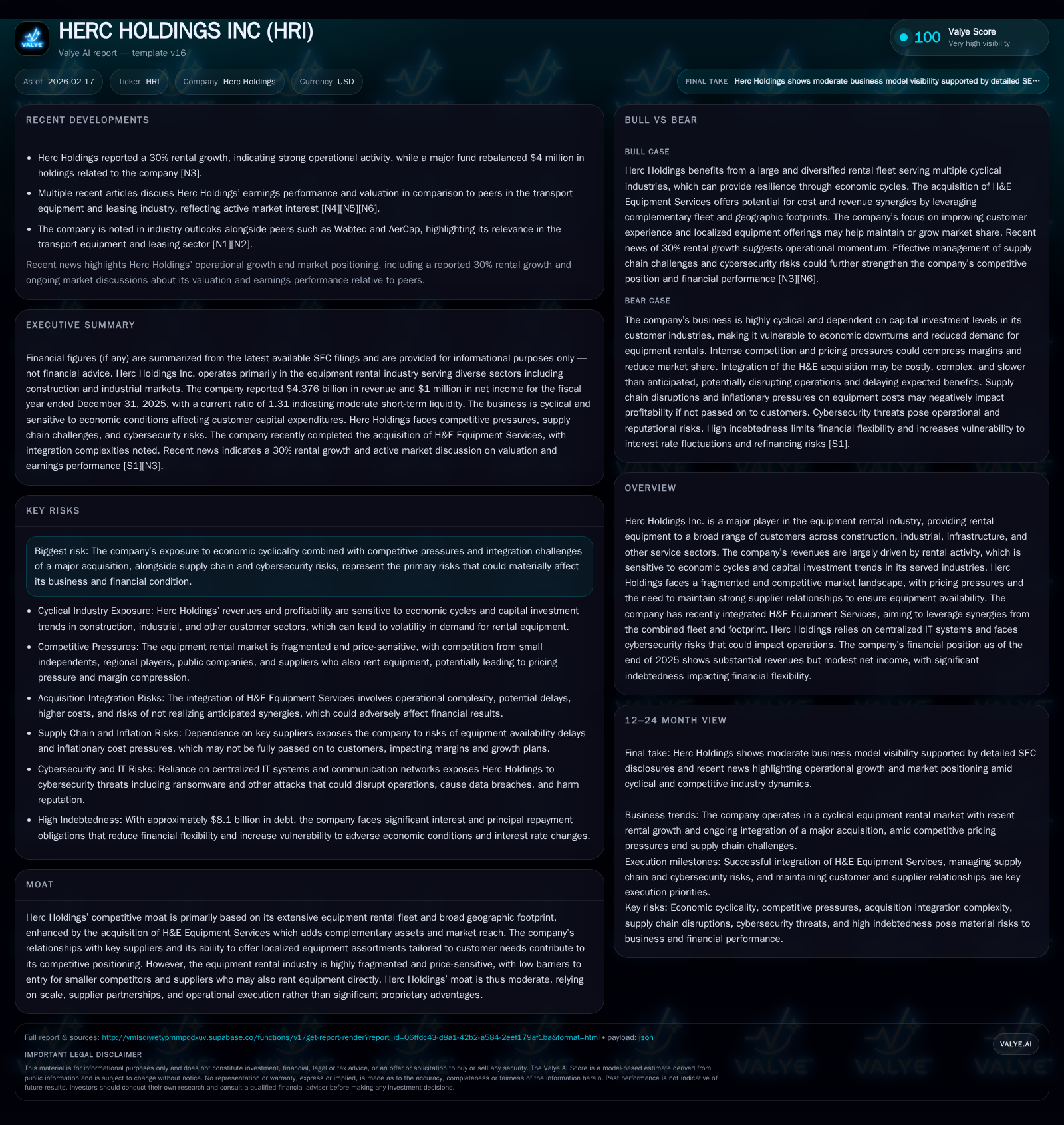
Herc Holdings Inc. has recently completed a significant merger with H&E Equipment Services, resulting in a notable increase in fleet size and geographic coverage that bolsters its presence in the fragmented equipment rental market. Despite achieving substantial revenue growth to $4.38 billion in 2025, the company faces profitability constraints due to integration costs, impairment charges, and elevated debt levels totaling approximately $8.1 billion. Herc’s ability to navigate cyclical demand shifts tied to construction and industrial spending, maintain supplier relationships amid pricing pressures, and manage refinancing risks define its near-term operational challenges. Additionally, centralized IT systems expose it to increasing cybersecurity risks that may affect operational continuity. The company’s moderate moat rests on scale, supplier partnerships, and operational execution rather than proprietary advantages.
Expansion Through Acquisition: The H&E Equipment Integration
Herc Holdings’ recent integration of H&E Equipment Services represents a transformative milestone for the company’s scale and footprint in North America's equipment rental industry. The merger significantly increased Herc's rental fleet size and branch network, enabling the company to offer a more diversified assortment of equipment tailored to its varied customer base across construction, industrial, infrastructure, and service sectors [S9]. This complementary geographic expansion enhances Herc’s reach into key regional markets previously dominated by competitors or smaller regional providers.
However, the path to realizing full synergy benefits remains complex. Integration efforts encompass streamlining back-office functions, consolidating IT systems, aligning sales channels, and rationalizing fleet compositions. The company acknowledges potential delays or cost overruns that could dampen anticipated cost savings or revenue enhancements from combined operations [S9][S11]. Moreover, successful merger execution is critical as competitors aggressively pursue market share in this highly fragmented sector.
Fleet Composition and Geographic Diversification Analysis
Herc's fleet post-acquisition spans a wide range of equipment types—ranging from aerial work platforms to earthmoving machinery—serving contractors engaged in commercial construction, remediation projects, industrial maintenance (petrochemical plants, refineries), renewable infrastructure development, as well as entertainment production services [S5][S6]. The expanded geographic footprint now covers more branches distributed strategically across urban and suburban hubs in the U.S. and Canada [S9][S10], supporting localized equipment assortments designed to meet regional customer demands.
Fleet utilization rates remain a key operational metric influencing rental yield optimization. Herc continuously adjusts its fleet mix based on real-time demand patterns while retiring underutilized assets or redeploying units across regions as needed to maximize asset turns . This dynamic asset management helps maintain competitive pricing leverage but also exposes the company to residual value risk upon equipment disposition.
Industry Cyclicality and Its Impact on Rental Demand
Equipment rental demand closely follows capital expenditure trends within construction and industrial end markets. Macroeconomic slowdowns or contractions in residential/commercial building projects can curtail rental volumes swiftly due to contractors scaling back activities [S13][S23]. Similarly, fluctuations in oil & gas prices influence upstream capital investments affecting rentals for drilling and maintenance equipment.
The company's revenues exhibit sensitivity not only from direct economic activity but also from government infrastructure initiatives or regulatory changes influencing project pipelines [S16]. As markets face overcapacity risks with competing fleets exerting downward pressure on rates, Herc must balance fleet growth cautiously against fluctuating utilization trends.
Competitive Dynamics: Pricing Pressures and Supplier Relationships
Despite scale gains from the H&E integration, Herc operates within an intensely fragmented industry where price competition is fierce [S5]. Customers often shop online comparing rental rates readily available due to internet-enabled transparency—heightening margin compression pressures.
The company's dependence on large OEM suppliers adds complexity; these suppliers can choose alternative distribution channels such as selling or renting direct to end customers or appointing competing dealers [S9]. Such supplier channel conflicts threaten Herc’s vendor relationships and pricing strategies. Consequently, maintaining supplier goodwill alongside competitive pricing policies is vital for sustaining service quality and profitability.
Capital Structure Risks and Debt Management Strategies
As of year-end 2025, Herc carried approximately $8.1 billion in debt—a substantial liability burden given the capital-intensive nature of its business [S7][F1]. The majority of this indebtedness is secured by fleet assets under credit facilities with borrowing limits tied to periodic collateral appraisals.
This borrowing base valuation mechanism injects volatility into liquidity availability since asset values can fluctuate due to prevailing market conditions or residual value adjustments . Furthermore, a significant proportion of Herc's debt bears floating interest rates indexed to benchmarks such as SOFR [S4], exposing cash flow sensitivity amid rising interest rate environments—a notable risk given current macroeconomic trends.
Refinancing needs loom as maturities approach; however, Herc’s credit profile depends heavily on stable operating cash flows which are intrinsically linked to cyclical demand patterns. Challenges in refinancing could restrict growth investments or necessitate deleveraging via asset sales or curtailed expenditures.
Information Technology, Cybersecurity, and Operational Continuity
Herc relies fundamentally on centralized IT systems handling end-to-end processes including rental bookings (e.g., ProControl by Herc Rentals™), inventory management, pricing analytics, customer billing, and reporting functions [S6][S20]. While centralization yields operational efficiencies, it also concentrates risk exposure: major system failures or sophisticated cyberattacks such as ransomware could severely disrupt operations.
Cyber-threat vectors continue evolving with increasing AI-augmented techniques making early detection difficult [S18]. Any material breach would jeopardize customer trust through potential data loss or service interruptions—damaging brand equity alongside incurring remediation costs.
Financial Performance Overview: Revenue Growth vs. Profitability Challenges
In fiscal 2025, Herc reported revenues of approximately $4.38 billion—a marked increase reflecting higher rental activity volume aided by the acquisition [F1][N5]. However, net income was modest at roughly $1 million due largely to early-stage integration expenses coupled with significant impairment charges like the $49 million recorded against Cinelease assets during the year [S1][N4].
These impairment charges highlight ongoing earnings quality concerns despite top-line expansion. Elevated operating expenses related to merging corporate functions alongside cyclical margin pressure inhibited profitability gains.
The sluggish bottom-line profitability underscores a transitional phase where synergy realization timelines remain uncertain amid external economic volatility.
Future Outlook and Risk Considerations
Looking ahead, Herc must continuously mitigate risks stemming from its high leverage profile against backdrop of possible industry downturns impacting rental demand [S16][N6]. Interest rate volatility remains a wildcard potentially elevating debt servicing costs beyond current projections.
Operationally, effective integration execution remains paramount; any setbacks could delay key cost synergies or hamper localized service delivery standards critical for customer retention [S11][S22]. Supply chain disruptions for new equipment acquisition further complicate fleet renewal strategies needed for competitiveness.
Cybersecurity vigilance will require sustained investment given heightened threat environment; failure here could trigger costly interruptions with cascading financial effects [S24].
In sum, Herc's competitive stance post-H&E hinges on disciplined capital management coupled with leveraging scale advantages without losing agility required in fragmented markets shaped by rapid technological adoption among peers.
Disclaimer: This report is intended solely for informational purposes based on publicly available data as of early 2026. It does not constitute investment advice or recommendations.
Disclaimer: This is research-only, informational analysis and not investment advice. It may include AI-generated interpretation and general industry context. Always verify important details using primary sources.

Comments