
Medicale Corp.: The Challenge of Launching Without Revenue or Staff
A thorough examination of Medicale Corp.’s formative financial and operational posture reveals the inherent hurdles in transitioning from a dormant shell to an active business.
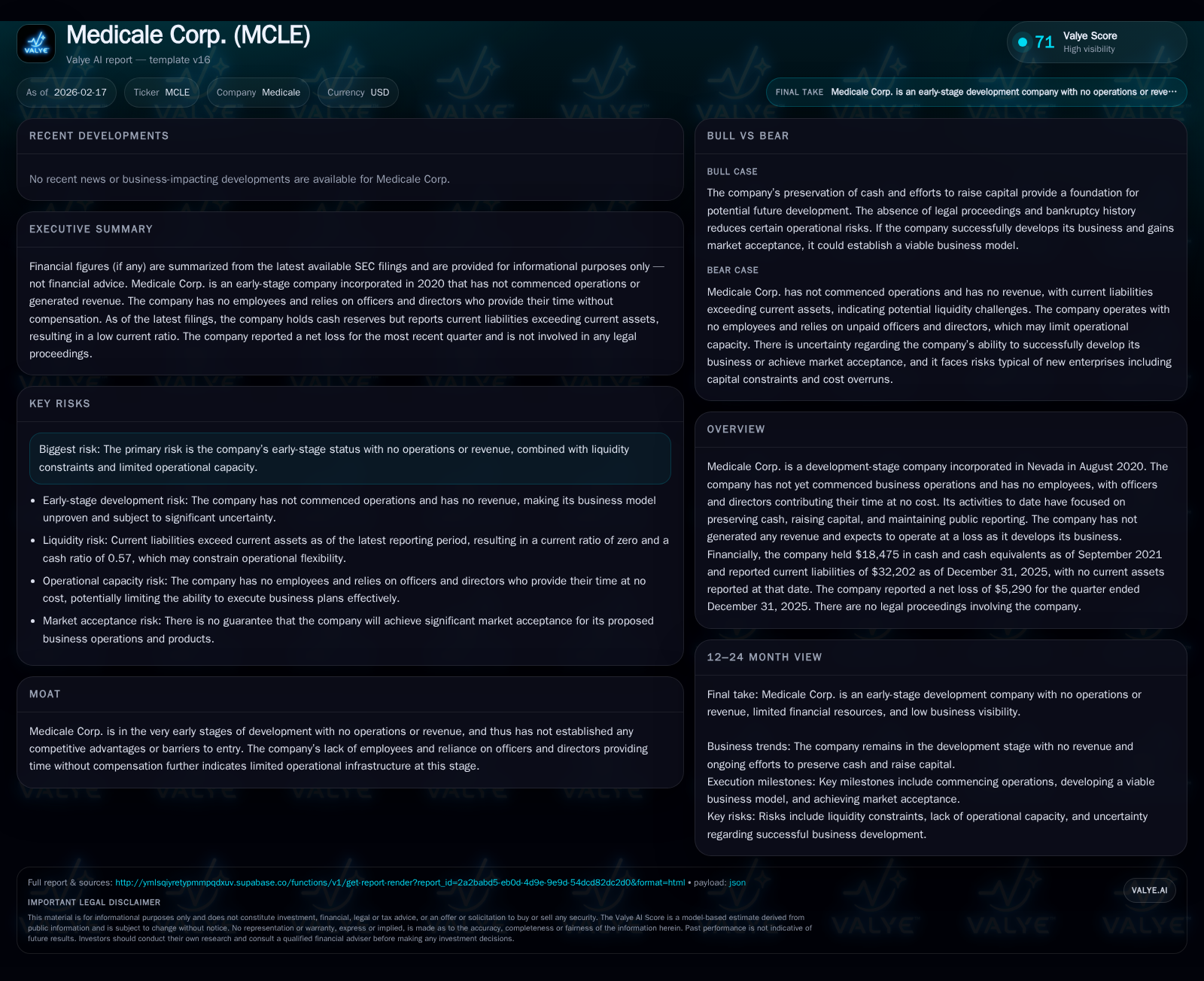
Medicale Corp. stands as a textbook case of an early-stage development company with no ongoing operations, no revenue, and a volunteer leadership structure. Founded in August 2020 and incorporated in Nevada, the company remains devoid of employees and has yet to commence business activity, relying on its officers and directors who provide services at no cost. Financially, the company exhibits a precarious liquidity position where current liabilities outstrip any current assets, signaling negative working capital and pressure on cash resources. Without concrete operational infrastructure or capital reserves, Medicale faces significant execution risk as it seeks to establish viable business operations amid capital constraints and regulatory simplicity.
Foundations of Formation: Medicale Corp.’s Origins and Current Status
Medicale Corp. was incorporated as a Nevada entity on August 17, 2020 [S1][S3]. Since inception, the company has remained inactive operationally; it has neither commenced business activities nor generated any revenue. The publicly available disclosures do not illuminate any specific industry focus or core business model—an absence that naturally warrants heightened investor scrutiny. Instead, the company’s efforts have centered on maintaining compliance with public reporting standards while conserving internal cash. This pattern is illustrative of many so-called "shell companies" awaiting catalytic initiatives or capital infusions before embarking on substantive commercial endeavors.
Such limited disclosure obscures clarity regarding Medicale’s strategic intentions and market positioning. From a governance perspective, this vacuum stresses the importance of transparent communication in mitigating informational asymmetry—a notable challenge for investors evaluating firms lacking operational history.
Financial Snapshot: Capital Resources, Liabilities, and Cash Flow Pressures
The latest financial evidences paint a stark picture of Medicale’s constrained liquidity landscape [F1][S1][S3]. As of September 30, 2021, the company held cash and cash equivalents totaling $18,475. However, by December 31, 2025—the close of its most recent fiscal year—it reported zero current assets juxtaposed against current liabilities totaling $32,202. This disparity translates into a current ratio of zero (Current Assets / Current Liabilities = 0/32,202 = 0), highlighting an acute inability to cover short-term obligations through liquid or near-liquid assets.
Moreover, the trajectory includes persistent net losses; specifically, a net loss of $5,290 was posted during Q4 ending December 31, 2025 [F1]. This negative earnings momentum compounds the liquidity crunch by draining scarce capital reserves. Such dynamics are not uncommon in bootstrapped startups where balancing burn rate against capital access defines survival odds.
Negative working capital combined with limited financing options poses immediate existential threats absent new external funding or revenue generation avenues.
Operational Blueprint: No Employees, No Revenue, and Reliance on Volunteer Leadership
Operationally unusual is Medicale’s complete absence of employees [S1][S3]. Instead, all managerial functions are performed by officers and directors who contribute their time voluntarily without compensation—a scenario commonly described by sector practitioners as “lean governance.” This approach minimizes overhead costs but also curtails operational bandwidth necessary for proactive business development.
Running an early-stage venture purely on unpaid leadership preserves cash but simultaneously constrains capacity to execute foundational tasks such as product development engineering or customer acquisition efforts. This setup typifies an embryonic phase where bootstrapping aims to buy time until viable business premises crystallize.
Further complicating matters is the company’s zero-revenue status since inception—a hard barrier preventing reinvestment into growth or expansion. Institutionalizing effective processes remains aspirational until Medicale transitions beyond volunteer stewardship.
Risk Environment: Early-Stage Vulnerabilities and Regulatory Simplicity
As stated in its SEC filings under risk disclosures [S4][S5][S7], Medicale benefits from smaller reporting company standards that exempt it from several disclosure requirements. While this streamlines compliance burden—potentially beneficial given resource constraints—it simultaneously elevates information asymmetry. Investors receive less comprehensive data to assess prospects accurately.
No known litigation or enforcement actions have been taken against the firm [S4], indicating regulatory simplicity thus far. However, this absence does little to offset pronounced execution risks endemic to early-stage startups. The company explicitly acknowledges these “early-stage execution risks,” pointing toward issues such as limited capital resources and uncertainty over product-market fit [S1].
Such vulnerabilities highlight inherent difficulties faced by entities undertaking embryonic phases without commercial traction.
Capital Resource Management: Strategies for Sustaining Business Viability
Financial stewardship efforts by management emphasize aggressive cash preservation matched by ongoing attempts at capital raising [S1][S3]. These measures aim principally at extending runway—the duration for which existing funds can sustain operations before depletion.
Such focus aligns well with standard startup capital management paradigms prioritizing prudence over premature scaling. By limiting expenditures largely to necessary compliance upkeep and overhead avoidance through volunteer leadership models, Medicale hopes to maintain solvency while pursuing fresh financing options.
Though specific fundraising initiatives are undisclosed publicly, successful capital inflows remain requisite catalysts for transitioning beyond nascent stages.
Strategic Imperatives: Potential Pathways to Business Commencement
Looking forward requires recognizing key milestones Medicale must navigate to progress from dormancy into an operating entity. Central among these is securing adequate working capital sufficient not only for sustaining minimal day-to-day functions but also enabling recruitment of paid personnel — indispensable for establishing operational capabilities.
Additionally, articulating and executing on concrete business plans aligned with viable market opportunities is vital. This may involve pivoting strategies responsive to market feedback or technological feasibility assessments — though such details currently remain opaque.
Adopting a "milestone gating" approach can help frame Medicale’s evolution: key objectives such as successful capital rounds, commencement of product development phases, or initial customer engagements serve as critical progression markers without venturing into speculative projections.
Investor Considerations: Evaluating Prospect Amid Noticeable Data Scarcity
For prospective stakeholders evaluating Medicale Corp., awareness of pronounced information asymmetry constitutes a primary consideration [S1][S2]. The limited disclosures surrounding strategic intent coupled with absent operations demand heightened prudence.
Investors must reconcile the inherent allure of nascent ventures promising exponential growth with stark realities — namely no revenues or assets supporting valuation at present alongside reliance on intangible governance efforts.
Understanding these elements fosters realistic expectations regarding uncertainties connected with developmental companies exhibiting sparse public footprints.
Comparative Context: Typical Development-Stage Company Benchmarks
Within the broader ecosystem of development-stage startups—particularly those seeking public listing—Medicale displays archetypal characteristics seen elsewhere: extended pre-revenue periods; reliance on minimal staffing often through volunteerism; urgent emphasis on cash runway extension; significant working capital deficits; combined with lack of tangible competitive differentiators initially.
Industry-standard burn rates for comparable firms typically necessitate multiple millions in capital infusion before reaching commercial operation milestones — underscoring the gulf between Medicale's current state and growth-phase benchmarks.
Data center infrastructure ventures in contrast face different challenges such as rack density optimization or PUE considerations; likewise banking entities track metrics like NIM or CET1 ratios — illustrating how sector context shapes developmental imperatives distinctly. For Medicale’s specific undefined industry positioning (not disclosed), traditional lean startup metrics focusing on burn rate management remain most salient.
Disclaimer: This analysis is based exclusively on publicly filed SEC documents and does not constitute investment advice. The discussion aims solely at contextual understanding of Medicale Corp.’s disclosed facts without predictive assertions.
Disclaimer: This is research-only, informational analysis and not investment advice. It may include AI-generated interpretation and general industry context. Always verify important details using primary sources.

Comments