
Trilogy Metals Advances Upper Kobuk Projects with Federal Support Amid Remote Infrastructure Challenges
Trilogy Metals focuses on developing its Alaska-based mineral assets through a joint venture and government-backed infrastructure efforts.
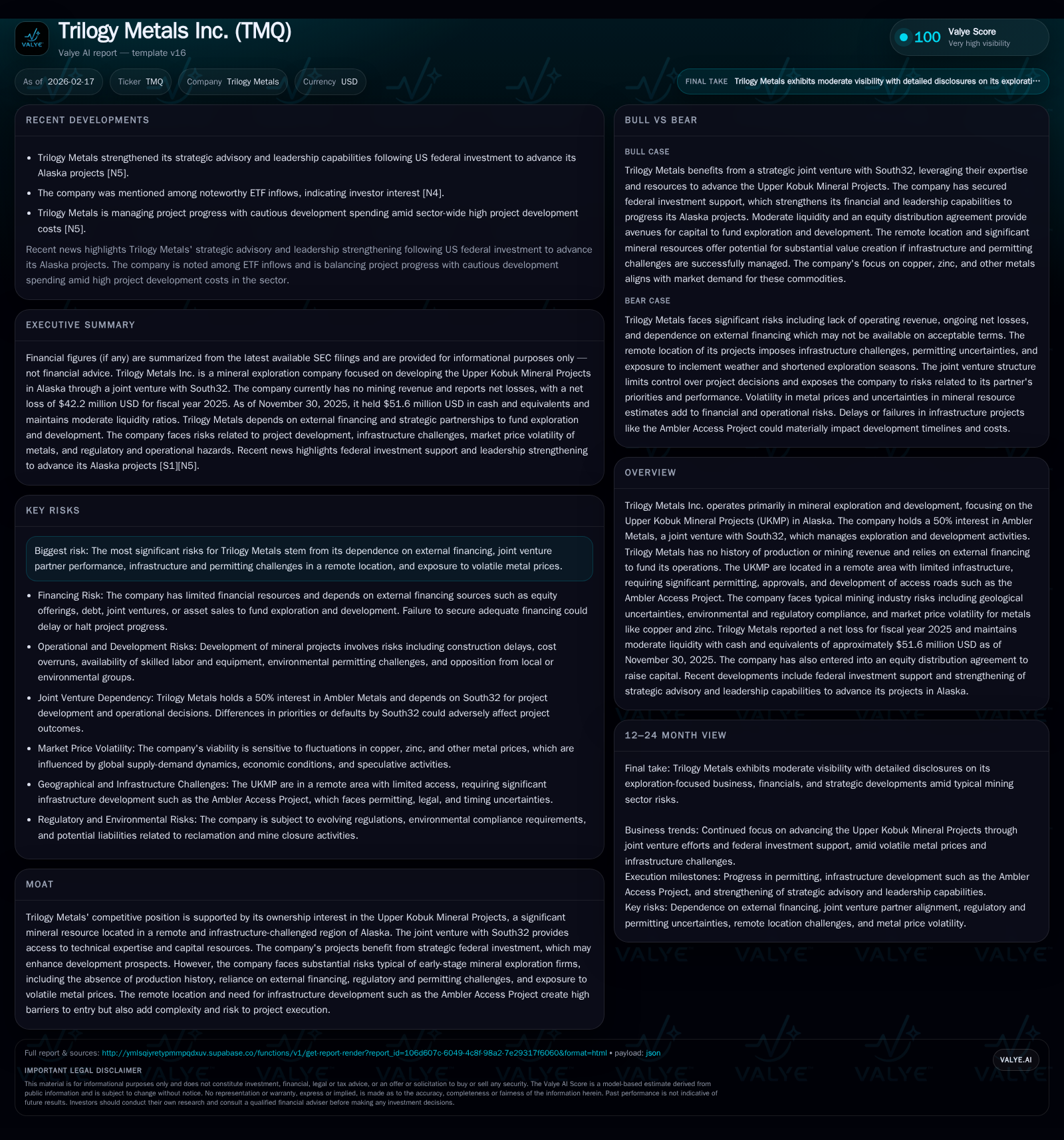
Trilogy Metals Inc. remains an exploration and development-stage company centered on the Upper Kobuk Mineral Projects (UKMP) in Alaska, operated through its 50%-owned joint venture Ambler Metals with South32. The company’s progress hinges on permitting, infrastructure development such as the Ambler Access Project, and volatile metal price environments. Recent U.S. federal investments have bolstered leadership and advisory capabilities, signaling increased government interest and support. However, significant operational risks persist due to the remote location, dependencies on joint venture partner decisions, complex permitting processes, and Trilogy’s lack of mining revenues to date.
Company Overview
Trilogy Metals Inc. operates as a mineral exploration and development entity primarily focused on the Upper Kobuk Mineral Projects (UKMP) located in northwestern Alaska. Its principal asset is an effective 50% interest in the Ambler Metals joint venture formed with South32, which oversees exploration and advancement activities within these projects [S1][S7]. Trilogy does not yet generate any operating revenues from mining since no production operations have commenced.
The UKMP are notable for their rich deposits of copper and zinc—metals critical to various industrial applications—but these assets are situated in a geographically isolated setting lacking established infrastructure such as roads, power supply, or processing facilities [S1][S20]. Due to this remoteness, substantial capital deployment will be required not only for mine development but also for enabling access via the proposed Ambler Access Project road.
Partnership Structure and Strategic Capital Injection
South32’s involvement since exercising its option in late 2019 has brought significant technical expertise and partial financial backing but also introduces dependencies related to partner alignment on project timelines and capital allocation [S26]. Despite shared ownership under Ambler Metals, Trilogy relies heavily on cooperative governance decisions for advancing the UKMP.
A key development in late 2025 was the U.S. Federal Government's strategic investment into Trilogy through the Department of Defense's Office of Strategic Capital (OSC). This capital infusion—approximately $17.8 million—came alongside stock issuance at a discount price along with long-dated warrants exercisable post-construction of the Ambler Road [N1][S10][S17][S18]. Beyond funding support, this federal backing advances national security interests by strengthening domestic critical mineral supplies.
The presence of a large government shareholder injects both opportunity and governance complexity, including potential dilution effects for existing shareholders alongside enhanced scrutiny from regulatory bodies [S10][S18]. The deal ultimately aims to facilitate permitting, financing frameworks for infrastructure construction, and bolster exploratory work under joint oversight arrangements.
Industry Context: Critical Minerals and Base Metals Landscape
Copper and zinc markets exhibit pronounced cyclicality tied to global economic conditions—manufacturing demand shifts directly influencing prices. Exploration-stage companies like Trilogy confront inherent volatility as metal price swings affect project valuations and capital market appetite [S25][S28]. With recent inflationary pressures driving up construction costs worldwide—including skilled labor shortages—developing new mines faces amplified cost risks [S14].
In addition to commodity price risk, jurisdictional complexities arise from stringent environmental regulations designed to address emissions control, land reclamation obligations, toxic substances management, and local stakeholder engagement requirements that have tightened over recent years [S19][S25]. These factors translate into extended permitting processes that substantially influence project timelines.
Permitting Challenges in Alaska’s Regulatory Environment
Upper Kobuk projects are subject to multilayered regulatory scrutiny spanning federal bodies (including BLM, EPA), Alaskan state agencies, tribal corporations such as NANA Regional Corporation with surface rights agreements, plus community input mechanisms [S20][S25]. The need for a federally led Environmental Impact Statement (EIS) adds procedural complexity dilated by limited federal agency staffing shortages causing bottlenecks.
Public perception challenges related to mining environmental stewardship often invite NGO opposition that can delay approvals or instigate litigation risks further complicating timelines [S8][S25]. Any failure or delay in obtaining required operational permits jeopardizes not just initial construction but ongoing compliance commitments critical to maintaining tenure rights [S19].
Financial Position and Operating Results
As of November 30, 2025 fiscal year-end, Trilogy reported total current assets of approximately $51.9 million against current liabilities near $33.1 million yielding a current ratio around 1.57—indicative of moderate liquidity suited for continuing exploration activities in the short term [F1]. However, no operating income exists yet; instead, net losses expanded to roughly $42.2 million reflecting heavy spending on drilling campaigns, environmental studies and administrative overhead [F1][N2].
The company explicitly states ongoing dependence on equity offerings or alternative financing means to fund near-term development phases including infrastructure deployment [S9][S14]. Financial discipline will be essential given dilution concerns stemming from share issuances linked to government funding deals.
Operational Risks Specific to Trilogy Metals
The remote site imposes significant logistical challenges: harsh weather conditions shorten field seasons; high transportation costs inflate capital budgets; limited availability of specialized equipment can cause project schedule slippages [S11][S20]. Moreover:
- Geological uncertainties impact resource estimates which remain probabilistic until more definitive drilling results solidify ore body models.
- Infrastructure gaps necessitate substantial upfront expenditures not only for mining facilities but also ancillary components like power generation plants and tailings disposal systems.
- Environmental liabilities—particularly those linked to tailings management—pose both cost escalation risks as well as potential reputational damage if failures occur.
- Talent acquisition in remote Alaska locations can limit workforce depth adding productivity constraints.
- Joint venture decision-making might be hindered by divergent strategic priorities between Trilogy and South32; any disagreements could slow momentum or disrupt milestones [S26].
- Metal price volatility could swiftly undermine economic assumptions underpinning feasibility studies potentially forcing scale reductions or deferrals.
- Compliance obligations include increasingly complex reporting controls under Sarbanes-Oxley that require substantial managerial focus away from operational execution [S8].
- Shareholder dilution remains a concern due to frequent reliance on issuing equity-linked instruments for capital needs amid absence of revenue generation [S10][F1].
Strategic Outlook: Infrastructure Catalysts and Federal Alignment
Federal government interest distinguishes Trilogy from many junior exploration companies given linkage between critical minerals strategy and national defense imperatives articulated by recent U.S. policy frameworks [N1]. This could expedite permitting via interagency coordination improvements while alleviating some financing pressures through public-private partnerships.
The successful construction of the Ambler Access Project road will serve as an operational game-changer enabling year-round material logistics reducing operational risk premia assigned by partners and financiers alike. Completion timelines remain uncertain pending multi-stakeholder alignment but are pivotal for unlocking large-scale commercial mine development prospects within the UKMP portfolio.
Continued expansion of technical teams alongside bolstered advisory boards signals commitment towards evolving Trilogy’s organizational capabilities commensurate with scaling project scope beyond exploration towards pre-feasibility engineering phases [N1].
Industry Analysis: Complexity of Arctic Mining Ventures
Mining ventures in Arctic terrains like northern Alaska require bespoke strategies given permafrost constraints affecting excavation stability; energy-intensive operations reliant on diesel fuel imports inflate operating costs; seasonally constrained ice roads limit bulk material transport window creating inventory management challenges downstream.
Innovations such as modular plant designs or hybrid power solutions incorporating renewables may improve long-term sustainability metrics post-development but require higher upfront capex currently difficult to justify absent proven ore output certainty —a classic exploration-stage dilemma intensified by environmental sensitivity considerations unique to fragile Arctic ecosystems.
Conclusion
Trilogy Metals represents a high-risk/high-reward entity advancing one of North America’s strategically important mineral resource hubs focused on copper-zinc deposits through collaborative ventures backed by both private capital partners like South32 and emergent U.S. federal investment aligned with critical mineral supply chain security objectives.
While bolstered by governmental support programs enhancing financial resources and advisory expertise—critical enablers at this stage—the company contends with inherent operational complexity characterized by remote location logistics, lengthy permit cycles exacerbated by multi-agency overlapping jurisdictional regimes, volatile commodity pricing input assumptions challenging project economics, intense capital demands without current operating cash flow generation capacity generating shareholder dilution risk exposure through continued external financing needs.
Looking forward hinges heavily on concerted progress on the Ambler Road permitting/construction plus alignment between joint venture stakeholders. Environmental stewardship practices will remain under stringent scrutiny constraining timeline optimism despite rising strategic importance of domestic/infrastructure-deployed base metals extraction contributing meaningfully to prospective production pipelines vital for future industrial decarbonization goals worldwide.
This analysis is based solely on publicly available information as of February 2026 including SEC filings and market disclosures; it does not constitute investment advice or recommendations.
Disclaimer: This is research-only, informational analysis and not investment advice. It may include AI-generated interpretation and general industry context. Always verify important details using primary sources.

Comments