
Honeywell International Inc: Balancing Legacy Operations with Quantum Innovation
Honeywell navigates the dual demands of maintaining industrial strongholds while advancing quantum and AI technologies amid strategic portfolio shifts.
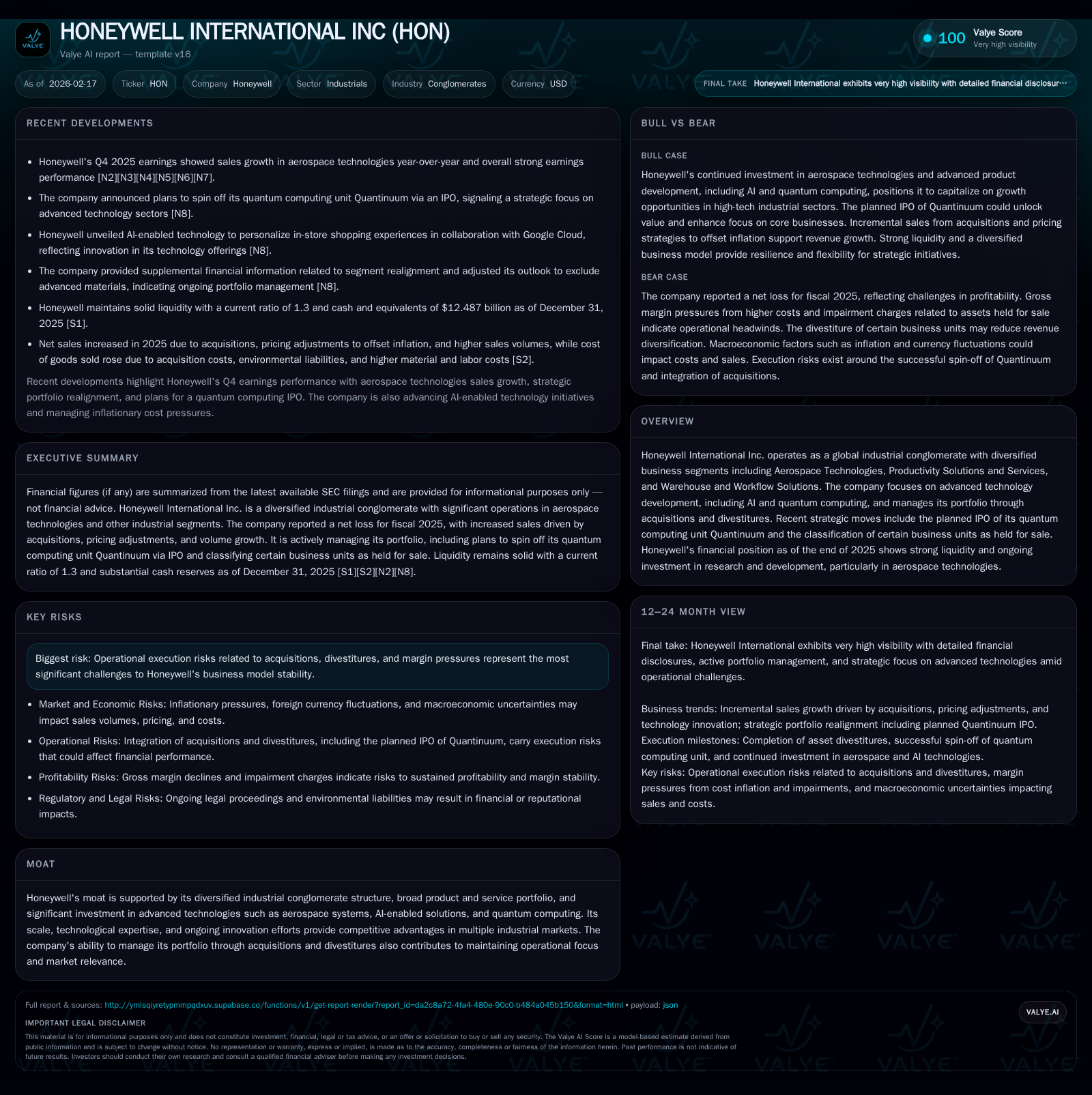
Honeywell International remains a diversified industrial conglomerate led by its Aerospace Technologies segment and bolstered by investments in emerging technologies like quantum computing and AI. Its near-term financials reveal robust liquidity and revenue growth in aerospace despite a net loss influenced by impairment charges related to held-for-sale business units. Strategic initiatives include an IPO plan for its Quantinuum quantum computing unit and the divestiture of Productivity Solutions and Warehouse Workflow segments, reflecting a sharpening focus on high-growth tech and aerospace niches. Operational execution risks and margin pressures from this complex transformation underscore the importance of disciplined portfolio management and sustained R&D investment.
Overview of Honeywell’s Industrial Conglomerate Framework
Honeywell International Inc. is structured as a classic diversified industrial conglomerate anchored by three main segments: Aerospace Technologies; Productivity Solutions and Services (PSS); and Warehouse and Workflow Solutions (WWS) [S1][S8]. The Aerospace segment extensively serves the commercial aviation and defense markets with advanced systems and components, representing the company's core revenue driver. PSS encompasses automation solutions aimed at enhancing productivity in various industrial settings, while WWS supplies software-driven logistics technology for warehouse operations.
This broad exposure allows Honeywell to leverage scale effects across sectors but also requires careful resource allocation to avoid operational complexity inherent to conglomerates.
Financial Snapshot: Strengths and Challenges in Late 2025
As of December 31, 2025, Honeywell reported solid financial metrics that illustrate both strength and transformation-related challenges [F1][S3]. Revenue remained robust at approximately $9.4 billion for the latest reported period. The company held $12.5 billion in cash and cash equivalents against current liabilities of $23.4 billion, yielding a current ratio around 1.3 — a comfortable liquidity buffer that supports ongoing investments.
However, Honeywell posted a net loss of $115 million for the year largely due to significant impairment charges related to its decision to classify PSS and WWS businesses as held for sale during Q4 2025 [S3][S14]. These impairments offset operating income gains primarily driven by Aerospace Technologies' strength.
Thus, while top-line growth persists—fueled by aerospace demand—the bottom line reflects the costs of portfolio reshaping.
Aerospace Technologies Segment: Revenue Drivers and Market Position
Honeywell's Aerospace Technologies segment reported year-over-year sales growth in Q4 2025 [N1][N5], reinforcing its role as a stable revenue engine. This unit benefits from Honeywell's deep technical expertise developing critical avionics systems, engines controls, sensors, and integrated defense solutions [S8].
The segment’s performance reflects favorable commercial aviation market trends as fleet utilization recovers post-pandemic combined with sustained defense spending. Honeywell’s ability to innovate within aerospace systems—leveraging advances in materials science and embedded AI—maintains its competitive positioning amidst industry peers.
Quantum Computing IPO Plans and AI-Enabled Technology Rollout
Signaling strategic transformation toward frontier technologies, Honeywell announced plans to spin off its Quantinuum quantum computing unit via an IPO planned for 2026 [N11]. This move crystallizes Honeywell’s ambition to capitalize on quantum technology commercialization while allowing clearer valuation separation between legacy industrial operations and high-tech ventures.
Complementing this are AI-enabled solutions such as the recent partnership with Google Cloud to personalize in-store shopping experiences leveraging Honeywell's automation expertise [N12]. These digital initiatives enhance product offerings within existing customers’ ecosystems without cannibalizing traditional industrial segments.
Such dual-track innovation reinforces Honeywell's transition strategy—augmenting legacy strengths with disruptive capabilities rather than replacing core businesses outright.
Portfolio Management: Strategic Acquisitions, Divestitures, and Held-for-Sale Units
Honeywell actively manages its conglomerate portfolio through acquisitions targeting high-growth tech areas alongside divestitures aimed at trimming non-core operations [S1][N11]. The decision to classify PSS and WWS as held-for-sale assets—reflected by associated impairment write-downs—illustrates intent to streamline focus on aerospace technology leadership and next-gen fields like AI/quantum computing [S14].
This active reshaping reduces operational complexity especially by concentrating capital deployment on market segments promising higher returns on investment. However, the process entails careful balancing act: retaining sufficient scale for economies while improving agility under competitive pressures.
Risks to Operational Execution and Margin Pressures
Operational execution risk is particularly salient given the breadth of ongoing corporate restructuring encompassing complex acquisitions/divestitures alongside launching an IPO for Quantinuum [S4][S5][N3]. Integration challenges could lead to disruptions or delayed synergies impacting earnings stability.
Margin pressures also emerge from inflationary input cost environments coupled with competitive pricing dynamics across sectors. Such factors necessitate rigorous cost control alongside innovation-driven premium product offerings to maintain profitability margins.
Monitoring how well Honeywell navigates these execution hurdles will be crucial in assessing medium-term operational resilience.
Liquidity, Capital Structure, and Investment in R&D
As of fiscal year-end 2025 financial disclosures indicate that Honeywell enjoys substantial liquidity headroom—$12.5 billion in cash equivalents paired with manageable short-term liabilities supporting financial flexibility [F1][S7][S10]. The company’s capital structure includes senior notes maturing staggered through 2036 but ample free cash flow underpins debt servicing capacity.
Capital expenditures remain steady targeting manufacturing capacity upkeep while R&D expenses continue on an elevated trajectory reflecting priorities toward advanced aerospace systems plus foundational investments into AI algorithms and quantum hardware/software development [S6][S9].
This capital discipline balances preserving legacy asset productivity with funding technology platforms that underpin future growth vectors.
Competitive Moat Anchored by Scale, Diversity, and Tech Leadership
Honeywell's enduring competitive moat stems from its conglomerate diversification which hedges cyclicality within various end markets plus access to broad-scale R&D resources enabling technological leadership [valye_report_excerpt.moat][S8]. Its aerospace systems benefit from decades-long domain expertise creating high switching costs among large aircraft producers.
Simultaneously, investments into artificial intelligence applications integrated into workflow automation or quantum computing hardware mark differentiation adaptive enough for long-term industry relevance.
This blend positions Honeywell uniquely amidst peers strictly confined to either heavy industrial manufacturing or pure technology development.
Outlook: Maintaining Relevance Amid Technological Transformation
Looking forward, Honeywell faces the challenge of sustaining momentum balancing mature industrial demands with the breakthroughs required for dominance within emerging technology sectors [N6][N13][valye_report_excerpt.overview].
Success hinges on execution precision amid divesting non-core businesses while scaling next-generation enterprise value creators like Quantinuum post-IPO. If managed prudently with ongoing innovation executed effectively alongside disciplined capital allocation—including maintaining healthy liquidity cushions—Honeywell could navigate cyclical headwinds while capturing premium growing market opportunities.
Selective optimism is warranted given the tentative signs of operational stabilization paired with technological advances embedded within aerospace upgrades plus burgeoning AI/quantum ecosystems.
Disclaimer: This report is intended solely for informational purposes grounded on latest available filings and news reports up to February 17, 2026. It does not constitute investment advice or recommendations regarding securities transactions involving Honeywell International Inc.
Disclaimer: This is research-only, informational analysis and not investment advice. It may include AI-generated interpretation and general industry context. Always verify important details using primary sources.

Comments