
Verde Resources’ Reliance on Ergon License Shapes Its Path in Sustainable Road Construction
Verde Resources leverages proprietary carbon-sequestering asphalt technology with critical dependence on a single licensing partner for commercial expansion.
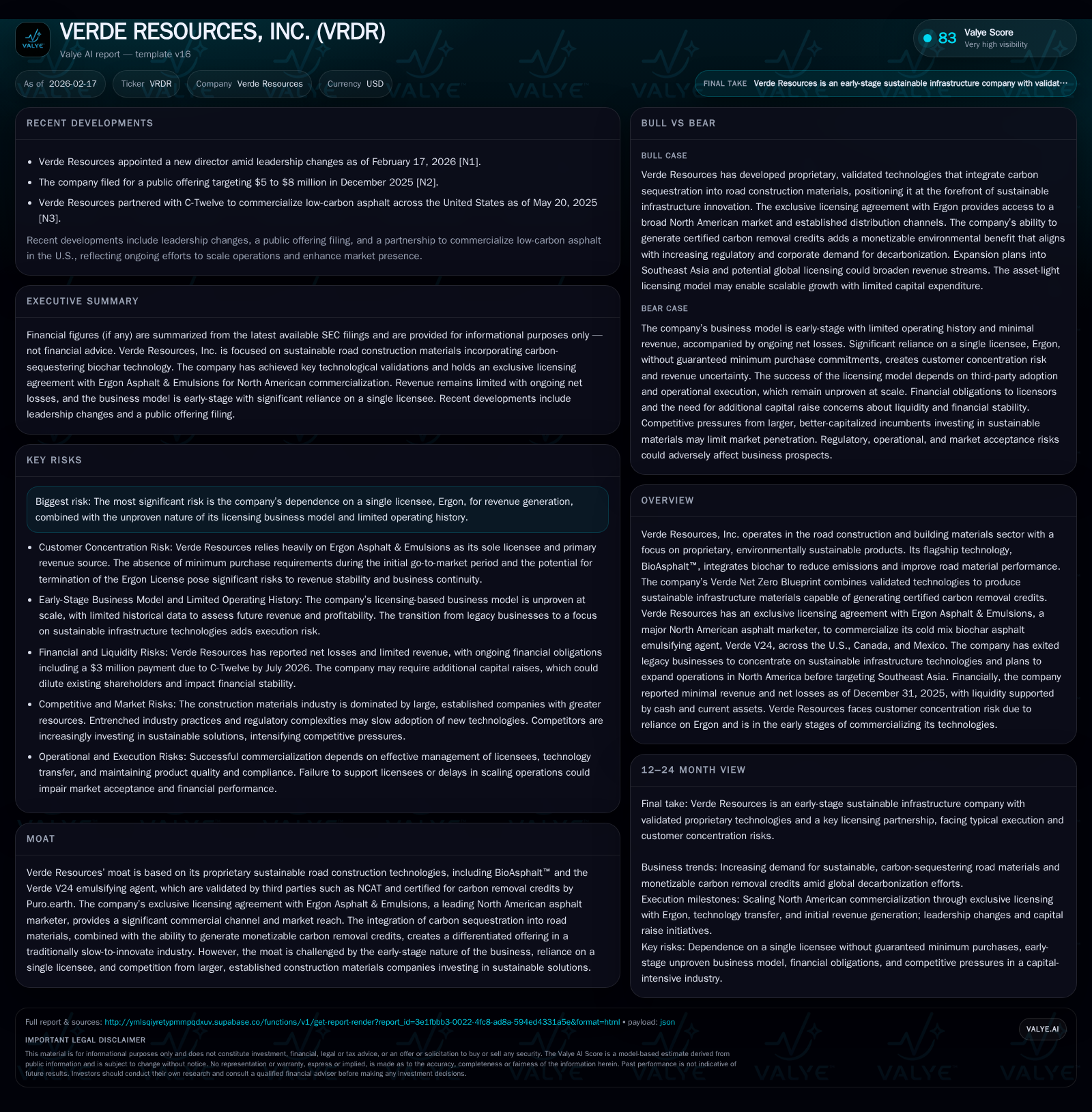
Verde Resources, Inc. is an innovative company focused on integrating biochar into asphalt to create sustainable road materials while generating carbon removal credits. The company operates under a licensing model, with an exclusive agreement with Ergon Asphalt & Emulsions enabling commercialization throughout North America. Despite significant third-party validations and a pioneering net-zero blueprint, Verde faces substantial risks including its dependency on Ergon’s performance, unproven revenue streams, and challenges in scaling its technology within a traditionally slow-moving construction sector. Financially, the company is early-stage and loss-making but aims to capitalize on growing demand for decarbonized infrastructure materials in North America and Southeast Asia.
Company Overview
Verde Resources, Inc. operates within the road construction sector focusing on proprietary, environmentally sustainable building materials. Its flagship product, BioAsphalt™, integrates biochar—a stable form of carbon derived from organic waste—into cold mix asphalt formulations designed to reduce greenhouse gas emissions, improve durability especially on low-volume roads, and lower lifecycle costs compared to traditional hot mix asphalt. Complementing this is Verde V24, a proprietary emulsifying agent critical for bonding biochar with aggregates in asphalt mixes.
The company’s mission centers around enabling a "Transition to Zero" by embedding carbon sequestration directly into infrastructure materials while generating certified carbon removal credits. This dual value proposition—combining performance improvement with measurable climate impact—is embodied in its Verde Net Zero Blueprint.
Key validations of Verde's technologies include technological validation by the National Center for Asphalt Technology (NCAT), which demonstrated superior performance metrics like tensile strength ratio and moisture resistance in recycled cold mix applications using 100% reclaimed asphalt pavement (RAP). Moreover, the issuance of the world's first carbon removal credit from asphalt production certified by Puro.earth confirms the company's pioneering role in engineered carbon removal.
Licensing Model & Strategic Partnership
Verde Resources operates primarily through a licensing model that entrusts production, distribution, and installation of its technologies to third-party partners rather than direct manufacture or sales. The most critical relationship is the exclusive licensing agreement signed with Ergon Asphalt & Emulsions—a leading North American producer with over 4,000 employees serving clients across more than 90 countries.
Under this agreement executed in October 2025, Ergon holds exclusive rights to use, manufacture, market, sell, and distribute products containing Verde V24 throughout the United States, Canada, and Mexico. This arrangement aligns Verde’s technology integration with Ergon's extensive existing infrastructure such as asphalt mixing plants that meet Department of Transportation specifications.
However, this reliance incurs material risk: there are currently no mandatory minimum purchase commitments forcing Ergon to buy Verde V24 volumes until at least 2027. Thus, revenue generation is contingent upon successful adoption by Ergon within its customer base of public agencies (state DOTs, municipalities) and private contractors who must be convinced of economic and environmental benefits.
Financial Profile
As of the fiscal year ending June 30, 2025 (latest reported data ending December 31 in Q1 2026 filings), revenues totaled approximately $4.68 million USD while net income remained negative near $931 thousand USD [F1]. The company retains cash and equivalents of about $2 million USD against current liabilities around $1.18 million USD for a strong current ratio of roughly 2.96 [F1]. This liquidity profile supports ongoing investments but underscores operating losses since inception.
Historically burdened by legacy businesses unrelated to sustainable infrastructure technology until recent divestitures, Verde aggressively refocused starting in 2023 towards BioAsphalt™ deployment via licensing fees, product sales (designer biochar blend & Verde V24), royalty streams from carbon credit monetization, and support services.
Capital expenditures remain modest owing to the asset-light business model; major expenses now concern R&D efforts aimed at optimizing product formulations alongside investments in IT platforms designed to manage complex customization requirements tailored to licensee operations [S11].
Market Opportunity & Industry Context
The global road construction materials industry historically emphasizes durability under strict governmental standards but struggles with decarbonizing greenhouse gas emissions associated with hot mix asphalt production—typically requiring temperatures above 300°C. BioAsphalt's cold mix technology circumvents these energy-intensive processes.
At the same time, governments increasingly mandate sustainability criteria for infrastructure projects alongside incentives for verified carbon offsets under emerging climate policy regimes. Verde’s ability to combine verified carbon credit generation with improved road material performance is unique within the still nascent market segment of engineered carbon removal embedded in infrastructure.
Furthermore, as digital measurement-reporting-verification (dMRV) becomes standard for environmental compliance monitoring in construction materials supply chains—as highlighted by organizations like Puro.earth—companies offering verifiable integrated solutions hold competitive advantage.
Technological Differentiation & Competitive Positioning
Green infrastructure materials remain fragmented among traditional producers pivoting incrementally toward greener additives or alternative formulation adjustments without fundamentally changing licensable technology platforms.
Verde’s patented biochar-emulsifier combination represents a first-mover advantage supported both by scientific validation (NCAT) and marketplace acceptance evidenced by early credit purchases from financial institutions partnered through Puro.earth frameworks [S24][S25]. Unlike other solutions focused solely on measurement or offset trading platforms without physical product innovation, Verde embeds physical carbon sequestration directly into asphalt products.
This approach also creates new revenue channels beyond materials supply: sales of licensed emulsifier agents plus recurring monetization through carbon credit royalties provide a multi-layered economics potentially attractive for scaling once regulatory requirements tighten globally.
Geographic Expansion Plans
North America remains the initial focus given market size, regulatory environment conducive to sustainability adoption in public works projects, existing relationships through Ergon’s distribution footprint spanning highways to municipal paving.
Beyond that region lies Southeast Asia where Verde already operates via its subsidiary Verde Resources (Malaysia) Sdn Bhd localized around the BioFraction facility in Borneo capable of producing up to 6,000 tons annually of designer-grade biochar tailored specifically for their applications [S22][S26].
Further licensing targets include palm-oil waste processors able to integrate specialized biochar production downstream while generating additional certified carbon credits—creating a tightly integrated supply chain minimizing capital intensity yet optimizing local resource utilization.
Risks & Challenges
Despite its promising profile and technology-first approach promoting sustainability transitions across a major industrial sector often characterized as slow-to-change:
- Single licensee dependence: The exclusive reliance on Ergon places Verde at significant revenue concentration risk. Failure or reduction in Ergon orders could materially impact cash flow.
- Unproven licensing scale: The business model itself remains early-stage without historical data proving reliable recurring income streams from multiple licensees or geographies [S1][S6][S9].
- Financial losses: The company has a history of losses totaling over $18 million accumulated deficit restricting operational flexibility or quick-scale R&D funding [F1][S11].
- Intellectual property exposure: Patent protection uncertainty exists given potential infringement claims or competitors circumventing proprietary technology—requiring ongoing legal vigilance [S16][S19].
- Regulatory & compliance risk: As products incorporate hazardous substances like certain biochars or emulsifiers—the failure to maintain regulatory approvals or environmental compliance could trigger liabilities or market withdrawal risks [S10][S14].
- Management key-person risk: Dependency on executive leadership with founder ties could expose operational stability risks if key personnel depart unexpectedly—and could jeopardize license agreements [S19][S20].
- Market adoption challenges: Convincing conservative infrastructure buyers accustomed to legacy materials requires evident performance gains coupled with cost-effectiveness; premature scaling without broad adoption risks excess inventory or reputational damage.
- Technological implementation complexity: Rolling out complex IT system customizations supporting quality control across diverse licensee sites poses potential cost overruns or delays impacting operational scale-up [S7][S11].
Management & Corporate Developments
Recent board changes announced February 2026 potentially signal strategic repositioning aiming at bolstering governance during critical commercialization phases [N1]. Additionally, corporate restructuring steps have included exiting non-core CBD businesses ending mid-2024 favoring full concentration on sustainable infrastructure technologies [S21][S27].
Leadership under CEO Jack Wong remains pivotal due to his deep network within climate-tech sectors but succession planning is essential given license agreements link licenses viability closely tied to executive positions [S19][S20].
Outlook
Verde Resources stands at an inflection point balancing innovative sustainable road material technologies validated scientifically yet constrained by commercial execution uncertainties inherent in early-stage licensing models reliant on singular industrial partners. If successfully leveraged across widespread infrastructure projects alongside continued regulatory emphasis on Scope 1/2/3 emission reductions—especially within public works paving funded by government stimulus incorporating net-zero mandates—the company's scalable blueprint affords meaningful long-term growth prospects.
However, close attention must be paid to developing multiple licensees globally post-North American foothold expansion; crystallizing minimum purchase commitments from Ergon; safeguarding intellectual property reserves; expanding operational support capabilities; navigating evolving construction regulations; diversifying revenue sources beyond sole licensing partner concentration; managing market education efforts; continuing R&D enhancements; sustaining capital access amid losses; and ensuring retention of founding leadership through transitional growth stages.
In essence, Verde’s pathway reflects both an emergent trajectory emblematic of sustainability-driven innovators transforming heavy civil sectors interlaced with pragmatic corporate governance needs to de-risk concentrated partnerships during initial commercialization pushouts across geographies with distinct regulatory frameworks.
Disclaimer: This report is prepared solely for informational purposes based on publicly available sources as of February 2026. It does not constitute investment advice or recommendations regarding securities transactions.
Disclaimer: This is research-only, informational analysis and not investment advice. It may include AI-generated interpretation and general industry context. Always verify important details using primary sources.

Comments