
urban-gro’s Exit from Design-Build Reshapes Its Role in Controlled Environment Agriculture Equipment Supply
Urban-gro transitions to a value-added reseller amid financial losses and competitive pressures in the CEA market.
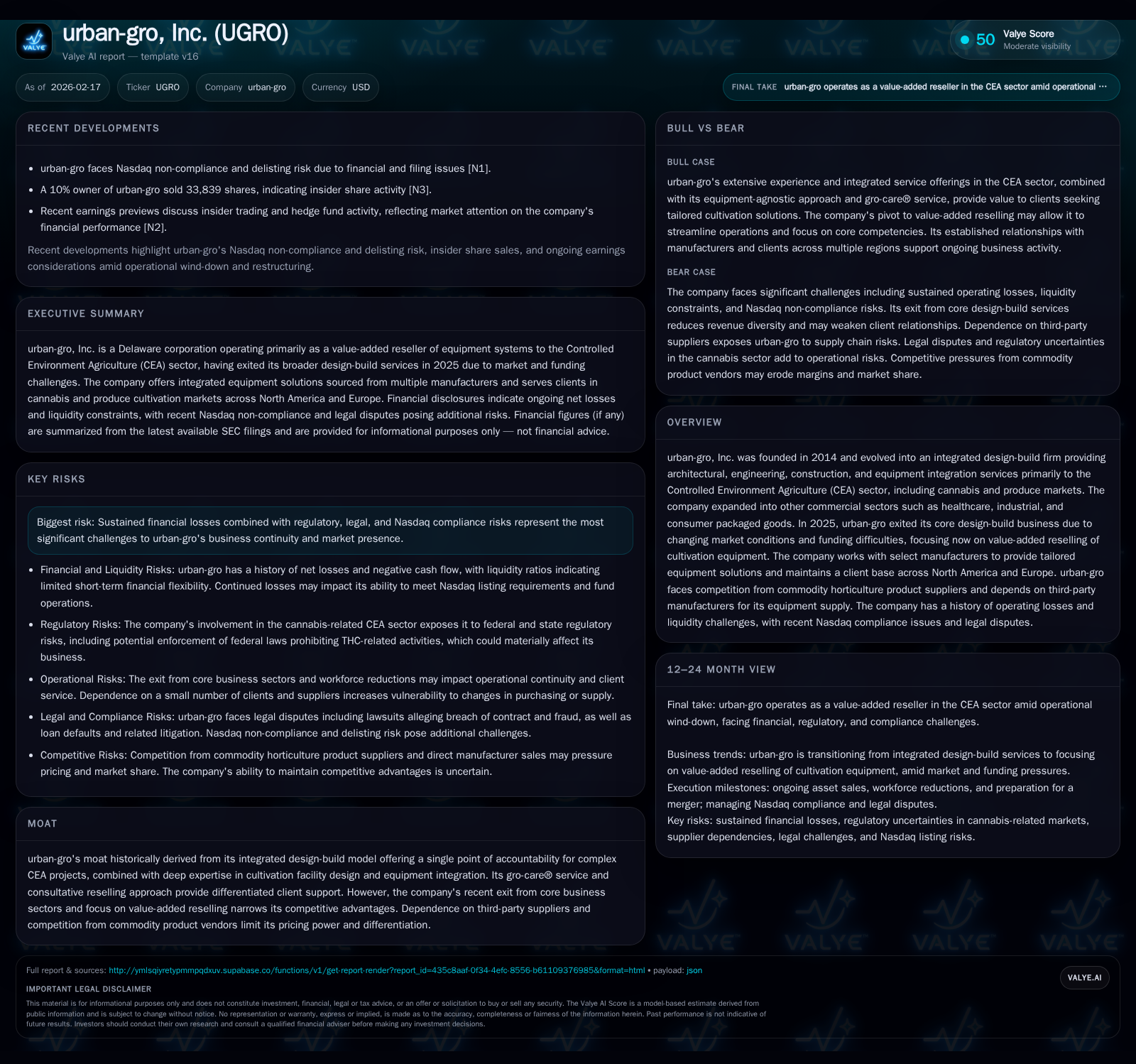
urban-gro, Inc., once an integrated design-build leader in Controlled Environment Agriculture (CEA) facilities, has exited its core architectural and construction business due to changing market dynamics and funding difficulties. The company now focuses solely on value-added reselling of cultivation equipment sourced from third-party manufacturers, serving North American and European clients. Persistent financial losses, regulatory complexities, concentration risks, and increased competition threaten urban-gro’s ability to regain stability. Its reliance on external suppliers and diminished differentiation constrains margins and operational leverage, requiring close monitoring of its evolving strategic position.
Company Evolution and Strategic Shift
urban-gro, Inc. was established in 2014 as a Colorado-based limited liability company before converting to a corporation in 2017 and subsequently uplisting to Nasdaq in early 2021 under ticker UGRO [S1; S9]. Initially focused on providing integrated design-build solutions for Controlled Environment Agriculture (CEA), emphasizing cannabis cultivation facilities, urban-gro expanded services organically and via acquisitions to include architecture, engineering, construction management, and equipment integration across North America and Europe [S9; S12]. This holistic service model offered clients a unique single point of accountability for complex indoor cultivation builds.
However, challenging market conditions coupled with tightening capital markets impaired urban-gro’s ability to fund operations while maintaining compliance with Nasdaq's timely filing rules [N1; S21]. In Q3 2025, the company strategically exited its core design-build business segments, divesting assets and reducing workforce headcount in preparation for a potential merger or restructuring [S18]. The current operating model centers exclusively on value-added reselling (VAR) of cultivation equipment systems sourced from multiple third-party manufacturers [S18]. Urban-gro positions itself as vendor-agnostic, leveraging technical expertise developed over years of integration work to tailor equipment packages such as lighting, automated benching systems, fertigation irrigation, environmental control units, odor mitigation technologies, and specialty fans customized for growers’ specific operational needs [S18; S28].
Market Position and Competitive Dynamics
Historically, urban-gro's moat derived from managing end-to-end projects—including design engineering through construction management—in heavily regulated indoor horticulture environments . This integration mitigated costly errors during build-outs while accelerating time-to-market for cultivators. Today’s pivot toward equipment reselling significantly reduces that differentiation. The company faces direct competition from commodity horticulture product suppliers including wholesalers, online retailers, and manufacturers selling directly to growers [S5; S18].
Market participants often operate with thin margins tied to "off-the-shelf" lighting fixtures or irrigation components. Urban-gro’s competitive advantage now largely rests on consultative selling — applying accumulated domain expertise to recommend appropriate system combinations that optimize plant health outcomes yet meet client budget constraints.
However, this business is highly reliant on uninterrupted third-party manufacturing supply chains. Supplier defaults or acquisition by competitors could jeopardize access or pricing terms [S10]. Unlike vertically integrated providers with proprietary equipment platforms or patents—urban-gro holds limited IP primarily around certain sensor technologies that contribute marginally to revenue—the firm lacks strong barriers against encroachment or downward price pressure [S24].
Financial Performance and Operational Risks
urban-gro’s financial trajectory illustrates deepening challenges. Revenue declined sharply following the exit of design-build services—from $69.9 million in 2023 down to roughly $2.4 million reported for Q3 2025 [S1; F1]. Correspondingly, net losses widened with a $4.8 million loss over nine months ending September 2025 [F1], continuing a multi-year pattern of unprofitable operations stretching back several fiscal periods where net losses exceeded $15 million annually [S1].
Operating cash flows remain negative (e.g., -$2.8 million in 2024), forcing the firm into repeated rounds of financing through secured term loans from Agile Capital Funding ($1.05 million loan) [S15; S22] and asset based credit lines through subsidiaries like UG Construction with Gemini Finance Corp., which defaulted resulting in forced asset sales in late 2025 [S6; S23]. Legal proceedings involving payment disputes with contractors such as Grow Hill LLC (breach of contract + fraud claims), RK Mechanical (default judgments), MJ’s Market over intellectual property issues, among others exacerbate cost burdens and management distraction [S8; S14; S20].
Additionally, urban-gro contends with client concentration risks—relying heavily on a small number of commercial cultivators whose license retention or renewal pose demand uncertainty amid federal-state regulatory incongruities governing cannabis [S10; S25]. Technology vulnerabilities stemming from cyber security threats also pose operational risks affecting internal controls or product delivery continuity [S11].
Industry Context: Controlled Environment Agriculture’s Bull-But-Challenging Tale
The CEA sector is expanding globally due to increasing demand for year-round controlled cultivation of cannabis as well as produce crops such as leafy greens and herbs grown indoors or vertically . This growth stimulates demand for turnkey facility solutions encompassing advanced HVAC systems that finely tune temperature/humidity parameters critical to crop yields without exacerbating energy consumption inefficiencies—a key driver of operating expense within CEA facilities.
Industry players face relentless pressure from commoditization—equipment like LED grow lights or irrigation controllers are broadly available at tightening price points while customers seek scale efficiencies amid regulatory scrutiny requiring robust operational reporting capabilities . Equity funding for expansive design-build projects in the sector has become scarce post-legalization hype cycles waning especially as federal cannabis illegality persists in the U.S., limiting institutional investor appetite.
Conclusion: Strategic Pivot Tightens Horizons Amid Financial Vulnerabilities
urban-gro’s contraction away from its hallmark integrated solutions model leaves it navigating squeezed margins in an increasingly crowded VAR landscape where technical expertise offers some insulation against pure price competition but cannot replace control over supply or differentiated project delivery prowess.
The confluence of ongoing net losses despite cost controls; significant legal entanglements; dependency on third-party manufacturers; risk exposure related to client licensing status; compounded by Nasdaq non-compliance puts pressure on both balance sheet flexibility and shareholder confidence. Future viability will hinge on successful restructuring efforts including possible mergers or capital raises capable of stabilizing financial footing while monetizing its long-held domain knowledge within the CEA ecosystem.
Disclaimer: This analysis is based on publicly available information as of February 2026 including SEC filings, news reports, and industry context. It is intended solely for informational purposes without constituting investment advice or recommendations.
Disclaimer: This is research-only, informational analysis and not investment advice. It may include AI-generated interpretation and general industry context. Always verify important details using primary sources.

Comments