
CONMED’s Share Repurchase Strategy and Innovation Drive Orthopedic Surgery Growth
CONMED leverages its capital allocation and R&D focus to bolster its position in the global surgical devices market, notably within orthopedic surgery.
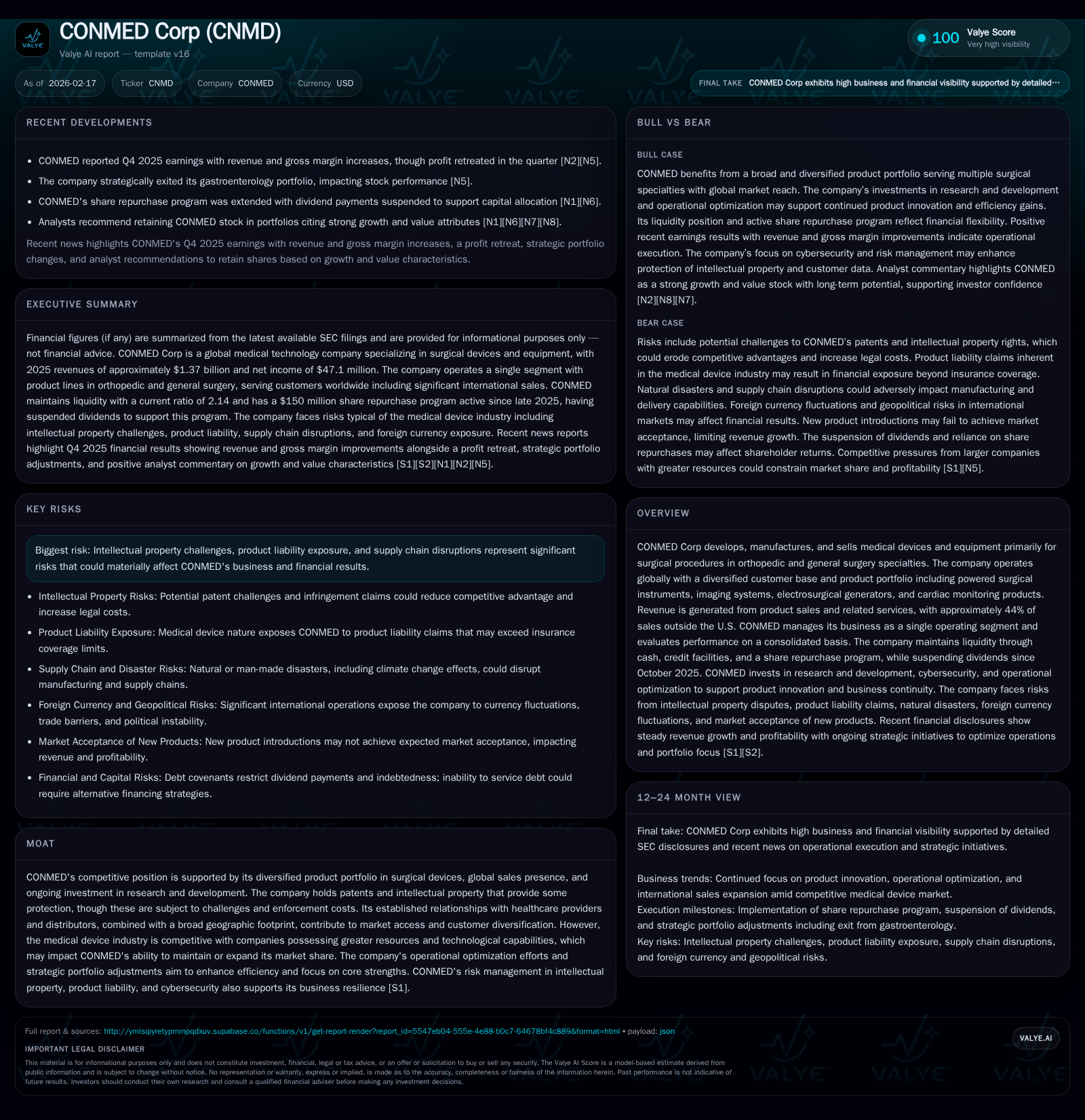
CONMED Corp reported a solid Q4 2025 with revenue surpassing $1.37 billion annually, driven by growth in orthopedic and general surgery devices. The company strategically manages its capital structure through limited term loan borrowings, an ample revolving credit facility, and a $150 million share repurchase program while suspending dividends to preserve liquidity amid a sizable convertible note maturity in 2027. Continued R&D investment supports innovation across powered instruments, imaging systems, and electrosurgical generators, sustaining competitiveness within a diversified global footprint where approximately 44% of sales derive from outside the U.S. Intellectual property challenges and supply chain risks remain material headwinds but are addressed through operational optimization and broad risk management.
Financial Performance Insights: Q4 Earnings and Margin Expansion
CONMED Corp posted annual revenues of approximately $1.375 billion for the fiscal year ended December 31, 2025 [F1]. This represented a modest but meaningful increase over prior years and surpassed consensus estimates, signaling resilient demand across both orthopedic and general surgery product lines [N1][N2]. Gross margins exhibited leverage from improved product mix—specifically growth in higher-margin powered surgical instruments—and operational efficiencies despite some profit pressures reflected in lower net income compared to prior periods [N5]. The reported net income of $47.1 million underscores ongoing margin compression challenges attributable to strategic investments and some one-time costs related to manufacturing optimization [S18]. However, gross margin increments point to favorable absorption of fixed costs amid rising sales volume.
In this context, operational execution retained competitive momentum by driving incremental revenue growth within its specialty endo-mechanical instrumentation category servicing minimally invasive procedures [S5]. Enhanced utilization across imaging systems also contributed, particularly within orthopedic applications where newer technology adoption is accelerating.
Capital Structure and Liquidity Management: Navigating Debt Covenants and Repurchases
Capital stewardship remains central to CONMED’s strategy as it manages its indebtedness profile anchored by an amended senior credit agreement collateralized by substantially all assets [S1][S4]. At year-end 2025, the company maintained only $40 million outstanding on a term loan facility alongside a fully available revolving credit line with capacity of $648.5 million (with minor letters of credit reservations) [S4][S6]. These facilities are governed by covenants restricting dividend payments—as evidenced by the October 2025 suspension of dividends—and impose minimum liquidity thresholds that become increasingly restrictive approaching the June 2027 maturity date of the sizable $800 million convertible notes issuance [S12][S15].
In response, CONMED implemented a modified $150 million share repurchase program authorized in late 2025 replacing a previously approved larger buyback plan under which it had already repurchased $162.6 million worth of stock prior [S1][S2]. Despite no repurchases taking place during the calendar year 2025—reflecting prudent liquidity hoarding during convertible note refinancing considerations—the company has committed to resuming buybacks at a minimum of $25 million annually starting in 2026 funded from operating cash flows or available borrowings under the revolving facility [S14][S15]. This balanced approach signals management confidence while conserving financial flexibility in an environment of constrained free cash flow due to elevated operational spend.
Research & Development Focus: Innovations Driving Product Competitiveness
Investments in research and development remain a strategic priority with spending stable near $56 million annually as documented in SEC disclosures [S27]. CONMED’s R&D efforts concentrate on advancing their portfolio of powered surgical instruments encompassing orthopedic sports medicine tools, next-generation imaging platforms optimized for minimally invasive procedures, electrosurgical generators enhancing precision coagulation, and cardiac monitoring products that support perioperative care.
Such focused R&D expenditure reveals operating leverage benefits derived from controlled capital outlays coupled with expanding utility across core franchises. The company’s patent portfolio provides a somewhat durable competitive moat albeit with recognized intellectual property enforcement risks given industry litigation tendencies [S1][S20]. The product development lifecycle emphasizes iterative enhancements aligned with practitioner feedback ensuring technology relevance amid intensifying competition from larger medtech peers endowed with greater scale.
Global Revenue Breakdown: Orthopedic vs. General Surgery Market Dynamics
With approximately 44% of sales generated outside the United States, CONMED maintains diversified geographic exposure across EMEA, Asia Pacific, Canada, Mexico, and other Americas regions [F1][S5][S18]. Sales distribution divides between orthopedic surgery ($575 million) primarily encompassing sports medicine instrumentation plus lower extremity implants and general surgery ($800 million) including laparoscopic gastrointestinal devices and smoke evacuation systems.
The U.S. remains the largest single market accounting for roughly $775 million of total sales predominantly weighted towards general surgery procedures reflecting established hospital system penetration [S5]. However, rapid expansion within Asia Pacific orthopedic segments—especially Japan, Korea, Australia—has contributed materially to growth trajectories with increasing adoption rates for minimally invasive technology driving sales momentum [S18]. Endo-mechanical instrumentation market penetration here is critical as these devices enhance operative outcomes while reducing patient recovery times.
Intellectual Property Challenges and Risk Mitigation Strategies
The protective strength of CONMED’s patent estate undergirds its ability to sustain pricing power though subject to constant risk from competitors seeking design-arounds or initiating infringement claims [S7][S8][S10][S11][S20]. Enforcement activities entail significant legal expense potentially limiting margin expansion over time.
Management acknowledges uncertainty regarding successful defense against future claims which can curtail offering certain products or necessitate costly settlements. The balance between investing in robust patent prosecution versus navigating litigation exposure exemplifies an inherent tradeoff especially given smaller scale relative to dominant medtech counterparts capable of more aggressive IP control [S1][S20]. Contingency reserves for product liability claims exist but insurance coverage cannot fully mitigate potential adverse outcomes given limits on deductibles and policy caps.
Supply Chain and Operational Continuity Amid Industry Pressures
Manufacturing continuity faces risks from natural disasters such as hurricanes or pandemics impacting supplier availability as well as volatility induced by geopolitical tensions altering logistics pathways [S1][S24]. CONMED pursues operational optimization initiatives encompassing supplier diversification strategies alongside targeted improvements in manufacturing processes comprising tooling standardization and lean inventory management aimed at minimizing disruption impacts [S23].
Insurance arrangements cover physical damage exposures alongside business interruption losses though inherent deductibles imply out-of-pocket risk remains significant if events persistently impair production capacity. Additionally, global currency fluctuations on foreign-denominated sales add complexity in achieving consistent profitability across regions dominated by local currencies such as Euro or Yen.
Strategic Portfolio Adjustments and Shareholder Value Initiatives
In further pursuit of operational efficiency gains, CONMED has implemented portfolio rationalization actions including discontinuation of select product lines deemed non-core following internal strategic reviews supported by consulting engagements [N3][S23]. These moves reduce overhead burdens and realign capital investments towards high-growth franchises mainly within orthopedics.
The augmented share repurchase authorization signals continued emphasis on shareholder value enhancement amidst suspended dividends—a measure taken to prioritize debt servicing ahead of convertible note maturity obligations scheduled mid-2027 [S1][S15]. This calibrated approach balances returning capital while managing liquidity prudently during an extended capital cycle demanding elevated R&D funding coupled with incremental capex increases anticipated through 2026.
CONMED Corp represents a mid-sized player effectively leveraging market diversification through global operations principally servicing orthopedic and general surgical specialties. Its financial management demonstrates disciplined balancing of existing debt obligations with ongoing investment needs anchored by a tight rein on liquidity facilitated via revolving credit availability.
Its innovation trajectory fortified by dedicated R&D spending supports sustained relevance amid an intensely competitive medical devices landscape characterized by rapid technological evolution alongside rigorous intellectual property battles. Nonetheless, material risks stemming from product liability exposures, IP litigation costs, supply chain vulnerabilities due to external shocks, plus pending sizable debt maturities require ongoing vigilance executing strategic priorities prudently.
This analysis integrates recent SEC disclosure updates together with contemporaneous earnings commentary capturing nuanced company dynamics beyond headline earnings beats into detailed capital management choices shaping CONMED’s pathway forward within the complex medical device ecosystem.
Disclaimer: This document is for informational purposes only and does not constitute investment advice or recommendations.
Disclaimer: This is research-only, informational analysis and not investment advice. It may include AI-generated interpretation and general industry context. Always verify important details using primary sources.

Comments