
Krystal Biotech’s HSV-1 Platform Enables Repeat-Dose Gene Therapy Amid Pricing and Expansion Challenges
Krystal Biotech leverages a unique HSV-1 gene therapy platform commercialized through VYJUVEK but faces meaningful reimbursement and pipeline diversification hurdles.
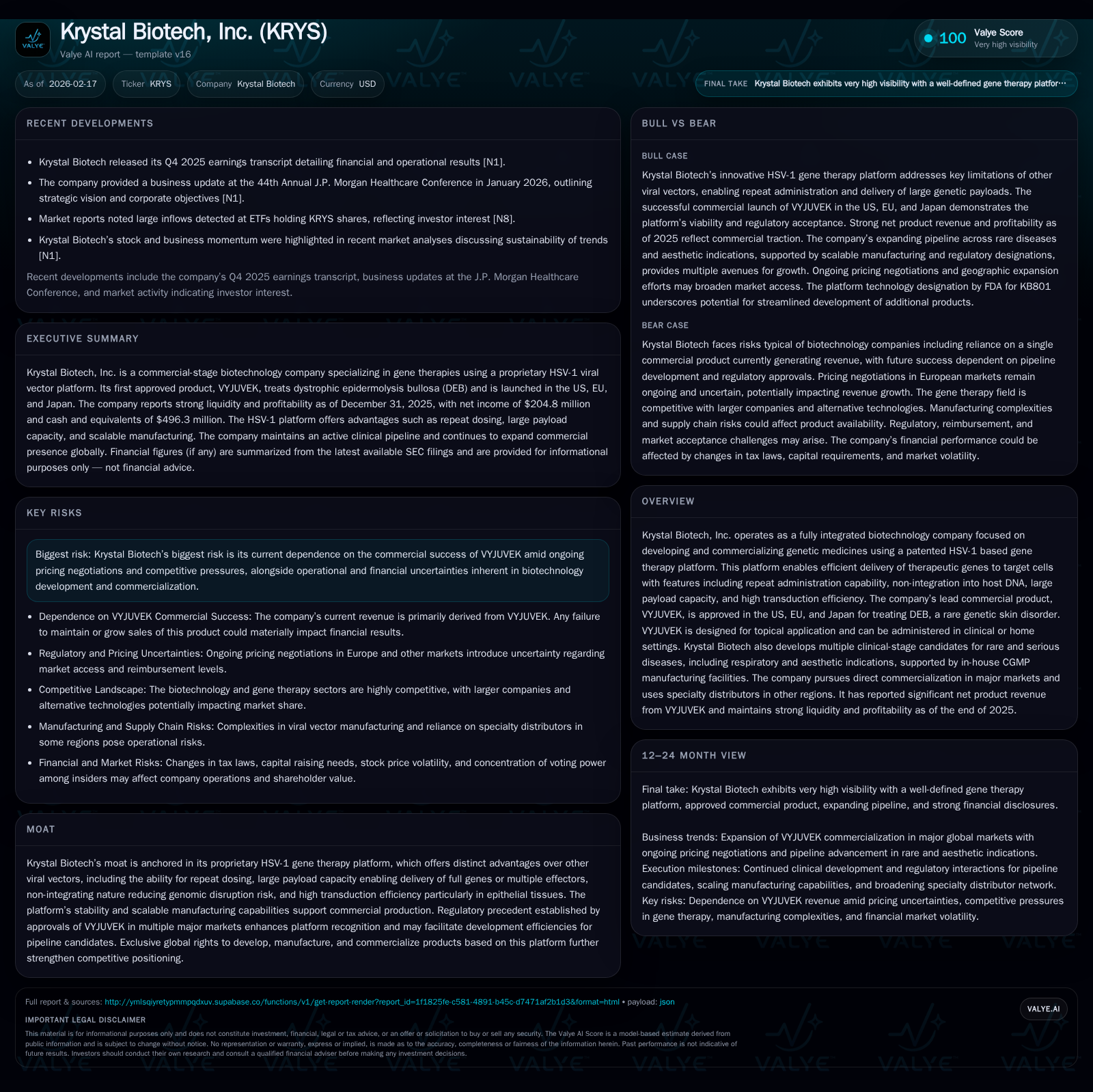
Krystal Biotech operates a differentiated gene therapy platform using engineered herpes simplex virus-1 (HSV-1) vectors that allow repeat dosing, large payloads, and non-integration into host DNA. Its commercial anchor is VYJUVEK, approved in major markets for dystrophic epidermolysis bullosa (DEB), with launches in the US, EU, and Japan. The company maintains in-house CGMP manufacturing supporting pipeline candidates targeting rare and serious diseases including respiratory and aesthetic indications. While regulatory approvals and manufacturing capabilities underpin its moat, Krystal confronts commercial risks tied to pricing negotiations, payer coverage uncertainty, and dependence on its single marketed product. Future growth will hinge on advancing multiple clinical-stage assets and navigating pricing pressures in diverse jurisdictions.
Company Overview
Krystal Biotech, Inc. (NASDAQ: KRYS) has carved a distinctive niche as a fully integrated biotechnology company developing genetic medicines using an engineered herpes simplex virus type 1 (HSV-1) platform. This proprietary platform is designed to deliver therapeutic genes directly to target cells efficiently, leveraging HSV-1's natural ability to evade host immune responses while removing pathogenic elements to enhance safety. As of early 2026, Krystal stands as a commercial-stage entity with its lead product VYJUVEK® approved in the United States, European Union, and Japan for dystrophic epidermolysis bullosa (DEB).
The HSV-1 Based Gene Therapy Platform
Conventional viral vector systems such as adeno-associated virus (AAV) often face limitations including host immune neutralization upon repeat dosing and limited payload capacity. Krystal’s platform addresses these constraints primarily through key biological engineering:
Repeat Administration: Wild-type HSV-1 establishes latent infections without triggering strong immune clearance. Krystal harnesses this feature by deleting immunogenic viral elements to permit multiple redosings necessary to sustain therapeutic gene expression.
Large Payload Capacity: HSV-1 vectors accommodate larger or multiple therapeutic genes than AAV or lentiviral vectors, critical for delivering full-length genes or combinational effectors.
Non-integration into Host DNA: The episomal nature of the vector reduces risks linked to genomic insertional mutagenesis that are a safety concern for integrating vectors.
High Transduction Efficiency in Epithelia: Given that many candidate indications involve skin or mucosal tissues (e.g., DEB), the virus’s natural tropism aligns well with target cell types.
These attributes provide Krystal with a competitive moat supported by composition of matter and method patents expiring around 2036 across key territories including the US, Japan, and Australia [S1]. The proprietary nature combined with stable scalable manufacturing sets it apart in an emerging field where supply chain bottlenecks often impede commercialization.
Commercial Product: VYJUVEK®
VYJUVEK is a topical gene therapy indicated for DEB, a severe inherited blistering skin disorder caused by mutations that affect collagen VII. This orphan disease has few treatment options beyond symptom management.
Launched first in the US in 2023 followed by Europe and Japan in 2025, VYJUVEK represents the company’s commercial cornerstone [S1][N1]. Its formulation enables administration not only by healthcare providers but also by patients or caregivers at home—an important convenience factor given the chronic nature of DEB lesions. This positions Krystal favorably within rare disease gene therapy commercialization dynamics where patient adherence and ease of use are paramount.
Sales growth hinges on pricing negotiations with payors amid intense scrutiny on high-cost therapies. The Inflation Reduction Act (IRA) and subsequent US legislative trends exert downward pressure through Medicare price negotiations, rebate mandates tied to inflation-linked price increases, and capped out-of-pocket expense thresholds [S4][S10][S20]. Similar challenges exist abroad where pricing controls differ widely by country but generally trend toward emphasizing pharmacoeconomics.
Manufacturing Capabilities
To support both clinical development and commercial launch requirements, Krystal owns two Current Good Manufacturing Practice (CGMP) compliant facilities enabling vector production at scale. Control over manufacturing processes is a strategic advantage given the complexity of biologics and gene therapies where lot-to-lot consistency affects safety profiles and regulatory approval.
This internal infrastructure supports cost containment relative to outsourcing partners who may face capacity constraints as industry demand ramps up [S1]. In-house cGMP scale also aids quicker batch release cycles potentially reducing lead times essential for commercial fulfillment.
Pipeline Development: Rare Diseases & Aesthetic Indications
Building beyond VYJUVEK’s DEB indication, Krystal advances several clinical-stage assets leveraging its HSV-1 technology:
- Investigational therapies target ultra-rare genetic diseases affecting epithelial tissues beyond skin,
- Respiratory conditions are addressed through alternative formulations exploiting mucosal delivery,
- Aesthetic dermatologic conditions pursued via wholly-owned subsidiary Jeune Aesthetics represent attempts to diversify into higher-volume markets leveraging platform versatility [S1].
Progression relies on demonstrating safety/tolerability consistent with prior products along with competitive efficacy endpoints favoring differentiated delivery modes or redosability.
Financial Position & Operational Risks
At fiscal year-end 2025, Krystal reported net income of approximately $205 million on robust revenue growth driven by VYJUVEK sales [F1]. Cash reserves hovered near $496 million yielding an exceptionally healthy current ratio close to 10x—indicative of strong liquidity allowing sustained R&D investment horizons absent immediate refinancing needs.
However, concentration of revenues on a single product exposes the company to material risks if pricing negotiations falter or competitive biosimilars/gene therapy platforms gain traction. Regulatory policies around pricing continue evolving quickly both domestically under federal programs like Medicare/Medicaid and internationally via government formulary restrictions [S4][S11][S20].
Further concerns relate to intellectual property claims from third parties active in related gene therapy IP spaces that could impose costly litigation burdens [S17]. Compliance with global healthcare laws including anti-kickback statutes, false claims acts, physician payment transparency laws (Sunshine Act), as well as data privacy regulations like GDPR and HIPAA adds operational complexity often underestimated by smaller biotechs .
Manufacturing risks include contamination control inherent when working with biohazardous vector agents plus scaling reproducibility across geographically dispersed sites subject to differing regulatory audits [S24]. Environmental laws governing hazardous waste further complicate logistics costs [S24].
Industry Context & Competitive Environment Analysis
Gene therapy focus has shifted towards utilizing unique viral backbones capable of overcoming immunity hurdles for repeated dosing—a known limitation preventing long-term durable responses from earlier one-and-done approaches predominantly reliant on AAV. Krystal’s HSV-1 system stands out against numerous competitors who either lack similar immune-evasion capabilities or contend with smaller payload sizes limiting therapeutic scope.
In rare disease segments such as DEB where incidence is measured in low thousands globally, specialized commercial strategy involving limited centers of excellence combined with home administration scalability is paramount given patient population fragmentation. Krystal’s direct-to-patient model coupled with existing approvals across three major regions affords valuable real-world evidence generation opportunities accelerating label expansion discussions.
Nonetheless, drug pricing reforms represent near-universal challenges across all gene therapy innovators—including established players like Spark Therapeutics (for hemophilia) or Bluebird Bio—as governments push for equitable affordability without stifling innovation incentives. Negotiations require sophisticated health economics dossiers demonstrating value beyond clinical endpoints incorporating quality-of-life improvements especially relevant for debilitating genetic diseases.
Regulatory agencies remain cautious about integrating novel gene platforms broadly until further long-term safety data accrues especially concerning off-target effects or vector shedding risks. Continuous pharmacovigilance post-marketing surveillance therefore intensifies operational expenditures impacting margin trajectories.
Outlook Considerations
Krystal Biotech’s future success hinges on balancing continued market penetration of VYJUVEK amid price resistance while accelerating advancement of second-generation assets targeting broader indications benefiting from HSV-1 vector advantages. Leveraging proprietary CGMP manufacturing enables some insulation from external supply shocks pervasive elsewhere in biotech.
Investments into robust compliance frameworks guarding against multifaceted legal/regulatory risk remain critical given gene therapy commercialization intricacies globally. Any arising intellectual property disputes will necessitate prudent resource allocation potentially diverting focus from research innovation activities.
The uniqueness of the viral vector platform provides differentiation difficult to replicate quickly; however sustained capital deployment will be necessary to translate pipeline potential into diversified revenue streams minimizing reliance on any individual asset while ameliorating reimbursement headwinds inherent in specialty therapeutics domain.
This analysis reflects publicly available information as of February 2026 from SEC filings ([S1]-[S29]) and recent market news ([N1]-[N14]). It does not constitute investment advice but intends to provide an informed perspective on Krystal Biotech’s current business fundamentals relative to its technological moat and associated industry risks inherent in biotechnology commercialization trajectories.
Disclaimer: This is research-only, informational analysis and not investment advice. It may include AI-generated interpretation and general industry context. Always verify important details using primary sources.

Comments