
Genmab’s Antibody Innovation and Commercial Strategy Fuel Oncology Breakthroughs
Genmab combines pioneering antibody technologies with global partnerships to advance oncology treatments despite financial leverage challenges.
Genmab A/S has solidified its leadership in oncology by leveraging proprietary antibody platforms such as DuoBody and HexaBody, enabling innovative bispecific antibodies like epcoritamab (EPKINLY). Its commercial success is augmented through strategic collaborations with AbbVie, Pfizer, and others, supporting robust royalty streams and product sales. However, Genmab’s significant indebtedness imposes restrictive covenants that constrain financial flexibility, requiring a delicate balance between aggressive R&D investment and operational discipline. The company’s diverse late-stage pipeline and recent trial successes underscore potential for sustained innovation-led growth, tempered by regulatory and legal hurdles inherent to biotechnology development.
Distinctive Antibody Platforms Powering Therapeutic Innovation
Genmab’s competitive edge stems from its proprietary antibody engineering technologies—principally its DuoBody bispecific platform, alongside HexaBody enhancements and advanced antibody-drug conjugate (ADC) modalities. The DuoBody technology facilitates the creation of bispecific T-cell engagers that simultaneously bind tumor-associated antigens and T-cell receptors, thereby directing immune effectors selectively against cancer cells. This enables the production of off-the-shelf bispecifics with improved targeting and safety profiles.
Epcoritamab (marketed as EPKINLY in the US/Japan and TEPKINLY in Europe) stands as a hallmark application of these platforms. As the first bispecific antibody approved broadly for multiple B-cell malignancies, it represents a transformative advancement in immuno-oncology therapeutics. Genmab’s HexaBody technology enhances Fc-mediated effector functions through engineered hexamerization post antigen binding, increasing potency particularly in hematological malignancies.
Additionally, Genmab’s ADC expertise is exemplified by tisotumab vedotin (Tivdak), an ADC targeting tissue factor-expressing cervical cancers. These platforms collectively diversify Genmab’s therapeutic arsenal beyond conventional monoclonals, supporting both commercial products and a clinical pipeline enriched by novel mechanisms.
Commercial Collaboration Dynamics: Partnership with AbbVie and Others
Genmab adopts a selective partnership approach to leverage commercialization scale while retaining meaningful economics. The collaboration with AbbVie for epcoritamab exemplifies this model: Genmab co-promotes the drug in the US and Japan—classified as principal for net sales recognition—with a 50/50 split on sales revenue and associated cost of product sales. Both companies equally share research & development and selling/marketing expenses related to these territories.
Outside the US/Japan, AbbVie manages global commercialization independently under a tiered royalty system (22-26% net sales), subject to reductions based on contractual terms. This arrangement optimizes Genmab's financial exposure while accessing AbbVie's global marketing infrastructure.
For tivdak, co-developed with Pfizer, Genmab co-promotes within the US but leads operations outside the US excluding China (where Pfizer holds rights once regulatory approvals are secured). This division balances internal capabilities with partner localization advantages.
Such collaboration structures spread commercial risk and investment burden while securing recurring royalties and milestone payments across jurisdictions—a vital revenue stabilizer for biotech firms reliant on multi-market commercialization.
Robust Pipeline Advancements Through Proprietary and Acquired Assets
Beyond marketed therapies, Genmab actively propels late-stage clinical programs including Rina-S (Phase 3 indications: platinum-resistant ovarian cancer , platinum-sensitive ovarian cancer , endometrial cancer) and petosemtamab targeting recurrent/metastatic head and neck squamous cell carcinoma (HNSCC). These assets underscore focus on addressing unmet oncology needs with next-generation antibody modalities.
Strategic acquisition of Merus notably bolstered Genmab’s ADC portfolio, integrating additional bispecific technologies and broadening preclinical candidates. Concurrently, ongoing Phase 3 data readouts continue to inform lifecycle management strategies for authorized products:
The January 2026 announcement of epcoritamab data from the EPCORE DLBCL-1 trial revealed progression-free survival benefits though no statistically significant overall survival advantage was observed; an important nuance guiding label expansion potential [N3][N9].
Expansion into immunomodulatory antibodies complements cytotoxic conjugates within targeted indications.
These clinical advancements reflect an ambition not only to sustain current product momentum but to build future therapeutic pillars enhancing long-term revenue visibility.
Revenue Growth Driven by Marketed Products and Royalty Streams
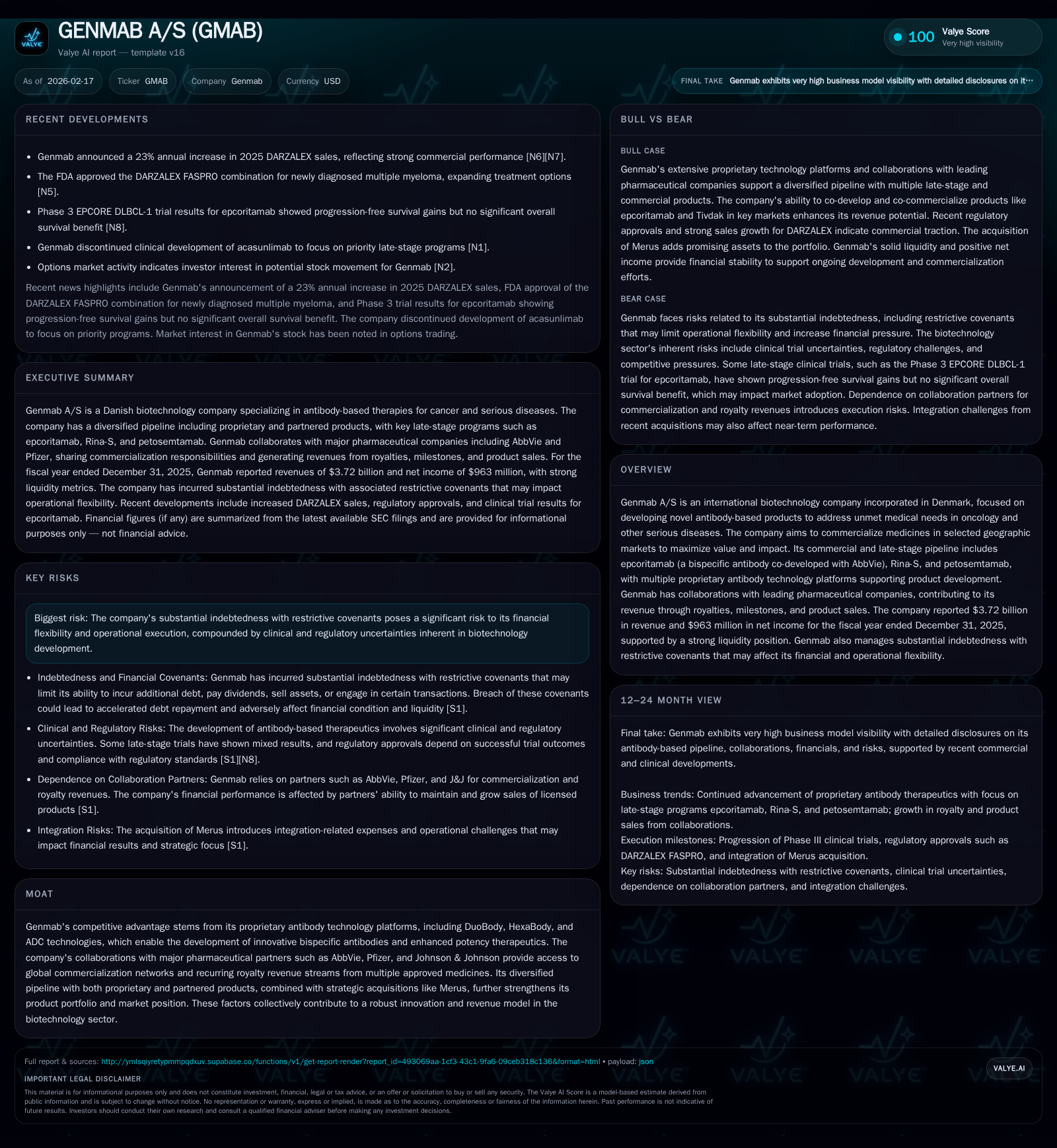
Fiscal year 2025 showcased robust financial outcomes: total revenues hit approximately $3.72 billion complemented by net income nearing $963 million—remarkable for a biotech balancing emerging products with established royalty flows [F1].
Key contributors include:
- DARZALEX (daratumumab), developed using Genmab's technology platforms licensed to Johnson & Johnson, realized a 23% annual sales increase credited largely to broad multiple myeloma indications globally [N7][N8]. Royalties from such partnered biologics form a substantial portion of Genmab’s high-margin income.
- Direct sales of epcoritamab in US/Japan markets occur under principal accounting treatment yielding stronger margin capture compared to traditional licensing revenues.
- Co-promoted Tivdak sustains early commercial traction following approval for recurrent/metastatic cervical cancer [S1].
Product mix diversification—from direct product sales capturing gross margins via cost sharing arrangements to unstable yet valuable royalties—demonstrates commercial maturity uncommon among biotech peers still reliant on single products or early-stage licensing.
Financial Position Analysis: Liquidity Strengths vs. Leverage Constraints
Despite strong cash reserves approximating $1.715 billion at year-end 2025 [F1], Genmab carries significant indebtedness which introduces operational constraints [S6][S12][S24]. Restrictive covenants embedded in credit agreements limit activities such as incurring additional debt, dividend payments, asset dispositions, mergers/acquisitions without lender consent—a common structural feature designed to protect creditor interests yet potentially impeding strategic agility.
Interest rate sensitivity elevates debt servicing costs risk amid macroeconomic tightening cycles. Covenants tied to financial maintenance metrics require vigilant compliance; breach could trigger defaults accelerating debt repayment obligations or curtailing future capital access.
Management faces a delicate balancing act: leveraging debt proceeds to fuel R&D investment without compromising liquidity or underwriting runway—especially critical given biotech’s inherently unpredictable clinical progress timelines.
Navigating Regulatory and Legal Challenges in Biotech Development
Regulatory oversight spans FDA (US), EMA (Europe), PMDA (Japan), each imposing rigorous pre-approval evidentiary standards coupled with post-marketing surveillance mandates [S4][S5][S9]. Maintaining compliance demands extensive resources devoted to quality systems management—current good manufacturing practices (cGMP), pharmacovigilance reporting—and submission upkeep.
Biologics' dependence on companion diagnostics further complicates commercialization pathways due to concurrent device regulation requirements ensuring precise patient stratification [S10][S19].
Adding complexity are ongoing legal disputes: notably AbbVie's claims alleging trade secret misappropriation pertaining to disaccharide use in ADC linkers implicate Genmab subsidiaries alongside ProfoundBio entities [S4][S7]. While no patent enforcement or development blocks currently exist and no accounting provisions made, potential litigation costs or injunction risks remain latent.
Moreover, health care regulatory compliance extends beyond product approval; federal anti-kickback statutes, false claims acts, HIPAA privacy rules impose stringent conduct standards across marketing practices impacting business reputations and financial penalties in case of infringements [S8][S13].
Strategic Outlook: Balancing R&D Investment with Operational Discipline
Genmab’s forward trajectory depends on sustaining innovation intensity while respecting capital structure limitations [S18][S20]. Its incremental approach targets advancing select proprietary candidates toward commercialization primarily in regions promising highest value capture—namely US, Japan, EU markets where reimbursement frameworks support premium pricing.
Simultaneously, partnerships mitigate upfront cost burdens; shared responsibilities reduce risk exposure amidst costly pivotal trials. The company must judiciously allocate resources between discovery efforts expanding its technology platforms—such as next-gen checkpoint modulators—and scale-up activities underpinning late-phase assets’ market readiness.
Operational discipline entails managing R&D spend growth predictably despite inherent trial variability; prudent expense control complements ensuring compliance across complex multi-jurisdictional regulatory environments.
In sum, Genmab exemplifies a modern biotech archetype combining cutting-edge science with collaborative commercialization tactics calibrated against financial prudence dictated by leverage profiles. Its pipeline depth coupled with validated technology platforms positions it well to deliver impactful oncology breakthroughs over the coming years whilst navigating inherent sector risks.
Disclaimer: This is research-only, informational analysis and not investment advice. It may include AI-generated interpretation and general industry context. Always verify important details using primary sources.

Comments