
Hillman Solutions’ Balance Sheet Maneuvers Signal Strategic Confidence
Hillman Solutions strengthens its financial footing through liquidity management and share repurchases, reflecting executive conviction amid market and leadership challenges.
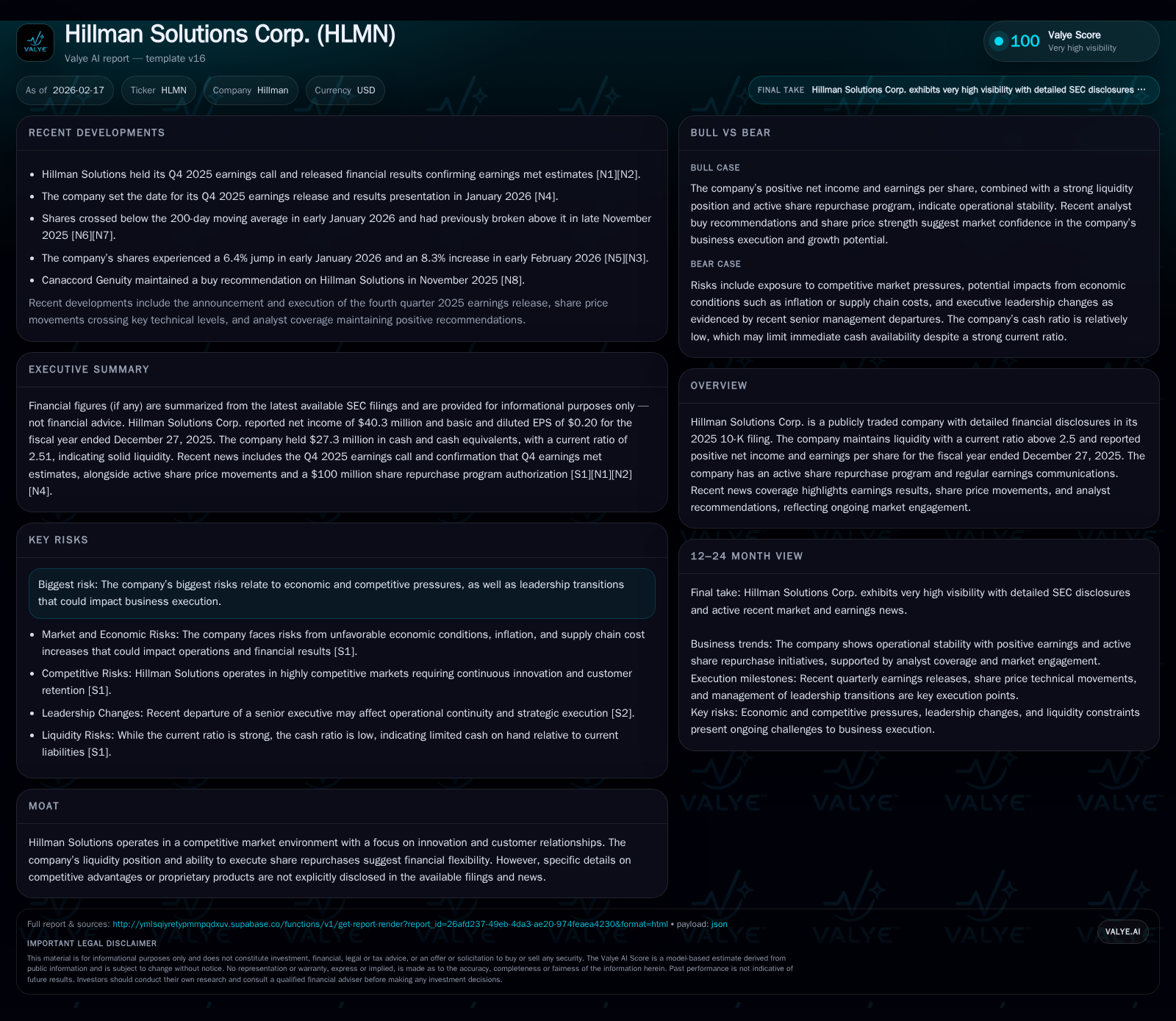
Hillman Solutions Corp. ended fiscal year 2025 with a robust current ratio of 2.51 and positive earnings, underscoring solid operating stability. The company’s initiation of a $100 million share repurchase program signals management’s confidence and strategic flexibility despite competitive pressures and ongoing leadership transitions. While explicit competitive moats are not detailed in filings, Hillman's emphasis on innovation and customer relations remain key pillars. Key risks include economic uncertainties, inflation-driven cost pressures, and legal/regulatory challenges, requiring cautious optimism as the firm balances growth prospects against execution risks.
Strong Liquidity Underpinning Operating Stability
Hillman Solutions closed its fiscal year ending December 27, 2025, with a notably strong liquidity position highlighted by a current ratio of approximately 2.51. This metric reflects total current assets reported at roughly $646.5 million against current liabilities near $257.6 million [F1][S9][S16]. Importantly, the company's cash and equivalents balance stood at about $27.3 million [F1], contributing to the immediate availability of liquid resources.
This liquidity enables Hillman not only to comfortably meet short-term obligations but also provides a financial buffer against potential market volatility or supply chain interruptions—a critical advantage in the industrial hardware space where demand can fluctuate with macroeconomic cycles. Liquidity strength also supports discretionary capital deployment initiatives such as share repurchases or strategic investments.
Earnings Performance Meets Analyst Expectations
Hillman's net income for FY2025 was reported at $40.3 million [F1], underscoring consistent profitability during a period characterized by economic uncertainties. Earnings per share aligned closely with consensus estimates according to recent earnings call transcripts and analyst reports [N1][N2].
This steady earnings performance has reinforced investor confidence, evident in relatively stable share price behavior despite broader market volatility [N4]. With revenues and margins maintaining their course amid an inflationary backdrop, Hillman demonstrated operational discipline that satisfied market expectations heading into the new fiscal year.
Active Share Repurchase: Financial Flexibility or Market Signal?
A central feature of Hillman’s capital strategy has been its $100 million share repurchase program authorized in mid-2025 [S10][S12][S14]. The program is executed through multiple channels including open market purchases compliant with SEC Rule 10b-18 safe harbor provisions and pre-established 10b5-1 trading plans that allow staggered buybacks independent of insider trading windows.
This opportunistic approach conveys management's confidence in current valuation levels while preserving flexibility to adjust pace based on prevailing market conditions, alternative investment opportunities, or liquidity needs. Such buybacks often signal to shareholders a belief that the company's shares are undervalued or represent efficient use of capital versus holding excess cash.
Competitive Position Despite Limited Moat Disclosure
The company's detailed public disclosures omit explicit mentions of proprietary technologies or formidable competitive moats [valye_report_excerpt.moat]. Instead, Hillman's strategy appears rooted in continual innovation within its product lineup alongside cultivating robust customer relationships—key levers to maintain relevance in the fragmented fasteners and hardware distribution sector.
Industry-specific elements such as streamlined product lifecycle management, supply chain optimization, and multi-channel customer service platforms likely contribute underpinning value propositions although these are not explicitly quantified in filings. The tradeoff intimate here is between broad market reach versus proprietary differentiation.
Leadership Transitions: Potential Impact on Execution
In late 2025, Hillman underwent notable leadership changes with the departure of Scott C. Ride, President of Hillman Canada, which adds an execution dimension to existing business risks [S20][S21][S22]. Separation terms were amicably negotiated involving severance payments extended over sixteen months plus continuation of health benefits—indicative of an orderly transition process designed to avoid disruption.
Such management changes create inherent uncertainty concerning continuity of strategic initiatives or regional operations performance. However, given the structured separation agreement and absence of wider executive turnover disclosures, this risk is elevated yet managed conservatively within corporate governance frameworks.
Navigating Economic Uncertainties and Inflation Pressures
Hillman's risk factors prominently cite inflation and increased input costs—raw materials, transportation, energy—as ongoing headwinds that pressure product margins [S17][valye_report_excerpt.risks]. These macroeconomic dynamics weigh heavily on industrial distributors who often face limited pricing power against commodity-driven cost escalations.
Ongoing scenarios include tariff adjustments and supply chain bottlenecks which can exacerbate procurement expenses or delay inventory replenishment cycles impacting customer satisfaction metrics. Hillman's balance sheet strength offers some mitigation leverage here but operational agility remains crucial.
Risk Factors Spotlight: Legal and Regulatory Challenges
The company outlined several active legal proceedings alongside regulatory compliance obligations typical for a publicly listed industrial supplier [S4][S5][S20]. While details remain guarded under standard disclosure constraints, litigation exposures appear reasonably contained without material impact forecasts.
Compliance burdens primarily involve adherence to safety standards, trade regulations, environmental mandates, and financial reporting requirements—core focus areas where lapses could invite penalties or reputational damage. Hillman’s transparent risk disclosures reflect awareness without highlighting imminent adverse contingencies.
Outlook: Risks and Growth Prospects in a Crowded Market
Hillman’s juxtaposition of sturdy liquidity with measured strategic maneuvers paints a picture of a company poised to weather sector competition while maintaining investor engagement through proactive communications and capital return policies [N5][N6][valye_report_excerpt.overview].
Growth vectors hinge on successful innovation cycles coupled with enhanced customer retention efforts amidst consolidation trends within industrial distribution networks. Yet vigilance remains warranted given economic uncertainties alongside execution risks tied to leadership realignment.
Overall, Hillman Solutions illustrates a disciplined financial stewardship balancing near-term stability with long-term competitive positioning—key for stakeholders tracking risk-reward dynamics carefully in this specialized marketplace.
Disclaimer: This analysis is for informational purposes only and does not constitute investment advice.
Disclaimer: This is research-only, informational analysis and not investment advice. It may include AI-generated interpretation and general industry context. Always verify important details using primary sources.

Comments