
Kyndryl’s Revenue Decline and Internal Control Challenges Pressure Operational Stability
Kyndryl Holdings faces strategic tradeoffs as it refines its portfolio while addressing regulatory scrutiny and market pressures.
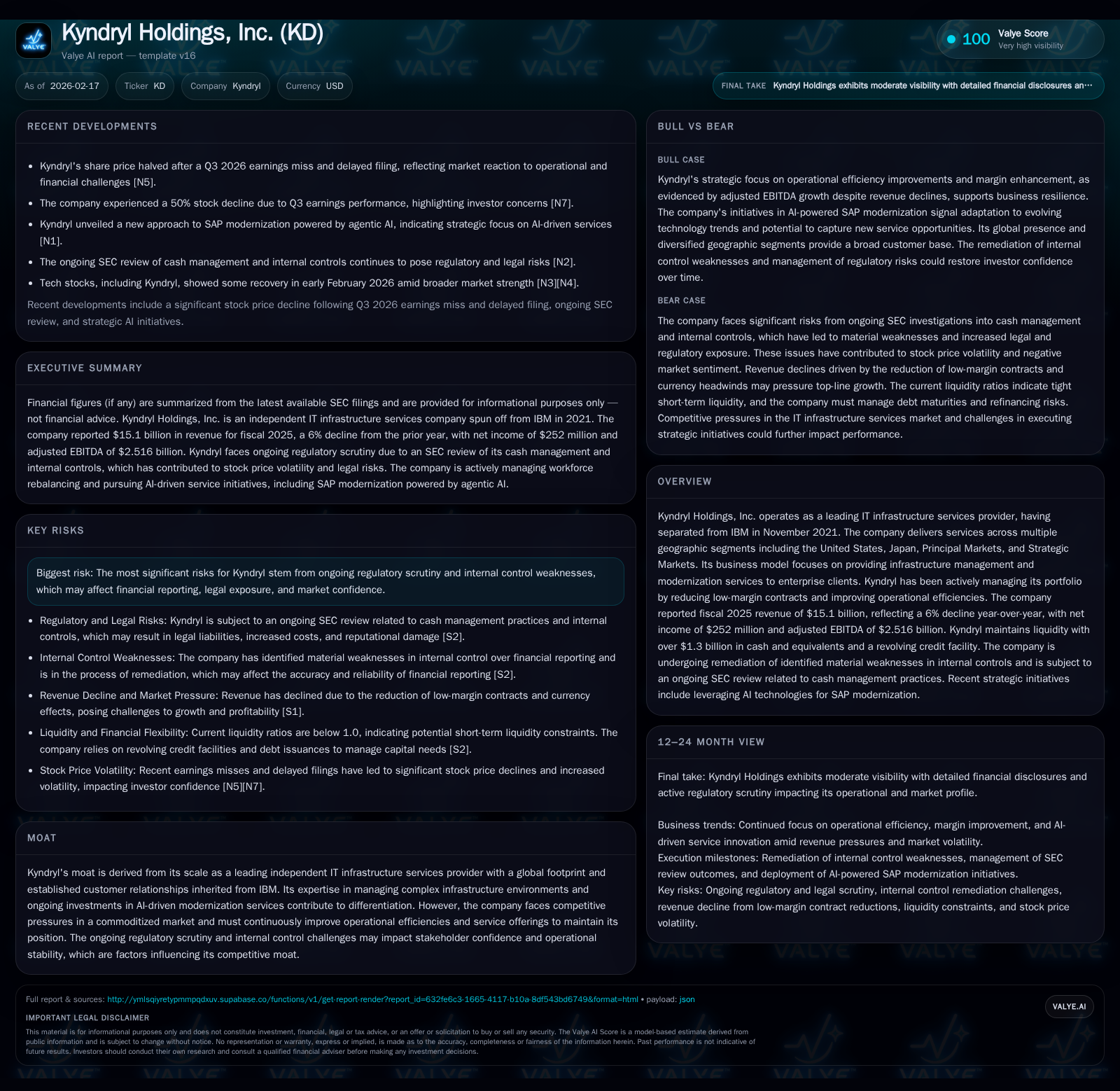
Kyndryl Holdings, spun off from IBM in 2021, reported $15.1 billion revenue in fiscal 2025, down 6% year-over-year due to deliberate reductions of low-margin contracts and unfavorable currency effects. Despite operational efficiency gains boosting adjusted EBITDA to $2.5 billion, the company grapples with material weaknesses in internal controls and ongoing SEC inquiries, which have dented market confidence and led to significant share price volatility. Geographic segmentation reveals mixed regional performance, with Japan showing slight growth contrasting declines in the U.S., Principal, and Strategic Markets. Kyndryl’s focus on AI-driven infrastructure modernization contrasts with a commoditized service landscape, heightening the importance of operational discipline.
Company Background and Spin-Off Context
Kyndryl Holdings, Inc. entered the public markets as an independent entity following its separation from IBM in November 2021. It inherited IBM’s Global Technology Services infrastructure operations, granting it substantial scale as a global IT infrastructure services provider. Leveraging legacy customer relationships across multiple geographies — notably the U.S., Japan, Principal Markets (such as Western Europe), and Strategic Markets (including Asia-Pacific excluding Japan) — Kyndryl aims to carve out a differentiated position through infrastructure management and modernization solutions.
The post-spin dynamics have presented opportunities for focus but also challenges common to carve-outs: redefining strategic priorities while establishing standalone governance and controls amid investor scrutiny.
Revenue Trends and Portfolio Rationalization
Fiscal year 2025 saw Kyndryl’s revenues decline 6% year-over-year to approximately $15.1 billion [S1][F1]. Management has actively targeted low-margin contracts for reduction or non-renewal as part of portfolio optimization efforts. This tactical pruning accompanied unfavorable foreign exchange effects that trimmed the top line further.
Segment analysis offers nuance:
- United States: The largest single region contracted by roughly 10%, driven primarily by low-margin contract expirations predating the spin-off [S9][S20].
- Japan: A relative bright spot with a modest revenue increase of about 1%, boosted by broadening service scopes offered to existing clients and positive currency effects [S9].
- Principal Markets: Closed the year down about 5%, yet adjusted EBITDA surged thanks to operating efficiencies and a favorable vendor credit [S11].
- Strategic Markets: Declined around 8% in revenue; adjusted EBITDA fell slightly due to the mix shift away from marginal contracts compounded by adverse currency moves [S16].
This segmentation underscores Kyndryl's regional disparities and validates its strategic priority on operational excellence combined with selective investment.
Profitability and Cost Management Initiatives
Despite revenue pressures, Kyndryl achieved an adjusted EBITDA increase of approximately 6% versus prior year, reaching $2.516 billion [S14][F1]. Key drivers included streamlined operations, enhanced margins on newly negotiated contracts, lower depreciation expenses from reduced capital intensity, and one-time gains such as the $138 million after-tax profit from divesting the Canadian SIS platform.
Workforce rebalancing remains an integral lever for cost control. Charges incurred for these actions totaled around $114 million during fiscal 2025 but have yielded estimated annualized payroll and rental savings near $400 million [S28]. Further site rationalization contributed positively but also involved upfront costs related to lease terminations.
Interestingly, selling, general, and administrative (SG&A) expenses declined proportionately with revenue drops but remained near steady at circa 17% of sales [S14], implying constrained fixed-cost absorption amid falling topline volumes.
Financial Position & Liquidity
On the balance sheet front, Kyndryl sustains a solid liquidity profile with over $1.3 billion in cash and equivalents complemented by a revolving credit facility of up to $3.15 billion due in October 2026 [S5][S25]. This liquidity supports ongoing restructuring programs and investments into emerging capabilities such as AI-powered infrastructure modernization.
Total assets slightly decreased during fiscal year reflecting normal depreciation outpacing capex additions, partly offset by cash flow improvements. Total liabilities fell owing to repayment of finance leases and moderated accounts payable balances—reflecting stringent working capital management [S18][S22].
The current ratio hovers below unity at approximately 0.86 per latest filings [F1], signaling working capital is tightly managed but warrants monitoring given inherent volatility risks.
Governance Challenges & Regulatory Scrutiny
Kyndryl faces pronounced governance headwinds due to identified material weaknesses in internal controls over financial reporting—a challenge inherited or developed post-spin that remains unremediated pending effective implementation over time [S2][S4][S8]. These issues have triggered an ongoing SEC investigation concerning cash management practices and disclosures.
Market reaction has been swift; consecutive quarters involving delayed filings combined with missed earnings estimates precipitated a near-halving of Kyndryl’s share price in early February 2026—a stark valuation shock accentuating investor wariness [N1][N3][N5].
The consequences extend beyond share price: heightened regulatory scrutiny raises legal exposure risks, potential costlier insurance for officers/directors, possible damage to vendor/customer relationships due to reputational factors, difficulty attracting talent amidst morale concerns, and more cautious credit markets engagement [S4].
Management is advancing remediation protocols while balancing operational demands—a critical dual-front approach essential for restoring confidence.
Market Position Amid Competitive Pressures
The broader IT infrastructure services market is characterized by commoditization pressures from established providers like Accenture, DXC Technology, and cloud hyperscalers increasingly encroaching on traditional managed services domains through platform-based offerings.
Kyndryl attempts differentiation via large-scale global delivery capabilities combined with investments in AI-driven technologies aimed at modernizing complex legacy environments—evident through new initiatives such as agentic AI-powered SAP modernization announced recently [N8].
However, sustaining competitive parity demands continuous innovation paired with tight cost controls given shrinking margins industry-wide . Operating leverage remains limited given labor-intensity intrinsic to managed infrastructure services though gradual automation provides incremental relief.
Strategic Tradeoffs & Outlook Considerations
Kyndryl’s current trajectory involves balancing selective business pruning against growth investments amid internal restructuring needs:
- Portfolio pruning reduces immediate revenues but improves profitability metrics.
- Addressing internal control weaknesses consumes management bandwidth yet essential for long-term sustainability.
- Liquidity supports ongoing transformation yet capital allocation decisions will be scrutinized amid market pressures.
- Geographic variations imply tailored market approaches are necessary rather than uniform global strategies.
- The regulatory environment injects uncertainty affecting stakeholder trust which could constrain agility.
Collectively these represent pivotal tradeoffs shaping operational stability going forward.
Conclusion
Kyndryl is navigating complex enterprise IT service dynamics post-IBM spin-off marked by strategic contractions in low-margin areas counterbalanced with efficiency gains enhancing adjusted profitability measures. Regional disparities highlight nuanced growth pockets even as dominant markets contract due to deliberate portfolio reshaping. Nonetheless, governance challenges particularly material weaknesses coupled with elevated SEC scrutiny introduce material risk factors impacting investor sentiment and potentially broader stakeholder engagement. Maintaining disciplined execution on remediation plans alongside agile operational refinements will be crucial as Kyndryl strives to assert footholds within a commoditized yet rapidly evolving IT infrastructure ecosystem.
This analysis is based on publicly available information including recent SEC filings (Forms 10-K/A, 10-Q), company press releases, earnings call transcripts, and reputable news sources as of February 17, 2026. It does not constitute investment advice.
Disclaimer: This is research-only, informational analysis and not investment advice. It may include AI-generated interpretation and general industry context. Always verify important details using primary sources.

Comments