
Verizon’s Spectrum Acquisition and Fiber Expansion Drive Network Leadership Versus Rising Competitive Pressures
Verizon balances aggressive capital investments in 5G and fiber with challenges from pricing strategies and emerging market entrants.
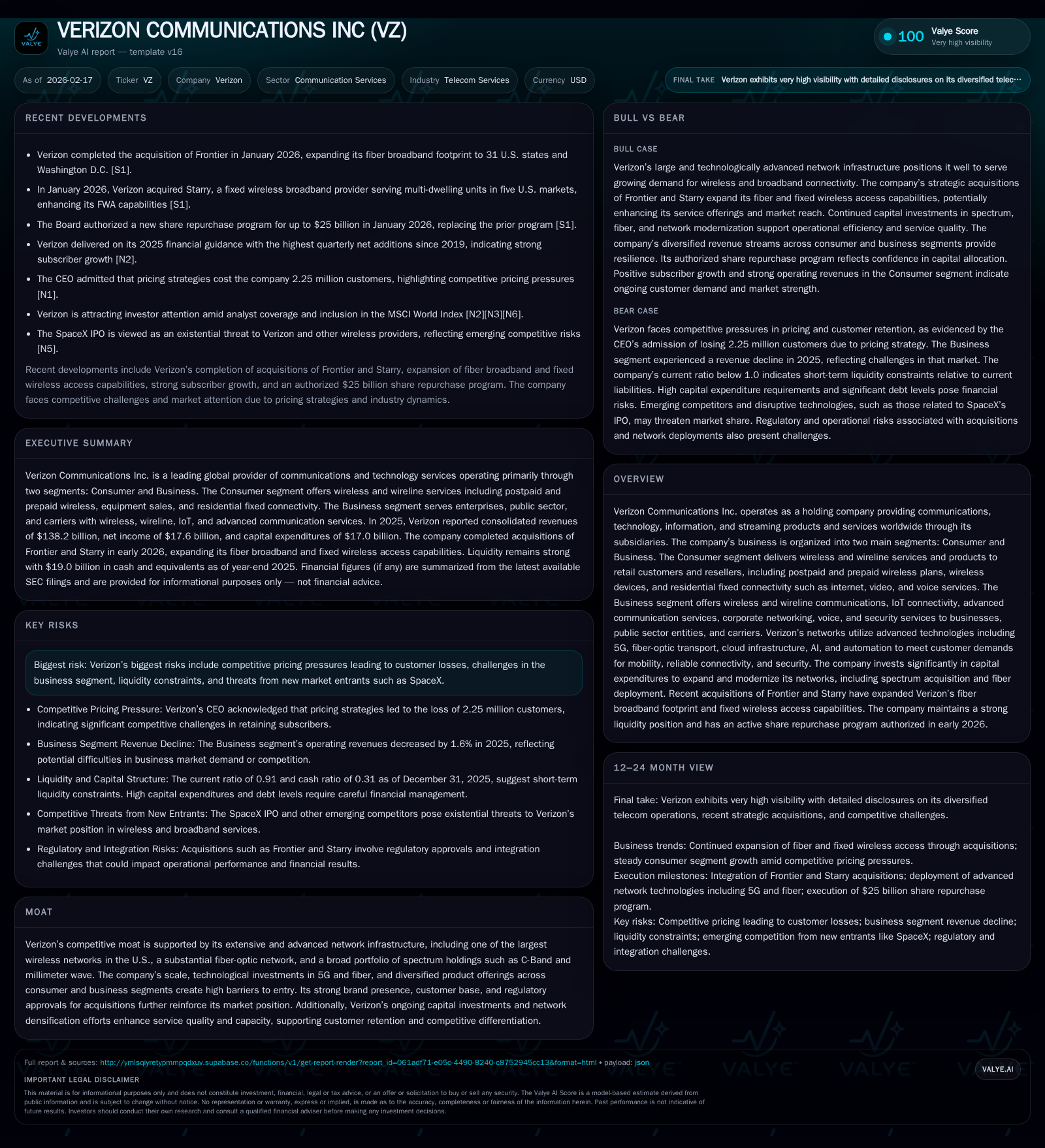
Verizon Communications maintains its competitive moat through extensive spectrum holdings including C-Band, a leading fiber-optic footprint, and a high-quality wireless network. The company’s 2025 financial results showed strong consumer revenue growth despite the Business segment facing declines amid intensifying competition. Major capital expenditures focus on network densification and broadband expansion, supported by robust liquidity but accompanied by elevated debt levels post-Frontier acquisition. Pricing missteps led to significant customer losses, underscoring the delicate tradeoff between market share and revenue retention amid evolving industry dynamics and looming threats from entrants like SpaceX.
Strategic Positioning Through Network Investment
Verizon Communications Inc. remains one of the dominant players in the U.S. telecommunications landscape as of fiscal year-end 2025. With a strategy grounded in a vast portfolio of spectrum—most notably C-Band mid-band frequencies—and an expansive fiber-optic network covering parts of nine states plus Washington D.C., Verizon’s infrastructure investments underpin its competitive moat [S1][S4][S15]. This spectrum advantage is critical for delivering enhanced 5G experiences including fixed wireless access (FWA) alternatives to landline broadband.
In January 2026, Verizon finalized its strategic acquisition of Frontier Communications for approximately $22.3 billion total consideration ($9.4B cash plus assumed Frontier debt). This transaction meaningfully expands Verizon's wireline footprint into additional geographic markets with fiber assets that complement its wireless offerings [S4]. The acquisition also added material debt burden but enhances Verizon's broadband scale which is a core non-wireless customer growth avenue.
Financial Performance Highlights: Consumer Growth Offset by Business Segment Headwinds
For the full year 2025, Verizon reported consolidated revenues of roughly $138.2 billion [F1], a moderate increase reflecting resilience in consumer demand despite broader macroeconomic constraints. The Consumer segment grew revenues by nearly 4% to about $106.8 billion driven largely by both wireless service revenue gains and higher equipment sales volume (notably upgraded devices with premium price points) [S6][S24]. Wireless retail postpaid connections climbed slightly (+0.7%) reaching over 31 million accounts—though net additions slowed sharply compared to earlier years due to pricing decisions and competition [S18].
Conversely, the Business segment encountered pressure with operating revenues declining approximately 1.6% to around $29.1 billion [S6][S18]. The business customer base faces stiff pricing competition, particularly in enterprise connectivity and IoT segments where competitors are aggressively courting contracts with innovative managed services bundles.
Customer Dynamics and Pricing Tradeoffs
Despite growth in lines overall, Verizon experienced an erosion of about 2.25 million customers attributed directly to aggressive pricing strategies that backfired at times according to CEO disclosures [N2]. Churn rates ticked higher especially among the postpaid phone subsegment (up from ~1.10% to ~1.23%), indicating that customer retention is an ongoing challenge in a saturated smartphone market where device upgrade cycles have plateaued [S18][N9].
Industry analysis notes that diminishing marginal returns on smartphone penetration force carriers into price-based battles or bundling tactics that can compress margins . Verizon appears to be recalibrating its approach balancing retention incentives against profitability goals.
Capital Deployment Priorities: Enhancing Network Capacity and Efficiency
Capex spending remained steady at approximately $17 billion in 2025 encompassing investments in spectrum deployment (including completing C-Band rollout), fiber optic expansion into residential broadband markets (via Fios), network densification to support high-band mmWave deployments, and upgrades harnessing AI-driven automation for operational efficiency gains [S11][S21].
Looking ahead into 2026, management has earmarked between $16 billion and $16.5 billion for continued network modernization initiatives emphasizing broadband footprint growth especially fiber deployment backed by improved cost controls [S4][S11]. This prioritization underscores technological leadership as crucial for defending against both incumbent telecom rivals and nascent satellite broadband providers.
Capital Structure and Liquidity Profile
On liquidity fronts, Verizon ended fiscal year 2025 with a strong cash position exceeding $19 billion [F1], bolstered by internal cash flows augmented by financing activities tied to acquisitions like Frontier [S16][S20]. However, total long-term debt rose to approximately $158 billion reflecting balance sheet leverage incurred for expanding infrastructure scale [F1][S16].
The company manages interest rate risk via swaps ensuring a prudent debt mix between fixed- and variable-rate obligations while maintaining compliance with covenants typical of investment-grade telecom issuers [S12][S16]. This financial flexibility supports ongoing capital programs despite macroeconomic uncertainties.
Competitive Environment: Emerging Threats from Non-Traditional Players
Traditional competition with AT&T and T-Mobile remains intense especially around wireless pricing plans and bundled offerings. Yet a notable development is the rising presence of satellite broadband challenger SpaceX Starlink which recently filed for an IPO spotlighting potential disruption risks identified by investors regarding Verizon’s core fixed wireless business lines [N7].
This represents a sector-wide inflection point where multi-layered connectivity options—terrestrial fiber/wireless combined with low Earth orbit satellites—pose complex strategic tradeoffs related to coverage quality, latency sensitivity, and service economics.
Business Segment Nuances: Diversification Beyond Core Wireless
Beyond consumer-facing operations concentrated on smartphones and residential connectivity products like Fios internet/video/voice services, Verizon’s Business segment diversifies into complex IoT solutions, corporate networking including SD-WAN architectures, security services, managed network operations, plus wholesale carrier arrangements [S19].
Despite reported revenue declines primarily due to competitive pricing pressures in enterprise public sector accounts (-4.8%) offset somewhat by growth in smaller business markets (+3.7%) [S18], this segment remains critical for long-term diversification given evolving digital transformation trends driving secure connectivity demands across industries.
Operational Transformation Leveraging AI Automation
Verizon continues deploying AI-enabled tools aimed at streamlining customer service workflows, optimizing network maintenance scheduling, fraud detection capabilities, and personalized marketing—all efforts designed to reduce SG&A expenses while enhancing consumer experience metrics [S11].
Such transformations represent vital components of cost structure evolution given telecom’s inherent capital intensity coupled with saturated subscriber bases limiting organic top-line expansion beyond service innovations.
Summary Outlook Considerations
Verizon stands at an inflection point harmonizing robust capital investment programs fueling next-gen network leadership against significant external pressures from aggressive pricing competition internally led customer losses—the balance between scale advantage protection versus margin dilution remains delicate.
Maintaining liquidity cushions amidst high leverage levels incurred through strategic acquisitions compounds near-term financial flexibility considerations.[S4][F1] The broadband market’s moderate growth prospects tied with burgeoning satellite internet threats necessitate continuous innovation across product suites.
Overall, Verizon’s execution focus on completing major C-Band deployments alongside expanding fiber footprints aligns well with industry expectations that mixed fixed-wireless offerings carry future growth potential even as traditional cellular market saturation persists.
Disclaimer: This analysis is based on publicly available information including Verizon Communications' SEC filings as of February 17th, 2026 ([S1]-[S29]) and recent news reports ([N1]-[N14]). It does not constitute investment advice or recommendations but aims to provide an informed overview respecting compliance guidelines concerning factual accuracy without speculative forecasts or purchase suggestions.
Disclaimer: This is research-only, informational analysis and not investment advice. It may include AI-generated interpretation and general industry context. Always verify important details using primary sources.

Comments