
Cogent Biosciences’ Path from Clinical Losses to Market Promise with Bezuclastinib
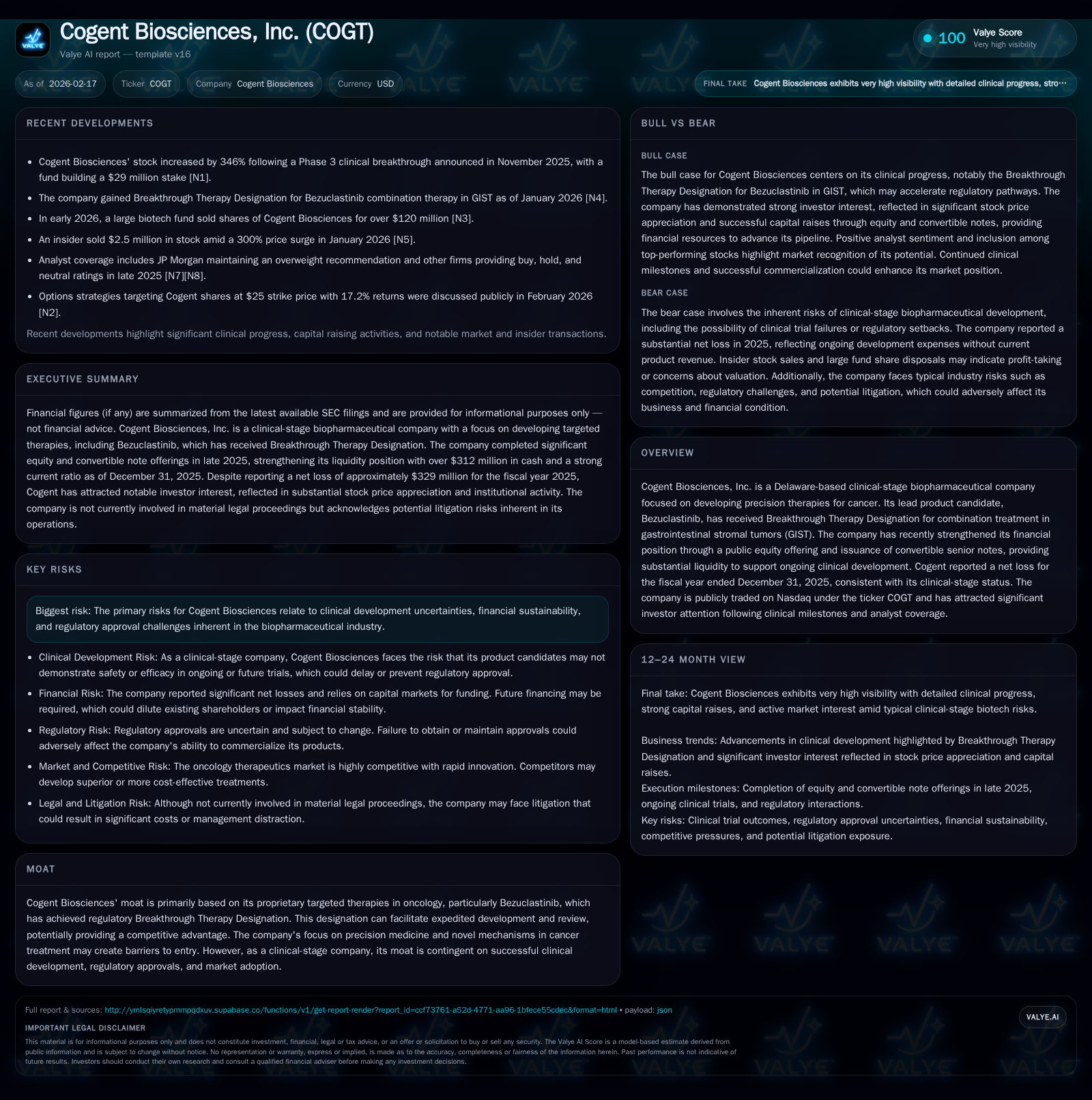
Cogent Biosciences leverages breakthrough therapy designation and robust capital raises to underpin its transition from heavy clinical-stage losses toward potential commercial oncology success.
Over the past four fiscal years, Cogent Biosciences has experienced deepening net losses driven by escalating R&D investments centered on its targeted oncology pipeline. The company’s lead candidate, Bezuclastinib, achieved Breakthrough Therapy Designation for gastrointestinal stromal tumors (GIST), initiating an expedited regulatory pathway and driving significant investor interest evidenced by a sharp stock price appreciation. Cogent recently fortified its balance sheet via a substantial equity offering and issuance of convertible senior notes, extending its operational runway well into the coming years. Despite no current revenues, strong liquidity cushions underscore financial sustainability at this stage, although the company remains exposed to typical clinical development and regulatory execution risks inherent in precision oncology. Upcoming Phase 3 readouts and NDA filing milestones will be critical signals for assessing commercial viability and valuation inflection points.
From Deep Operating Losses to Strategic Liquidity: A Historical Overview
Cogent Biosciences has exhibited substantial operating losses expanding steadily over the last four fiscal years as it transitions through late-stage clinical development. Operating income declined from a loss of $148 million in FY2022 to $333 million in FY2025, marking a compound acceleration in research expenditures signifying ramped-up trials across multiple indications [F1]. Net income mirrored this trend with increasing losses culminating at nearly $329 million in FY2025. Meanwhile, operating cash outflow expanded 27% year-over-year in the latest period reaching $264 million, consistent with intensified Phase 3 activity [F1]. Capital expenditure was nominal relative to burn, underscoring the intangible nature of drug development costs. Importantly, the company's equity base more than doubled—from approximately $256 million at the end of FY2024 to over $636 million by FY2025—reflecting significant capital raises that have materially strengthened Cogent’s financial resources [F1]. This enhanced balance sheet underpins a current ratio above 14x, signaling an ample liquidity buffer against liabilities [F1]. This financial profile typifies clinical-stage biotech firms investing aggressively toward pivotal data generation while lacking commercial revenues.
Historical performance (annual)
| FY | Net ($mm) | CFO ($mm) | OpInc ($mm) | Capex ($mm) | Net YoY |
|---|---|---|---|---|---|
| 2025 | -329 | -264 | -333 | 2 | -28.6% |
| 2024 | -256 | -208 | -276 | 1 | -33.0% |
| 2023 | -192 | -154 | -208 | 3 | -37.2% |
| 2022 | -140 | -119 | -148 | 7 |
Note: Omitted columns lack sufficient annual XBRL coverage in the provided tags (need ≥2 annual points): Rev, Div, Buybacks. Source: SEC companyfacts cache [F1].
Capital returns and efficiency (annual)
| FY | FCF ($mm) | ROE% |
|---|---|---|
| 2025 | -266 | -51.7 |
| 2024 | -208 | -99.8 |
| 2023 | -156 | -74.6 |
| 2022 | -126 | -54.8 |
Source: SEC companyfacts cache [F1].
Note: Revenue and dividend data unavailable; no buyback activity reported.
Bezuclastinib’s Breakthrough Therapy Designation: Clinical Progress Driving Prospects
A pivotal catalyst for Cogent is Bezuclastinib's receipt of Breakthrough Therapy Designation (BTD) by the FDA for use in combination therapy targeting gastrointestinal stromal tumors (GIST) [N4]. This designation typically accelerates regulatory review by prioritizing development resources and enabling closer agency interaction — critical advantages that can compress time-to-market in oncology where early entry confers pricing and reimbursement edge.
Bezuclastinib targets KIT/PDGFRA mutations selectively, offering a precision medicine approach aligned with evolving treatment paradigms favoring selective tyrosine kinase inhibitors (TKIs) that overcome resistance mechanisms prevalent in GIST patients [N4]. Positive Phase 3 trial top-line results released earlier fueled a dramatic stock price rally exceeding 300%, attracting sizeable institutional stakes signaling bullish analyst sentiment on commercial potential [N1]. Additional encouraging data across systemic mastocytosis subtypes further validate Bezuclastinib's differentiated profile [S23][S25].
Public Equity and Convertible Notes: Capital Raises Fueling Development
In November 2025, Cogent strategically augmented its capital base via two complementary financing maneuvers executed within days: a public offering of roughly 11 million common shares generating gross proceeds around $354 million (netting ~$324 million after fees) [S20], alongside the issuance of $230 million aggregate principal amount of convertible senior notes maturing in 2031 carrying a low fixed interest coupon of 1.625% per annum [S8–S11].
These convertible notes feature conversion terms tied to stock price performance thresholds starting from March 31, 2026 onward which could lead to equity issuance that dilutes shareholders but offers non-cash interest expense benefits improving bottom-line dynamics [S9][S10]. The notes’ maturity and call provisions provide Cogent flexibility but also set redemption conditions linked to share price strength.
This capital influx materially expanded cash and equivalents beyond $310 million as of December 31, 2025, underwriting ongoing high-cost clinical programs without immediate dilution pressure and ensuring an extended operational runway beyond mid-decade timelines commonly associated with pivotal oncology developments [F1].
Evaluating Financial Sustainability Amidst Elevated R&D Investments
While revenues remain non-existent given the clinical stage focus—revenue data are not available from provided tags—Cogent’s cash runway calculation—current assets over operating burn rate—suggests coverage extending multiple years assuming stable spending patterns given its current assets exceed $910 million versus annual operating cash outflow near $264 million [F1]. However, escalating yearly losses imply continuous dependency upon external funding until commercialization or partnership revenues commence.
The approximate return on equity stood negative at about -51.7% for FY2025 reflecting the cumulative impact of sustained losses against equity invested predominantly via recent financings—a common profile among late-stage biotech incubators financing heavy R&D [F1]. The firm has not distributed dividends nor executed buybacks consistent with its investment phase stance focused on reinvestment into pipeline progression rather than capital return (dividends and buybacks data not available from provided tags).
Caution colors this sustainability view given risks if pivotal trial endpoints fail or approvals delay—potentially pressuring liquidity despite current buffers—thus necessitating vigilant milestone tracking.
The Roadmap Ahead: What Upcoming Milestones Could Signal for COGT
Key impending catalysts include expected New Drug Application submissions to the FDA for Bezuclastinib targeting advanced systemic mastocytosis indications during first half of 2026 supported by positive APEX Part 2 trial outcomes reported late in calendar year 2025 [N4][S26]. Success here would validate clinical regimen positioning ahead of commercial launch possibilities.
Subsequent presentation of comprehensive data sets at scientific forums planned within H1-2026 will serve as vital validation points for clinician adoption potential and payer engagement strategies integral to market penetration [S26]. Absence of explicit forward guidance intimates reliance on these binary events as major valuation inflection windows in near term.
Shareholder Returns and Capital Allocation: The Current Landscape
As expected for a clinically focused biotech entity yet to generate product revenue, Cogent does not currently pay dividends or conduct share repurchases reflecting prioritization of funds toward R&D (no dividends or buybacks reported) [F1]. Recent insider stock sales totaling approximately $2.5 million amid massive share price appreciation appear tactical rather than indicative of diminished confidence given concurrent large biotech fund sales approximating $120 million—likely portfolio rebalancing influenced by valuation spikes rather than fundamental concerns [N3][N5].
Capital employed primarily funds clinical progressions supported by liquidity strengthens balance sheet robustness but brings potential future dilution contingent upon note conversions tied to stock price triggers embedded within debt instruments.
Risk Factors in Focus: Clinical, Regulatory, and Financial Challenges
Cogent operates under ubiquitous sector-specific risks including dependency on successful completion of multi-center Phase 3 trials meeting primary endpoints crucial for FDA approval pathways [S4][S6]. Regulatory scrutiny extends beyond efficacy into chemistry/manufacturing/controls (CMC) compliance foundational for product quality assurance—an area that has recently become a heightened bottleneck among targeted therapies requiring complex manufacturing processes.
Convertible notes raise embedded risks around mandatory conversions or redemptions inducing dilution pressure or cash strain under adverse market conditions [S9][S10], compounded by covenants that may trigger defaults linked to financial health or corporate actions.
Furthermore, biopharma volatility driven by emergent competitive therapies targeting overlapping molecular mechanisms increases commercial uncertainty despite current Breakthrough Therapy status granting expedited review benefits.
Strategic Positioning in Precision Oncology’s Competitive Environment
Cogent situates itself firmly within the cutting-edge niche of precision oncology concentrating on selective TKIs designed to overcome resistance mutations often neglected by broader-spectrum inhibitors [N4][S7]. This biomarker-driven approach matches prevailing oncologic treatment evolution away from cytotoxic chemotherapies toward personalized regimens tailored to individual tumor genotypes.
By leveraging Breakthrough Therapy Designation alongside demonstrated clinical efficacy signals across systemic mastocytosis subsets and GIST populations—which together represent unmet needs with limited therapeutic options—Cogent is poised potentially to establish durable differentiation reflected both clinically and commercially if regulatory approvals are secured promptly.
In summary, Cogent Biosciences charts a path emblematic of high-risk/high-reward playbooks dominant in contemporary biotech innovation cycles pivoting from sustained pre-commercial capital deployment toward anticipated value creation anchored upon scaffolded regulatory milestones and robustness of strategic liquidity management.
This report is prepared solely for informational purposes reflecting publicly available data as of February 2026 without constituting investment advice or recommendations regarding Cogent Biosciences or any securities mentioned herein.
Disclaimer: This is research-only, informational analysis and not investment advice. It may include AI-generated interpretation and general industry context. Always verify important details using primary sources.

Comments