
AMETEK’s Strategic Expansion and Financial Discipline Power Growth Outlook
AMETEK’s 2025 results and recent acquisitions reinforce its diversified manufacturing growth model amid macro uncertainties.
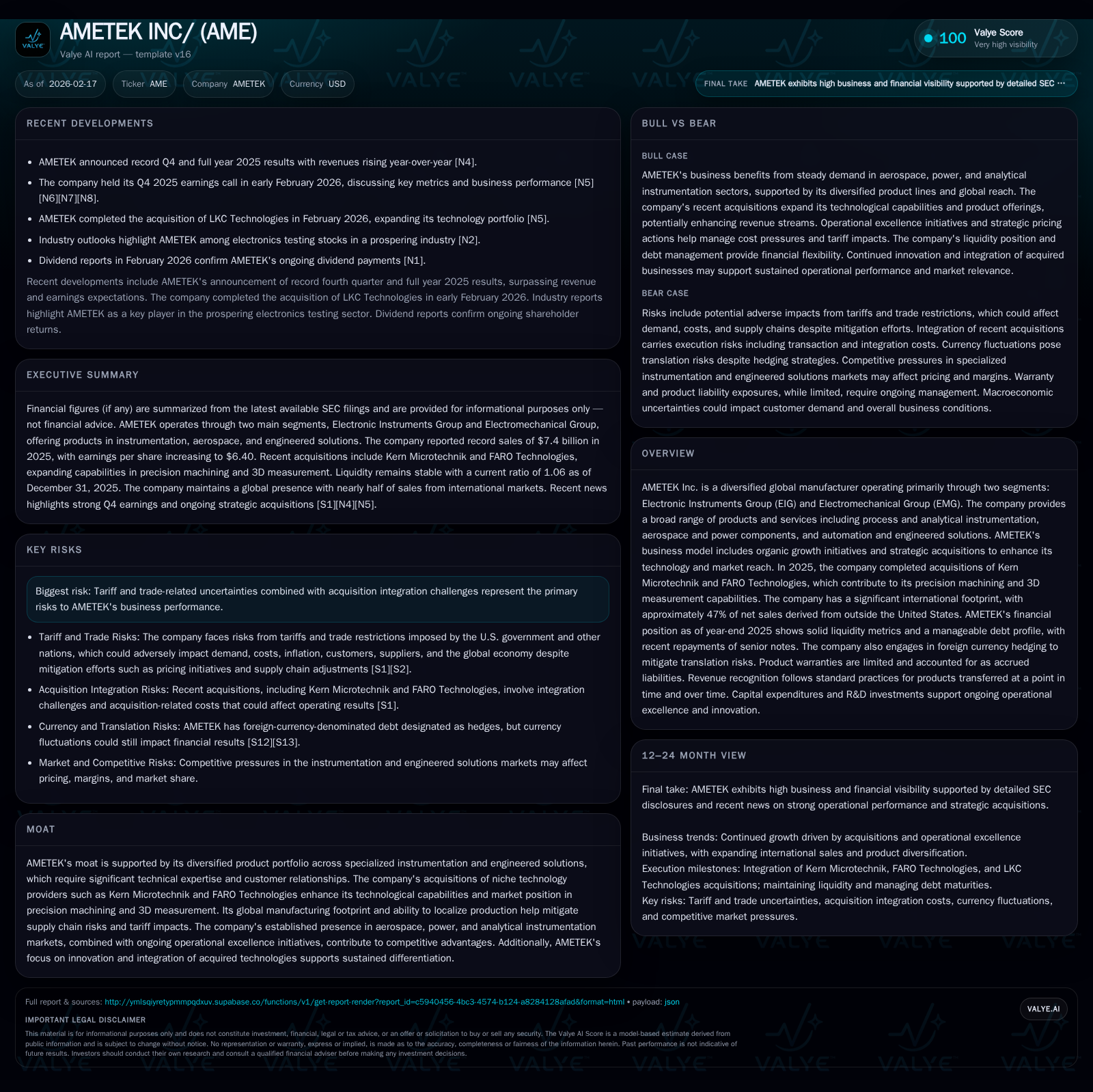
AMETEK Inc. demonstrated solid financial performance in fiscal 2025, with operating income rising 7.3% year-over-year and net income increasing 7.6%, driven by both organic growth and strategic acquisitions. The company expanded its technological capabilities through acquisitions of Kern Microtechnik and FARO Technologies, strengthening its position in precision machining and 3D measurement sectors. With approximately 47% of sales derived internationally, AMETEK navigates trade policy challenges with a global manufacturing footprint and localization strategies. Capital allocation remained disciplined, marked by a 10% dividend increase, significant debt repayment, and accelerated share repurchases. Key risks include integration complexities and tariff uncertainty, but the firm’s robust cash flow generation and operational initiatives underpin positive growth prospects heading into 2026.
FY2025 Financial Performance: Solid Gains Backed by Diversification
AMETEK concluded fiscal year 2025 with robust financial metrics underscoring its diversified industrial manufacturing model's resilience. Operating income rose to approximately $1.91 billion for the year ended December 31, 2025, marking a healthy increase of about 7.3% over the prior year total of roughly $1.78 billion [F1]. Net income similarly grew to $1.48 billion, representing a parallel rise of approximately 7.6%. Though full revenue data for FY2025 is not explicitly tagged as XBRL facts here, management reported total sales around $7.4 billion—a solid YoY gain of nearly 6.6% driven primarily by combined organic expansion and acquisition contributions [S1][N8].
This operating leverage—reflecting efficient cost management alongside sequential top-line increments—was partly fueled by firm orders backlog increasing notably through the year within both principal reporting segments: Electronic Instruments Group (EIG) and Electromechanical Group (EMG). The firm maintains a backlog horizon that stretches predominantly across two to three years for non-cancelable orders beyond one-year delivery windows, providing both revenue visibility and production planning stability [S4]. Incremental capital expenditures were modest at around $130 million—up roughly 2.5% from the prior year—indicating steady investment without dilutive overreach [F1].
Margin resilience was further supported by ongoing Operational Excellence initiatives aiming for manufacturing efficiency gains across the global footprint [N8]. Such efforts compensated partially for currency translation headwinds—common among multinational manufacturers facing fluctuating GBP/EUR rates—and slightly offset acquisition-related margin dilution.
Historical performance (annual)
| FY | Net ($mm) | CFO ($mm) | OpInc ($mm) | Capex ($mm) | Net YoY |
|---|---|---|---|---|---|
| 2025 | 1480 | 1802 | 1910 | 130 | +7.6% |
| 2024 | 1376 | 1829 | 1780 | 127 | +4.8% |
| 2023 | 1313 | 1735 | 1707 | 136 | +13.3% |
| 2022 | 1160 | 1149 | 1501 | 139 |
Note: Omitted columns lack sufficient annual XBRL coverage in the provided tags (need ≥2 annual points): Rev. Source: SEC companyfacts cache [F1].
Capital returns and efficiency (annual)
| FY | Div ($mm) | Buybacks ($mm) | FCF ($mm) |
|---|---|---|---|
| 2025 | 285 | 434 | 1672 |
| 2024 | 259 | 212 | 1702 |
| 2023 | 230 | 8 | 1599 |
| 2022 | 202 | 333 | 1010 |
Source: SEC companyfacts cache [F1].
Note: Revenue not available from tags; other metrics omitted due to insufficient annual data points.
Acquisitions Enhance Precision Technologies and Market Reach
Strategic acquisitions marked a pivotal element of AMETEK’s growth platform in FY2025 with two key deals closing: Kern Microtechnik in January and FARO Technologies in July [S1][N2]. Kern brings high-precision machining and optical inspection solutions while FARO adds leading-edge capabilities in advanced three-dimensional measurement and imaging systems.
These cogent additions serve to expand AMETEK's product breadth notably within niche precision instrumentation markets where technical differentiation is paramount—especially aerospace components manufacturing and high-tech automation sectors where tolerances mandate exacting quality control measures.
The combined cash consideration near $933 million underscores the company’s commitment to accretive acquisitions that complement both EIG’s analytical instrumentation focus and EMG's electromechanical engineered solutions portfolio [S1]. Successful integration will hinge on effective synergy realization timelines focused on streamlining overlapping operations without diluting customer-facing innovation momentum.
However, sector-native insights signal meaningful integration risk exists given the sophisticated nature of these specialized technologies plus market dynamics requiring agility amid ongoing trade uncertainties [S8][S10]. Accordingly management has identified these as principal business risks while implementing rigorous due diligence post-close.
Segment Analysis: EIG and EMG Contributions to Revenue Mix
AMETEK operates principally through two reportable segments:
- Electronic Instruments Group (EIG): Centered around process and analytical instrumentation solutions serving industries requiring sensor accuracy such as environmental monitoring and general manufacturing measurement.
- Electromechanical Group (EMG): Focused on aerospace power components plus automation-driven engineered solutions integral for critical infrastructure applications.
For the first nine months of calendar year-to-date September 30th 2025 (latest available interim data), EIG generated roughly $3.55 billion in net sales versus EMG's approximately $1.85 billion — collectively accounting for close to $5.4 billion total consolidated revenues excluding corporate eliminations [S4][S6].
EIG's strength remains anchored in process instrument sales (which reached over $2.46 billion YTD), while EMG captured sizable demand gains from aerospace/power products along with automation-engineered solutions totaling over $1.3 billion YTD sales within that segment alone [S6]. Despite EIG experiencing some operating margin compression attributable partially to acquisition dilution (~50bps impact) along with currency swings, EMG improved margins sharply reflecting leaner operating models post acquisition integration luggage removal [S27].
The differing product lifecycles between durable aerospace components versus steady demand for analytical instrumentation also provide natural cyclicality hedging within AMETEK portfolios.
Geographic Exposure: Balancing U.S. Dependence with International Sales
Approximately 47% of AMETEK's net sales stem from outside the United States—a significant but well-managed global footprint balancing domestic exposure with vital international markets including Europe (notably UK & EU countries) plus Asia-Pacific regions [S4][S6]. This broad geographic diversification supports resilience against localized disruptions such as tariffs or geopolitical tensions.
Sales segmentation indicates steady expansion internationally through export activities too — with U.S export sales accounting for nearly half a billion dollars quarterly contributing materially to these statistics [S4]. The company leverages an effective 'localization strategy' by producing goods closer to end markets mitigating tariff impacts augmented by flexible supply chain reconfiguration capabilities detailed in filings [S13][S19]. This multi-pronged approach aims to ensure supply chain continuity despite evolving global trade policies.
Outlook 2026: Guidance Reflecting Opportunities and Trade Uncertainties
AMETEK issued preliminary guidance reflecting ongoing moderate growth tempered by broader external factors such as potential new tariffs or regulatory changes affecting its end markets [N7].[N2] Management highlighted expectations for continued organic sales acceleration driven by sustained demand within aerospace power components alongside incremental contributions from recent acquisitions fostering technology-driven competitive advantages.
Notwithstanding this positivity on demand visibility across core sectors—the forecast horizon embeds caution around evolving trade policies which may introduce cost pressures or timing delays impacting margin trajectory temporarily.
Absent definitive forward-looking quantitative guidance within public disclosures at present, stakeholders should monitor order backlog evolution—especially >12 month firm commitments—as early signs of demand inflections or softness.
Capital Allocation Priorities: Share Repurchases, Dividend Increases, and Debt Management
Fiscal discipline remains prominent in AMETEK’s capital deployment framework during FY2025 with meaningful progress made across several fronts:
- Dividends: The Board approved a 10% raise on quarterly dividends effective February 2026 elevating payouts from $0.31/share to $0.34/share—a signal of confidence in ongoing free cash flow generation capacity [S3][N13].
- Share Buybacks: Fiscal year repurchases surged substantially—to over $434 million, doubling prior year activity reflecting opportunistic capitalization on market conditions alongside excess liquidity accumulation [F1].
- Debt Repayment: Senior notes totaling $425 million matured fully and were retired during multiple quarters throughout FY25 reducing interest expense load incrementally while maintaining manageable leverage levels consistent with maintaining investment-grade credit standing per risk disclosures [S15],[S23],[F1].
A simple return on equity measure derived from last reported figures approximates ROE near 13.9%, reinforced by improved net income yields coupled with moderate leverage usage supporting enhanced shareholder returns metrics without compromising balance sheet flexibility [F1]. This capital allocation stance balances rewarding shareholders today while preserving resources for future strategic investment opportunities.
Operating Cash Flow Dynamics and Free Cash Flow Generation
Operating cash flow generation totaled approximately $1.80 billion during FY25 representing a slight decline (-1.5%) versus prior year levels which included some higher working capital timing effects; nonetheless it provides ample coverage for capital investments supporting expansion plans including acquired asset integration plus dividend commitments [F1].
Capital expenditures at about $130 million reflect steady reinvestment primarily aimed at capacity enhancements supporting precision machining tooling upgrades plus automation solution deployments aligned with long-term manufacturing scalability needs [S9],[F1]. After capex adjustments, free cash flow approximated $1.67 billion which affords strong liquidity cushion underpinning strategic flexibility even amidst macroeconomic volatility.
This conversion cycle profile highlights prudent inventory controls; notably raw material stocking increased modestly supporting Kanban replenishment systems aiding just-in-time production flows especially relevant within precision instrument fabrication segments where material lead times can extend significantly.
Risks to Watch: Acquisition Integration and Trade Policy Challenges
AMETEK explicitly flags acquisition integration complexity as a critical risk considering recent substantial deals involving highly technical firms Kern Microtechnik and FARO Technologies whose cultural/operational assimilation requires delicate orchestration across engineering teams globally [S8][S10].
Moreover geopolitical trade uncertainties continue posing potential disruption via tariffs or retaliatory duties introducing input cost volatility or logistics delays particularly impacting materials sourced internationally or products sold into tariff-sensitive markets. While proactive price adjustments have been implemented where feasible concurrent with supply chain re-shoring/localization tactics these risks remain material watchpoints amidst evolving trade negotiations.
Environmental liability exposures linked historically to manufacturing practices also persist but remain well reserved against with no material adverse impact anticipated imminently per SEC disclosures [S8],[S10].
What Investors Should Monitor Ahead
Looking forward into calendar year 2026 key operational indicators warrant careful observation:
- Firm orders backlog evolution exceeding one-year delivery commitments – early harbinger of cyclical shifts or demand strength sustaining top-line momentum;
- Margin progression amid foreign currency fluctuations coupled with cost inflation / supply chain input pricing developments;
- Progress against acquisition synergy targets particularly related to FARO transaction finalized mid-2025;
- Execution advancements on Operational Excellence programs driving productivity gains;
- Capital deployment effectiveness evidenced via balanced increases in dividends coupled with disciplined buybacks without eroding financial flexibility;
- Macroeconomic/tariff environment updates including new policy enactments potentially adjusting cost structures or competitive positioning.
Subsequent earnings releases communicated clarity on these frontiers will provide critical directional cues catalyzing investor reassessment given external macro sensitivities affecting industrial manufacturing cohorts broadly.
Disclaimer: This analysis is intended solely for informational purposes based on publicly sourced company filings and news as cited; it does not constitute investment advice or recommendations.
Disclaimer: This is research-only, informational analysis and not investment advice. It may include AI-generated interpretation and general industry context. Always verify important details using primary sources.

Comments