
Eversource Energy Balances Regulatory Complexity and Cybersecurity Risks with Strong Operational Growth
Eversource Energy shows robust revenue and operating income growth despite net income pressure, navigating regulatory and cybersecurity challenges inherent in New England utilities.
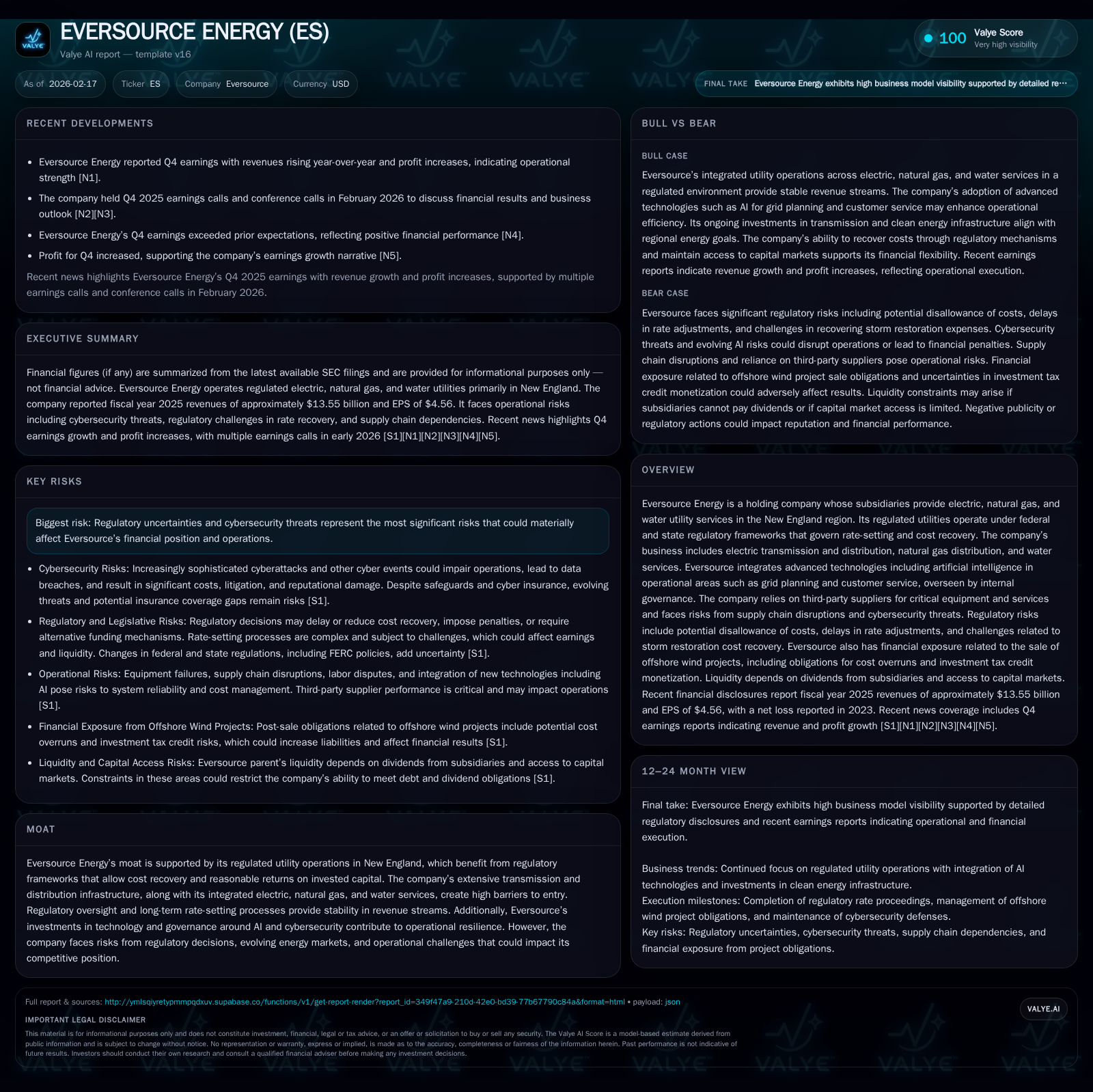
Eversource Energy's regulated utility model, grounded in electric, natural gas, and water services across New England, has supported substantial revenue and operating income growth through 2025 despite a net loss reported in 2023. The company's future growth is anchored in infrastructure investments, technology integration including AI, and regulatory approvals, though headwinds from regulatory uncertainties, cybersecurity threats, and climate change persist. Cash flow generation remains strong with high operational cash flow offsetting capital expenditures. Dividend payments have steadily increased without clear buyback activities disclosed. Investors should track evolving regulatory outcomes, cost recovery proceedings particularly surrounding storm restoration expenses, and management’s approach to cybersecurity as critical milestones.
Company Overview and Historical Performance
Eversource Energy is a holding company operating essential electric, natural gas, and water utilities throughout New England. Its subsidiaries operate within federal and multiple state regulatory frameworks that establish rate-setting protocols to recover prudently incurred costs plus reasonable returns on investment capital [S1][S4]. The company’s broad infrastructure network creates significant entry barriers supported by regulatory oversight granting predictable revenue streams.
Historical financial performance reflects steady growth punctuated by recent net income variability. Revenue rose from $11.9 billion in 2023 to $13.5 billion in 2025—a solid compound annual growth trajectory of approximately 6% annually—but with variable underlying factors driven by regulatory outcomes and energy market conditions (see Table below) [F1].[^
Historical performance (annual)
| FY | Rev ($bn) | Net ($mm) | CFO ($bn) | OpInc ($bn) | Rev YoY | Net YoY |
|---|---|---|---|---|---|---|
| 2025 | 13.5 | 4.1 | 3.0 | +13.8% | ||
| 2024 | 11.9 | 2.2 | 2.4 | -0.1% | ||
| 2023 | 11.9 | -435 | 1.6 | 2.4 | -3.1% | -130.8% |
| 2022 | 12.3 | 1412 | 2.4 | 2.2 | +15.0% |
Note: Omitted columns lack sufficient annual XBRL coverage in the provided tags (need ≥2 annual points): Capex, Buybacks. Source: SEC companyfacts cache [F1].
Capital returns and efficiency (annual)
| FY | Div ($mm) | FCF ($bn) | ROE% |
|---|---|---|---|
| 2025 | 1093 | -0.0 | |
| 2024 | 1001 | -2.3 | |
| 2023 | 919 | -2.7 | -3.1 |
| 2022 | 860 | -1.0 | 9.1 |
Source: SEC companyfacts cache [F1].
Note: Net income for FY2025 not available; net shown for most recent years only.
The large jump in operating cash flows in FY2025 (+90%) underpins the company’s ability to finance substantial infrastructure investments while maintaining dividend payouts above $1 billion annually [F1]. Capital expenditures have remained elevated between $3-4+ billion annually as Eversource upgrades its aging electric transmission & distribution assets alongside expanding natural gas and water infrastructure to meet grid reliability standards and environmental mandates [F1][S4][S13].
Growth Drivers and Future Prospects
Eversource’s core growth engine is its regulated utility model which provides near-term visibility into tariffs that recover invested capital plus an allowed return on equity (ROE). The company’s extensive investments in upgrading transmission infrastructure—amid regulatory approval of rate cases—are pivotal growth drivers [S8][S16][S18]. Furthermore, Eversource actively pursues emerging clean energy projects such as distributed generation interconnections and grid modernization initiatives including AI adoption for asset management & grid planning [S10].
These technological advancements promise enhanced operational efficiency but simultaneously introduce novel risks around AI governance, bias mitigation, forecast reliability, and evolving compliance demands [S10]. Integration of AI reflects broader industry trends as utilities digitize operations; however, it demands cautious oversight given its potential impact on customer service quality and outage response.
The company is also navigating an energy transition landscape shaped by increased renewable portfolio standards requiring higher renewable energy credit purchases which may elevate compliance costs if new capacity lags demand growth [S7]. Additionally, growing attention to environmental issues such as lead pipe replacement in water services and PFAS contamination necessitates significant capital allocation impacting near-term cash flow flexibility [S22][S23].
On regulatory fronts, periodic rate case approvals can be contentious with uncertainties from delayed adjustments or partial disallowances—storm restoration cost recovery being a key challenge given the increasing frequency of extreme weather events linked to climate change [S6][S19]. Success navigating these approvals will be critical for sustaining revenue momentum.
Financial Health, Returns and Capital Allocation
Despite mixed earnings results evidenced by net losses recorded in FY2023 (-$435 million), Eversource maintains robust operational cash flow generation supporting substantial reinvestment into capital assets as well as consistent dividend payments totaling approximately $1 billion annually by FY2025 [F1]. The company’s approximate ROE based on trailing net income against equity stands negative due to episodic charges but should be viewed considering the regulated nature which typically dampens earnings volatility over longer cycles [F1].
The absence of disclosed share repurchase programs suggests dividends remain the primary channel for shareholder returns currently.
From a liquidity perspective, Eversource raised $600 million via senior notes at fixed rates recently underscoring active debt market access crucial for funding its aggressive capex plans under tight credit conditions [S26][S28]. Subsidiary dividends fund holdco liquidity which is essential since parent entity has no direct revenue stream—a common structure for regulated utilities [S9][S29].
Risks Concentration: Regulation and Cybersecurity
Key vulnerabilities persist around regulatory outcomes that influence timing & adequacy of cost recovery across electric, gas & water operations encompassing storm expenses, prudency reviews, return allowances, and legislated environmental mandates [S5][S16][S18].[^
Cybersecurity risks constitute another existential threat with Eversource facing increasingly sophisticated AI-enabled cyberattack attempts targeting critical infrastructure systems controlling transmission/distribution assets across all utilities lines-of-business [S14][S15]. Despite comprehensive multi-layered defenses including encryption protocols, patching regimes for vulnerabilities, insurance coverage limitations highlight residual exposure to potentially disruptive incidents leading to service interruptions or data breaches impacting financial reporting fidelity.
Furthermore, reputational risk stemming from adverse public or regulatory perceptions around safety performance during outages or environmental compliance failure also poses downside operational impact potential requiring continued proactive engagement.
Operational Considerations Amid Climate Change Pressures
Climate change intensifies physical risks through more frequent severe weather events necessitating higher restoration spend potentially not fully recoverable depending on prudency assessments by regulators—a tension balancing reliability investment versus cost containment remains acute for investor confidence [S19][S25].[^
Water business segments face inherent supply adequacy constraints aggravated by stricter downstream release regulations coupled with contamination control requirements driving higher maintenance costs threatening margin pressures without timely regulatory recovery mechanisms [S22][S23].
What to Watch Ahead: Analysis Perspective
With no explicit forward guidance provided publicly recently beyond general strategic initiatives noted in filings and earnings commentary ([N1],[N2]), market participants should closely monitor:
- Outcomes of ongoing & future base rate cases especially related to storm restoration cost recovery timing.
- Regulatory responses to AI incorporation practices affecting operational risk exposures.
- Capital spending effectiveness versus allowed returns within altered FERC transmission incentive landscapes.
- Progress on environmental compliance projects addressing PFAS lead concerns impacting water utilities.
- Developments surrounding offshore wind project financial exposures post asset divestitures.
- Cybersecurity incident reports or lack thereof given rising attack sophistication.
- Credit rating changes influenced by leverage effect of large scale capex programs.
Conclusion
Eversource Energy exemplifies a utility leveraging stable regulated frameworks while embracing technology-driven efficiencies amidst evolving risk landscapes encompassing both traditional regulatory uncertainties and cutting-edge cybersecurity challenges involving AI tools deployment. The firm’s strong revenue and operational cash flow growth juxtaposed with episodic net loss badges caution highlighting importance of effective capital allocation discipline alongside successful navigation through complex stakeholder environments governing cost recovery mechanisms detailed extensively throughout its latest disclosures. Analysts should prioritize monitoring regulatory milestones tied directly to earnings sustainability alongside management’s advancement on infusion of technology balanced with prudent risk governance shaping longer-term performance prospects.
This analysis incorporates data derived from SEC filings dated up to February 17, 2026 ([F1],[S#]), combined with recent market commentary ([N#]). It does not constitute investment advice but serves as a thorough informational assessment.
Disclaimer: This is research-only, informational analysis and not investment advice. It may include AI-generated interpretation and general industry context. Always verify important details using primary sources.

Comments