
Tenet Healthcare’s Earnings Momentum and Strategic Investments Highlight 2025 Performance
Tenet Healthcare sustained strong cash flow and completed key network expansions in 2025 despite operating income margin pressure and sizeable debt obligations.
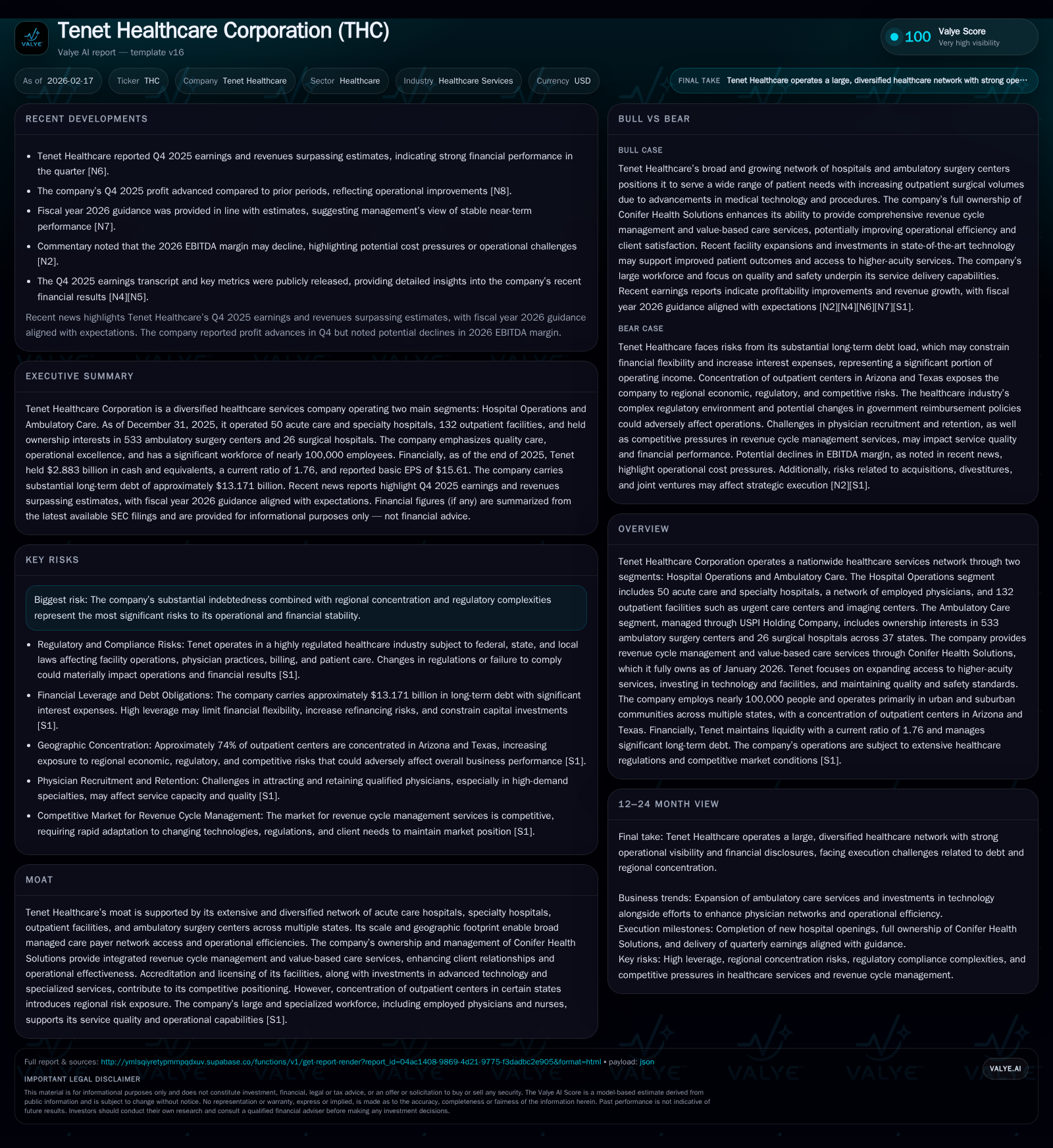
In 2025, Tenet Healthcare Corporation achieved a robust operational cash flow increase supporting strategic investments including new hospital openings and ASC expansions. While revenue rose modestly by 4% year-over-year, operating income declined by 41%, reflecting margin pressures from managed care reimbursement dynamics and elevated costs. The company’s extensive acute care and ambulatory networks, underpinned by its Conifer Health Solutions revenue cycle management services, provide scale advantages but face regional concentration risks. Tenet’s capital allocation heavily favored share repurchases alongside sizeable capital expenditures, balanced against a substantial long-term debt load bound by restrictive covenants. Market watchers should monitor managed care contract renewals and regulatory developments closely as Tenet approaches key refinancing milestones in 2026.
Resilient Operating Performance Drives 2025 Financial Results
Tenet Healthcare posted revenue growth of approximately 4% for fiscal year 2025 compared with the prior year, reaching $3.508 billion in operating income down from $5.956 billion in 2024—a decline of about 41%. This divergence illustrates significant margin compression likely driven by ongoing reimbursement rate pressures from managed care payers alongside inflationary cost increases [F1],[N1],[N4]. However, the company’s ability to convert earnings into cash improved notably; operating cash flow jumped nearly 73% from $2.047 billion in FY2024 to $3.540 billion in FY2025 [F1]. This robust cash generation improved liquidity substantially even as earnings volatility persisted.
The disparity between declining operating income yet accelerating CFO suggests effective working capital management—possibly leveraging tighter revenue cycle controls through Conifer Health Solutions—and underscores an operational focus on cash generation amid market challenges [N4]. Capex rose modestly (+8.5%) to $1.01 billion reflecting growth investments [F1].
Historical performance (annual)
| FY | CFO ($bn) | OpInc ($bn) | Capex ($mm) |
|---|---|---|---|
| 2025 | 3.5 | 3.5 | 1010 |
| 2024 | 2.0 | 6.0 | 931 |
| 2023 | 2.4 | 2.5 | 751 |
| 2022 | 1.1 | 2.3 | 762 |
Note: Omitted columns lack sufficient annual XBRL coverage in the provided tags (need ≥2 annual points): Rev, Net, Div, ROE%. Source: SEC companyfacts cache [F1].
Capital returns and efficiency (annual)
| FY | Buybacks ($mm) | FCF ($bn) |
|---|---|---|
| 2025 | 1386 | 2.5 |
| 2024 | 672 | 1.1 |
| 2023 | 200 | 1.6 |
| 2022 | 250 | 0.3 |
Source: SEC companyfacts cache [F1].
Note: Revenue absolute values for FY2019-20 not directly comparable due to different line items reporting; Net Income unavailable beyond early data points; Dividends not disclosed.
Expansion of Acute Care and Ambulatory Networks Bolsters Service Offering
Tenet continues to grow its footprint across both Hospital Operations and Ambulatory Care segments—two pillars defining its market presence nationwide ,[S1],[N2]. The opening of the Florida Coast Medical Center (54 beds) in Port St. Lucie in September 2025 exemplifies strategic investment focused on advancing access to higher-acuity services such as advanced cardiac care, neurosciences, orthopedics, robotics, and urology within attractive urban-suburban markets [N2],.
The Hospital Operations segment manages an extensive network comprising approximately fifty acute care and specialty hospitals augmented by over one hundred outpatient facilities like urgent care centers (UCCs), imaging units, micro-hospitals, and off-campus emergency departments [S1],. This variety addresses a wide acuity spectrum and leverages ambulatory surgery center (ASC) penetration—the latter primarily driven though the Ambulatory Care segment under USPI holding company ownership.
USPI’s portfolio spans ownership interests across more than five hundred ASCs and over two dozen surgical hospitals delivered via joint ventures with physicians or health systems covering thirty-seven states ,[S21]. This broad ASC presence reflects important healthcare sector trends favoring ambulatory procedures for lower costs relative to inpatient stay while maintaining clinical outcomes—a competitive imperative for healthcare operators seeking utilization leverage.
Conifer Health Solutions' acquisition completion in January of this year integrates revenue cycle management more fully within Tenet’s service delivery model, aiming to reduce denials, improve coding compliance, and enhance billing efficiency supporting both segments’ volume growth ambitions ,[S21]. Regional concentration risks exist given outpatient centers cluster within several states—a common healthcare challenge balancing scale against local market exposure .
Managed Care Contract Landscape: Risk and Revenue Implications
Managed care contractual relations underpin most of Tenet's net patient service revenues—approximately seventy percent deriving from contracts with HMOs, PPOs and government payers including Medicare/Medicaid managed care programs [S1],[S24]. Notably, Tenet’s top-10 managed care payers together contributed close to seventy percent of this segment’s reimbursements during FY2025 [S1], marking significant counterparty risk if negotiations falter or reimbursement rates decline.
Contractual dynamics are critical in light of industry consolidation among payers—which inevitably strengthens their negotiating clout—and ongoing efforts encouraging use of certain preferred providers through discounts or utilization management protocols [S24]. These contractual limits constrain Tenet’s ability to implement price increases sufficient to offset inflation-driven cost trends.
Additional headwinds cited include escalating payment denials both prospectively and retrospectively from managed care entities alongside rising coverage shifts towards high-deductible health plans raising patient collection risk profiles at point-of-service [S1],[S24]. Regulatory price transparency mandates further complicate rate negotiation as competitive provider networks increasingly face payer scrutiny on quality versus cost trade-offs impacting final reimbursement schedules going forward [S24].
Capital Allocation Strategy Reflects Focus on Returns and Deleveraging
Tenet’s capital deployment priorities over recent years demonstrate heavy shareholder returns via share repurchases climbing from around $200 million in FY2023 to nearly $1.39 billion in FY2025 while simultaneously directing roughly one billion dollars annually towards capital expenditures targeting strategic growth projects including new hospital builds [F1],[N1],[S5].
Dividend payments remain undisclosed within available filings or XBRL metrics indicating either a pause or absence presently—a not uncommon stance for companies balancing aggressive buybacks amidst sizable leverage burdens.
Despite an operating environment featuring negative net income visibility at times historically, the approximate return on equity stands at an elevated ~26.5%, largely supported by substantial shareholder capital returns through repurchases which compress equity while deploying capital efficiently relative to reported net earnings [F1].
Nevertheless, such a buyback-heavy strategy invites scrutiny given Tenet’s meaningful outstanding debt load requiring careful balance with deleveraging ambitions as well as credit covenant compliance constraints discussed below.
Cash Flow Strength Fuels Growth Investments Amid Elevated Capex
The surge in CFO from $2.05 billion to $3.54 billion year-over-year materially supports increased capex spending (+8%) totaling approximately $1 billion invested mostly into foundational infrastructure such as the new Florida Coast Medical Center launch [F1],[N2].
Positive free cash flow exceeding $2.53 billion underscores effective conversion from revenues despite margin challenges providing financial flexibility for organic expansions while maintaining operational capabilities [F1]. This robust liquidity base is critical amid other financial commitments requiring focus beyond just earnings figures.
Debt Profile and Covenant Constraints: Navigating Financial Flexibility
At December end-2025, Total Long-Term Debt stood near $13.17 billion supported by revolving credit facilities up to $1.9 billion subject to borrowing base calculations tied to inventory and accounts receivables collateralization [S4],[S5],[S6],[S7],[S9]. Interest expense represented roughly twenty-three percent of operating income ($821 million), highlighting the substantial financing cost burden relative to earnings capacity [F1],[S10].
Debt agreements impose numerous restrictive covenants limiting incurrence of liens, asset sales, mergers/acquisitions activities outside approved parameters as well as additional indebtedness subject to thresholds potentially curbing operational agility if leverage targets are breached or liquidity tightens unexpectedly [S5],[S7].
Moreover, certain maturity clauses ('Springing Maturity Dates') require principal repayments or refinancings linked with upcoming note maturity profiles stretching between fiscal years 2027–2030 positioning upcoming years as sensitive periods for securing refinancing on acceptable terms amidst broader capital markets uncertainty [S14],[S19],[S22],[S27].
Regional concentration risks compound financial leverage exposure given outpatient center clustering remunerated primarily via state-specific commercial contracting arrangements vulnerable to legislative or payer policy shifts .
What to Watch: Upcoming Milestones and Market Signals for 2026
The calendar ahead features potential managed care contract renegotiations that may materially influence patient volumes and pricing power—contract renewals will bear watching given rising costs confronting payers alongside evolving utilization reviews potentially impacting procedure mix realized pricing [N10],[N6].[N7]
Tenet has guided FY26 EBITDA margins aligned with consensus estimates but flagged possible margin compression given ongoing inflationary and competitive pressures despite prior quarterly earnings beats suggesting cautious operational optimism balanced against payer leverage realities [N1].
Debt refinancing activity looms large due to significant note maturities approaching within five years mandating proactive liquidity planning especially under current credit covenant frameworks constraining financial maneuverability [S4],[S14],[S27]. Regulatory developments related to price transparency requirements could add additional administrative burdens influencing revenue cycle efficacy particularly through Conifer operations necessitating heightened compliance protocols moving forward [S8].[S11].[S17]
Investors should monitor capital markets conditions affecting refinancing costs as well as execution on growth strategy including further facility openings or acquisitions signaling long-term confidence despite near-term headwinds.
Disclaimer: The information provided herein is based solely on publicly available data up to February 17, 2026 ([F1], [N#], [S#]) without speculative forecasts or investment recommendations.
Disclaimer: This is research-only, informational analysis and not investment advice. It may include AI-generated interpretation and general industry context. Always verify important details using primary sources.

Comments