
UDR's Mixed Asset Strategy Balances Growth Prospects with Interest Rate Sensitivities
UDR, Inc. leverages its multifamily portfolio diversification and disciplined capital management to drive stable results amid evolving economic conditions.
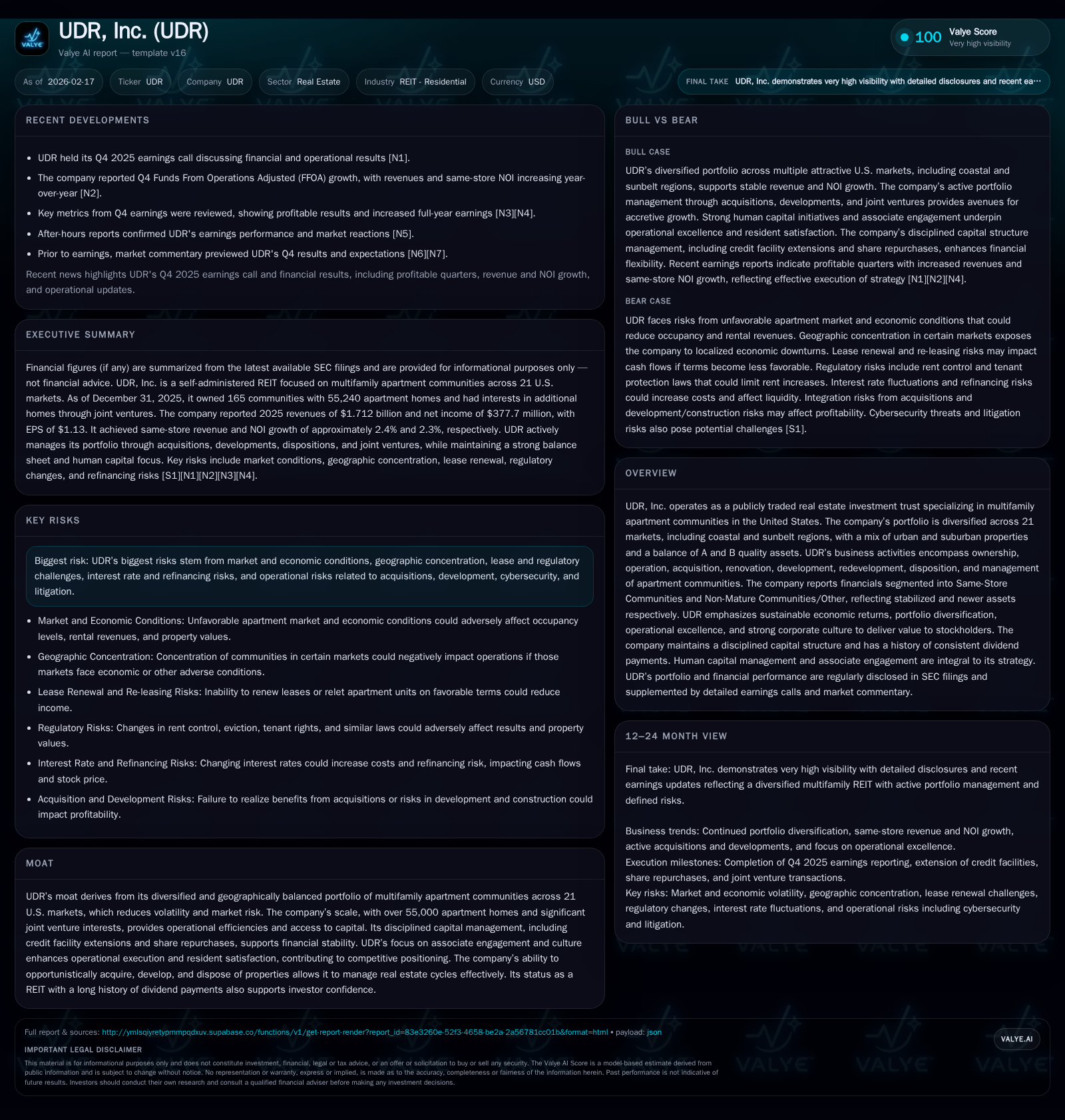
UDR operates a large diversified portfolio of multifamily apartment communities spanning 21 U.S. markets, blending urban and suburban assets across A and B quality segments. The company has delivered consistent revenue and cash flow growth driven by operational excellence and strategic property reinvestment amid a cautious development pipeline. Capital allocation emphasizes steady dividends supported by strong operating cash flows, with heightened focus on managing interest rate risks through its flexible capital structure. Key risks include market concentration, regulatory challenges, and refinancing needs as unsecured debt maturing in 2026 creates liquidity considerations.
Company Overview
UDR, Inc. is a publicly traded REIT specializing in the ownership, operation, acquisition, renovation, development, redevelopment, disposition, and management of multifamily apartment communities across the United States. The company's footprint spans 165 communities concentrated in 21 diverse geographic markets covering coastal and sunbelt regions. Within these markets, UDR holds a portfolio balanced between urban (32%) and suburban (68%) locations alongside a mix of A (44%) and B (56%) quality properties, aiming to mitigate market volatility through diversification strategies [S1][S12].
The company also holds interests in unconsolidated joint ventures comprising an additional approximate 12,167 apartment homes — including preferred equity stakes — broadening its operational scale beyond wholly owned assets [S1][S17].
Historical Performance
Over the past several years leading into calendar year-end 2025, UDR consistently expanded revenues and maintained positive net income trajectories rooted in stable rental demand and effective portfolio management.
Historical performance (annual)
| FY | Rev ($mm) | Net ($mm) | CFO ($mm) | OpInc ($mm) | Rev YoY | Net YoY |
|---|---|---|---|---|---|---|
| 2025 | 1712 | 378 | 903 | 554 | +2.4% | +321.6% |
| 2024 | 1672 | 90 | 877 | 285 | +2.7% | -79.8% |
| 2023 | 1628 | 444 | 833 | 635 | +7.3% | +411.2% |
| 2022 | 1517 | 87 | 820 | 251 |
Note: Omitted columns lack sufficient annual XBRL coverage in the provided tags (need ≥2 annual points): Capex, FCF. Source: SEC companyfacts cache [F1].
Capital returns and efficiency (annual)
| FY | Div ($mm) | Buybacks ($mm) | ROE% |
|---|---|---|---|
| 2025 | 568 | 118 | 11.5 |
| 2024 | 558 | 25 | 2.6 |
| 2023 | 540 | 25 | 11.1 |
| 2022 | 484 | 49 | 2.1 |
Source: SEC companyfacts cache [F1]. | Notes:
- 'Rev' is total revenue; 'OpInc' is operating income; 'Net' is net income; 'CFO' is cash flow from operations; 'Div' is dividend payments.
- Significant fluctuations in OpInc & Net reflect gains from asset sales realized mainly in FY23 & FY25 impacting comparability.
Revenues have increased modestly but steadily largely driven by incremental rent growth within the same-store portfolio and contributions from newer properties moving into stabilization phases as well as fee income from management of joint ventures [N13][N3]. Operating income exhibited notable volatility linked to gains on dispositions—$195 million gain recorded on partial sale transactions during FY25 bolstered operating results substantially compared to prior years [S13].
Net income showed similar step changes impacted primarily by these gains and timing of impairments or amortizations related to preferred equity investments held by UDR's unconsolidated entities [S17]. Operating cash flows advanced steadily supporting both dividend payouts and reinvestment in property improvements.
Growth Prospects
Looking forward, UDR’s growth outlook builds on several pillars:
- Portfolio Optimization: Continued selective acquisitions geared towards primary growth markets with favorable demographic trends alongside disposals of underperforming or non-core assets are expected to enhance yield quality [S13].
- Operational Excellence: Investment in asset enhancements including technology integrations such as smart home systems amplifies resident retention metrics and supports premium pricing capabilities [S13].
- Limited Development Pipeline: With only one development project underway (300 units budgeted at ~$134 million due Q2 2027) and no major redevelopment currently active, organic growth opportunity through supply addition is constrained but reflects prudence amid macroeconomic uncertainty [S10][S13].
- Joint Ventures Expansion: Leveraging partner capital allows exposure to complementary portfolios without increasing balance sheet leverage materially—participation in preferred equity investments provides steady fee streams plus long-term appreciation potential [S17].
Potential headwinds include rising interest rates increasing borrowing costs as variable-rate debt accounts for nearly half of interest-bearing liabilities without swaps hedging some of this exposure [S15]. Also, concentrated presence in select sunbelt/coastal metros entails vulnerability should localized economic or regulatory conditions deteriorate unexpectedly [S1][N1]. Lease renewal rates and regulatory environments such as rent control remain ongoing considerations affecting operating margins.
Financial Structure & Liquidity
At December 31st, 2025, UDR reported robust liquidity characterized by ample undrawn availability under its revolving credit facility ($1.3 billion capacity) along with access to a $700 million unsecured commercial paper program — issued notes outstanding at $445 million leaving meaningful unused capacity [S4][S18].
Long-term debt maturity schedules indicate that about $801 million of secured debt obligations plus roughly $745 million unsecured debt face repayment during FY26 requiring either refinancing actions or deployment of free cash flows generated from operations or asset dispositions [S20][S26]. These maturities highlight refinance risk common across REITs but mitigated here through prudent staggered debt structures.
As of year-end:
- Interest rates on the revolving facility hover around SOFR plus ~0.775%, with a facility fee approximating .15%; term loan margins are slightly higher averaging at SOFR plus .85%. The extension options established through amendments provide flexibility on maturity timelines through early next decade [S5][S6].
- Variable-rate debt totaling approximately $673 million exposes the company to incremental cost pressure; sensitivity analysis suggests a parallel shift of one hundred basis points would elevate annual interest expense by ~$6+ million absent strategic hedging adjustments or liability restructuring [S15].
Capital Allocation & Returns
UDR returned $567.9 million to common stockholders via dividends in FY25 — reflecting its commitment as a longstanding dividend-paying REIT — paired with share repurchases totaling nearly $118 million demonstrating opportunistic financial discipline aimed at offsetting dilution while supporting price levels where feasible [F1][S14].
Operating cash flow generation ($903 million) comfortably exceeds capex needs (not fully tagged but indicated near low hundreds millions previously) implying healthy free cash flow (approximate FCF close to $898 million), sufficient for dividends and selective buybacks without compromising balance sheet integrity.
While explicit ROE data isn't directly provided within tags, calculated approximate ROE stands near an estimated ~11.5%, indicating efficient use of shareholder equity given the capital-intensive nature of real estate operations [F1].
Industry Context & Operational Insights
In the multifamily REIT sector amid current macroeconomic trends characterized by rising interest rates post-pandemic recovery cycles combined with inflationary pressures impacting maintenance costs and wage inflation for onsite management teams — operators like UDR emphasize technological upgrades (e.g., IoT-enabled smart apartments) that can drive both operational efficiency gains for property teams as well as elevated resident satisfaction leading to lower churn rates .
Additionally, balancing urban versus suburban inventory confers strategic flexibility since preferences continue evolving with work-from-home patterns influencing rental demand dynamics differently among locations—a nuanced insight aligned with UDR’s ~32% urban/68% suburban mix targeting broad renter demographics [S12].
Risks Highlighted by Management
UDR’s Form 10-K discloses comprehensive risk factors including:
- Lease renewal rate volatility exacerbated by competitive supply increases or weaker demand;
- Geographic concentration risks potentially magnified if specific markets face downturns;
- Interest rate fluctuations impacting refinancing costs leading to margin compression;
- Regulatory uncertainties related to rent control legislation or eviction moratoria especially at localized levels;
- Integration risks tied to acquisitions or redevelopments affecting short-term cash flows;
- Cybersecurity threats posing risks to operational continuity;
- Potential impacts from health crises or other macro shocks reducing occupancy levels or rental revenue streams [S1][N3].
These underscore the importance of maintaining financial flexibility echoed through sustained strong liquidity buffers.
What To Watch Next (Analysis)
Absent explicit forward earnings guidance from recent filings or news transcripts ([N3],[N14] confirm earnings beats but do not offer annual guidance), market participants might monitor:
- Leasing velocity trends particularly renewal spreads vs new lease rents reflecting underlying pricing power;
- Debt refinancing progress particularly for unsecured tranche maturities due mid-year including pricing spreads compared with peer benchmarks;
- Capital expenditure execution especially organic NOI enhancing improvements versus recurring maintenance balancing near-term margin stability vs long-term asset quality enhancement;
- Development completions timeline adherence for the single community underway influencing incremental revenue recognition starting mid-2027;
- External macroeconomic variables such as regional employment statistics affecting occupancy/demand impacts.
Conclusion
UDR’s strategy neatly balances growth opportunities stemming from a scaled multi-market presence with rigorous capital structure stewardship amidst external challenges like cyclical interest rate hikes and evolving regulatory landscapes which characterize the residential multifamily REIT space today.
The company’s disciplined merger-acquisition approach complemented by sound operational upgrades has translated into solid free cash flows enabling consistent dividend distribution alongside sizeable share repurchases that demonstrate confidence in intrinsic value while preserving liquidity corridors essential for upcoming refinancings.
Investors focusing on multifamily REIT fundamentals should keep track of leasing trends and financing developments within UDR’s portfolio context given its moderate development pipeline suggesting future growth will rely more heavily on existing asset optimization than large-scale expansions over the near-term horizon.
Disclaimer: This report is for informational purposes only based on publicly available data sources as of February 17, 2026, including SEC filings ([S1]-[S29]), recent news releases ([N1]-[N14]), and the latest XBRL financial snapshots ([F1]). It does not constitute investment advice or recommendations.
Disclaimer: This is research-only, informational analysis and not investment advice. It may include AI-generated interpretation and general industry context. Always verify important details using primary sources.

Comments