
Centene's Fiscal Turn: Revenue Expansion Masks Deeper Profitability Challenges
Despite strong revenue growth driven by Medicaid and Marketplace expansion, Centene faces a sharp earnings downturn in 2025 due to rising medical costs and regulatory complexities.
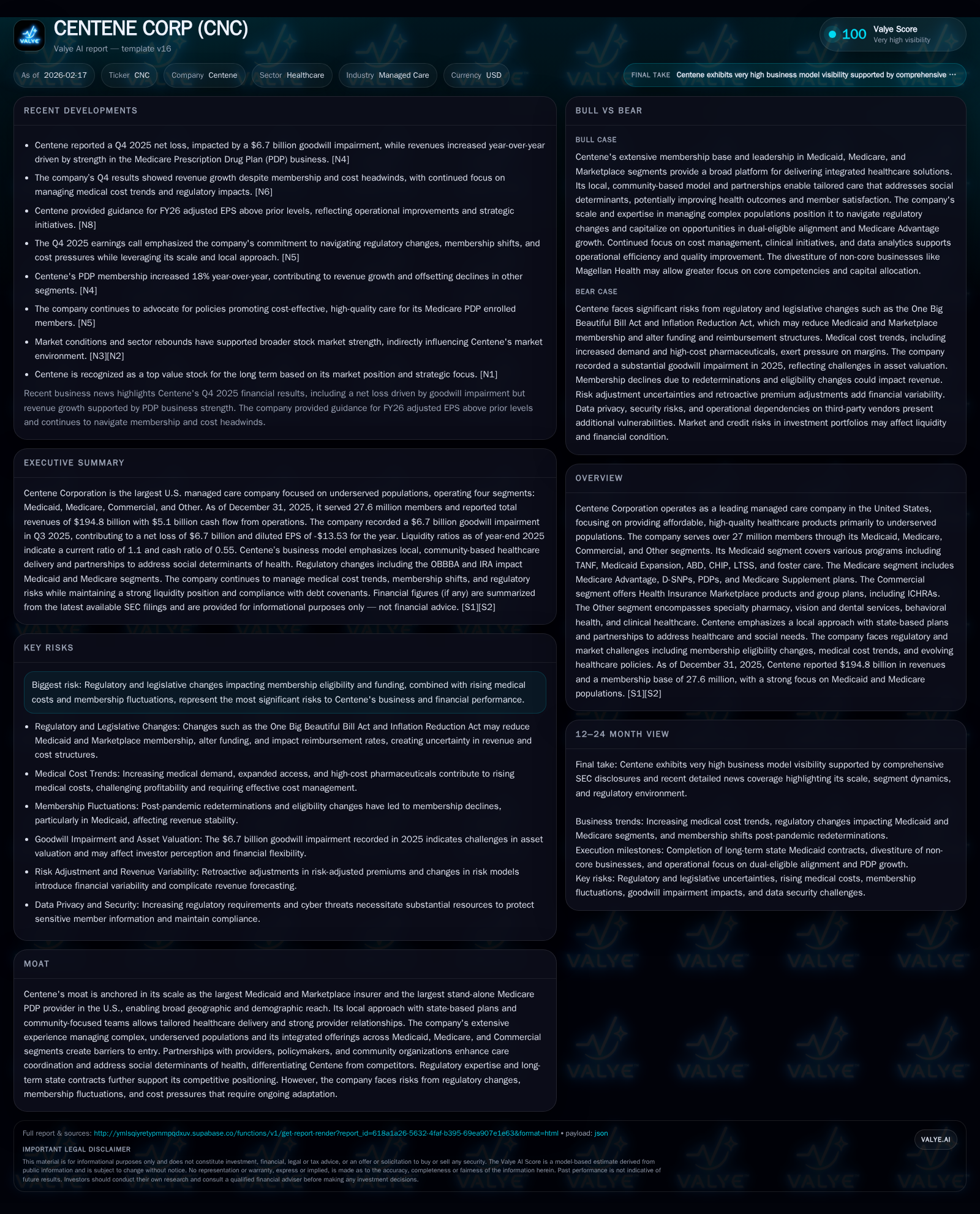
Centene Corporation delivered robust revenue growth of nearly 20% in FY2025, primarily fueled by expanded Medicaid membership and Health Insurance Marketplace enrollment. However, this topline success belies significant pressure on profitability, with operating income plunging into a $7.6 billion loss, largely from accelerated medical cost trends and impairment charges tied to the Magellan Health divestiture. The company’s health benefits ratio expanded sharply amid rising acuity, increased pharmaceutical costs, and state policy shifts such as carve-ins and Medicaid redeterminations following the pandemic public health emergency. Despite positive operating cash flows and ongoing capital discipline evidenced by moderated share repurchases, return on equity turned negative, highlighting the tension between scale growth and margin compression. Centene’s integrated local approach and focused Medicare D-SNP strategy offer a foundation for medium-term recovery, though near-term risks remain from regulatory uncertainty and membership changes.
Historical Performance Highlights: Growth Fueled by Medicaid & Marketplace Expansion
Centene Corporation has demonstrated solid revenue growth over the past several years, underpinned by its dominant presence in government-sponsored healthcare programs—primarily Medicaid—and its expanding footprint in the Health Insurance Marketplace segment. From fiscal year (FY) 2022 to FY2025, total revenues increased from $144.5 billion to $194.8 billion, representing a compound annual growth rate exceeding 11%[F1]. This surge reflects growing memberships across core segments combined with targeted state expansions.
Medicaid remains the largest contributor at 57% of total revenues as of FY2025[S1][S22]. The company serves approximately 12.5 million Medicaid members across 30 states at year-end 2025[S1], a number buoyed initially by the COVID-19 public health emergency (PHE) which caused significant enrollment increases due to paused eligibility redeterminations[S2]. Additionally, the Health Insurance Marketplace segment added approximately 5.5 million lives via individual plans covering both subsidized and unsubsidized enrollees[S1].
The company’s commitment to local-state plans supported broad geographic reach with tailored offerings adapted for underserved populations[S1]. Divestitures of non-core assets such as Magellan Rx Specialty have reshaped comparability but sharpened focus on integrated managed-care models[S1]. While these sales generated one-time gains previously, adjustments related to impairment charges commenced in 2025 impacting overall profitability.
Historical performance (annual)
| FY | Rev ($bn) | Net ($bn) | CFO ($bn) | OpInc ($bn) | Rev YoY | Net YoY |
|---|---|---|---|---|---|---|
| 2025 | 194.8 | -6.7 | 5.1 | -7.6 | +19.4% | -301.9% |
| 2024 | 163.1 | 3.3 | 0.2 | 3.2 | +5.9% | +22.3% |
| 2023 | 154.0 | 2.7 | 8.1 | 2.9 | +6.5% | +124.8% |
| 2022 | 144.5 | 1.2 | 6.3 | 1.3 |
Note: Omitted columns lack sufficient annual XBRL coverage in the provided tags (need ≥2 annual points): Capex, Div. Source: SEC companyfacts cache [F1].
Capital returns and efficiency (annual)
| FY | Buybacks ($bn) | FCF ($bn) | ROE% |
|---|---|---|---|
| 2025 | 0.5 | 4.3 | -33.4 |
| 2024 | 3.1 | -0.5 | 12.5 |
| 2023 | 1.6 | 7.3 | 10.5 |
| 2022 | 3.1 | 5.3 | 5.0 |
Source: SEC companyfacts cache [F1].
Note: Data source [F1]. Metrics omitted due to insufficient data include dividends paid.
Recent Financial Pivot: Understanding the 2025 Earnings Downturn
In contrast to steady revenue gains, Centene's earnings profile took a noticeable turn in FY2025 with operating income plunging into a loss of approximately $7.6 billion compared to a positive $3.2 billion in FY2024[F1]. This reversal stems largely from an accelerated increase in the health benefits ratio (HBR), indicative of rising medical expenditures relative to premiums received[S1][N3][N4].
A material impairment charge of roughly $513 million before tax was recorded related to pending divestiture activities involving Magellan Health business units completed in late December 2025[S1][S3]. These non-cash goodwill-related charges compounded profitability weaknesses triggered by other operational drivers.
Medical cost inflation intensified due primarily to an uptick in member acuity levels exceeding previous actuarial estimates[S1][N9]. In mid-2025, independent actuarial data highlighted far greater morbidity for Marketplace members than anticipated, leading to reduced net risk adjustment revenues—a key source offsetting claims costs[N9][S6]. Moreover, unanticipated cost increases arose mainly from behavioral health services, home health care expansions, and expensive new pharmaceuticals particularly impacting Medicaid populations[S1][N3].
These effects were exacerbated by evolving state healthcare policies that expanded coverage scope through "carve-ins" – absorption of incremental services such as behavioral health or long-term supports previously excluded – inevitably widening downside on benefit expenditures[S1]. Late post-PHE Medicaid eligibility reviews resulted in a remaining member pool with significantly higher utilization rates reflecting complex health needs[S1][S2], creating timing mismatches where premium rates lag actual incurred medical costs.
Medical Cost Trends and Regulatory Impact on Profitability
Centene’s health benefits ratio—the proportion of premiums paid out as medical expenses—grew substantially during FY2025 as heightened service utilization collided with lagging rate adjustments[S1][S9][N9]. Management disclosed that factors driving this trend include rising medical demand facilitated by expanded access under various state programs,[e.g., additional home & community-based services carve-ins] coupled with a faster influx of high-cost specialty drugs newly approved within short cycles[S1][S18]. The latter is notable given the outsized cost pressure specialty pharmaceuticals present across Medicaid/Medicare formularies.
Risk adjustment program results added complexity; changes in government methodologies reduced premium revenues retroactively while shifting members' stratification lowered aggregate plan risk scores impacting reimbursed rates adversely[S9][S15]. The overlapping dynamics imposed volatility on forecasted margins.
The interplay between acuity profiles post-PHE redetermination versus historical claims profoundly constrained Medicaid rate-setting fidelity where actuaries rely heavily on retrospective data that becomes stale when member health deteriorates unexpectedly fast[S2]. This impediment means Centene often absorbs more claims expense upfront than reimbursed until rates reset annually or biannually.
On the regulation front, uncertainty around federal legislative initiatives such as the One Big Beautiful Bill Act (OBBBA), which modifies premium subsidies and marketplace program parameters materially influences enrollee behavior—prompting care-seeking patterns potentially substituting services or accelerating utilization ahead of anticipated coverage changes[N9][S6].
Provider reimbursement changes also loom large; reductions or restructuring negotiated between states or CMS threaten future margin compression downstream[S10]. Centene continues deploying targeted clinical programs aimed at clinical outcome improvement while maintaining affordability through sophisticated network management including value-based contracting[N2].
Segment-Level Analysis: Medicaid, Medicare, Commercial, and Other Contributions
Centene operates four principal business segments whose contributions showcase its diversified yet focused strategic posture:[S1][S22]
- Medicaid: The anchor segment accounting for roughly 57% of external revenues; comprising TANF programs, ABD populations, CHIP services plus Specialty Dual Eligible products embedding long-term support services via MMPs.
- Commercial: About 21% revenue share deriving primarily from Health Insurance Marketplace plans coupled with group coverage options including ICHRAs targeting employer-provided arrangements.
- Medicare: Contributed around 19%, encompassing Medicare Advantage with notably high concentration (~D-SNPs), Prescription Drug Plans (PDPs), and Medicare Supplement policies.
- Other: Smallest segment at c.~3%, covering clinical healthcare offerings like vision/dental services plus behavioral health after scaled-back specialty pharmacy operations following Magellan divestiture.
Membership metrics align tightly with revenue breakdowns: combined total stood near 27.6 million lives enrolled as of December end-2025 with Medicaid memberships sustained at around 12.5 million individuals concentrated across thirty states[S1]. Medicare enrollments hold steady at about 6 million, reflective of strategic targeting toward complex dual eligibles benefiting from integrated D-SNP product placement[S22].
Margin pressures vary across segments but all feel squeezed: Medicaid's elevated utilization after PHE redetermination inflates cost ratios; Medicare PDP faces seasonality swings alongside regulatory recalibrations impacting risk pool estimation; Commercial Marketplace must navigate subsidy rollbacks affecting demand elasticity.[S22] Continuing migration away from specialty pharmacy supports reduces overhead yet narrows ancillary revenue diversification capabilities.[S1]
Capital Allocation Review: Share Buybacks, Cash Flows, and ROE Under Pressure
Despite accounting losses in FY2025 amounting to nearly $6.7 billion net income decline[F1], Centene maintained robust operational cash generation notwithstanding challenging external conditions—recording operating cash flow upwards of $5.1 billion (+3200% YoY vs prior year) attributed partially to working capital management improvements among other factors[F1]. After capital expenditure outlays totaling approximately $767 million reflecting investments mostly into IT infrastructure enhancements and system upgrades[S7], free cash flow remained healthy at circa $4.3 billion[F1], supporting operational liquidity needs.
However, return on equity contracted deeply negative at approximately -33%, illustrating pronounced erosion of shareholder capital resultant from net loss accumulation relative to an equity base reduced from roughly $26 billion down below $20 billion for calendar-year end[F1].
Buyback activity curtailed substantially in comparison with prior periods where repurchases exceeded multiple billions; FY2025 buybacks totaled about $475 million funded primarily via free cash flow generation alongside proceeds received from strategic divestitures[S8][F1]. No dividend payouts were reported in available data.
Balance sheet leverage crept upward due partly to goodwill impairments lowering equity values while total debt levels remained stable near $17 billion without drawdowns against revolving credit facilities demonstrating solid covenant compliance[S4][S5][S7]. This mix signals management intent toward capital preservation amid acute earnings headwind episodes.
Strategic Initiatives and Market Positioning for Future Growth
Centene’s strategic outlook emphasizes leveraging local market knowledge embedded through autonomous state teams responsible across business lines enabling nimble responses to shifting member needs based on geographic nuances[S22][N2]. Focused efforts encompass expanding integrated care coordination models especially within high-value Medicare Advantage D-SNP segments aiming at complex beneficiaries requiring longitudinal care management linked tightly with social determinants interventions.
The recent finalization of Magellan remaining divestitures clarifies portfolio concentration while funding clinical initiatives such as network redesigns emphasizing selective contracting aligned with value-based reimbursement frameworks[N2][N5][S6]. These approaches aim both at improving quality metrics and controlling escalating medical expenses viewed through analytics-driven fraud waste abuse safeguards[S21].
The company also invests heavily into data analytics platforms enhancing preemptive care delivery models optimized against risk adjustment payment structures underlying many government contracts[N2]. Digital engagement tools tailored locally pave pathways for personalized healthcare journeys enhancing retention rates critical under uncertain subsidy landscapes[S15].
Collectively, these maneuvers underpin centering strategy around sustaining long-term scale while mitigating margin erosions through care intensity management combined with innovation adoption amidst complex regulatory environments.
Near-Term Headwinds and Opportunities: What Investors Should Monitor
Looking ahead into FY2026, several pivotal areas warrant close scrutiny:[N9][N10]
- Medicaid Rate Setting: Resolution outcomes from state-level actuarial adjustments aspirationally matching rapidly evolving population acuity will directly dictate reimbursement adequacy affecting next-gen profitability benchmarks.[S2]
- Advance Premium Tax Credit Policy: Modifications introduced under OBBBA alongside potential federal reforms could materially influence Marketplace dynamics including enrollment stability via subsidies impacting consumer affordability[N9][S6]
- Risk Adjustment Program Revisions: Ongoing CMS recalibrations could substantially alter retroactive settlements exposing plan financial outcomes either favorably or adversely.[S9]
- Enrollment Volatility: Post-PHE eligibility fluctuations remain unpredictable especially if eligibility redeterminations expand churn or disenrollment influencing premium pool risk composition.[N9]
- Regulatory Developments: Heightened scrutiny around provider contracting standards including directory accuracy requirements combined with potential emerging AI-focused compliance mandates pose operational risks.[S18][S19]
- Competitive Pressures: Provider negotiations continue evolving towards value-based arrangements potentially compressing fee-for-service margins necessitating agile contract modeling capability; competitive positioning among major peers remains fierce particularly in key states.[N10]
Monitoring these vectors will elucidate whether Centene can architect margin recovery trajectories balancing member affordability with provider incentives amidst fiscal pressures shaping U.S managed care markets.
Disclaimer: This report is prepared solely for informational purposes without regard to individual investment objectives or suitability considerations; it does not constitute investment advice or recommendation.
Disclaimer: This is research-only, informational analysis and not investment advice. It may include AI-generated interpretation and general industry context. Always verify important details using primary sources.

Comments