
Kite Realty’s Growth and Capital Strategy Balances Portfolio Strength with Refinancing Risk
A leading grocery-anchored retail REIT leverages strategic acquisitions and redevelopment in Sun Belt markets but faces concentrated refinancing maturities and tenant sector challenges.
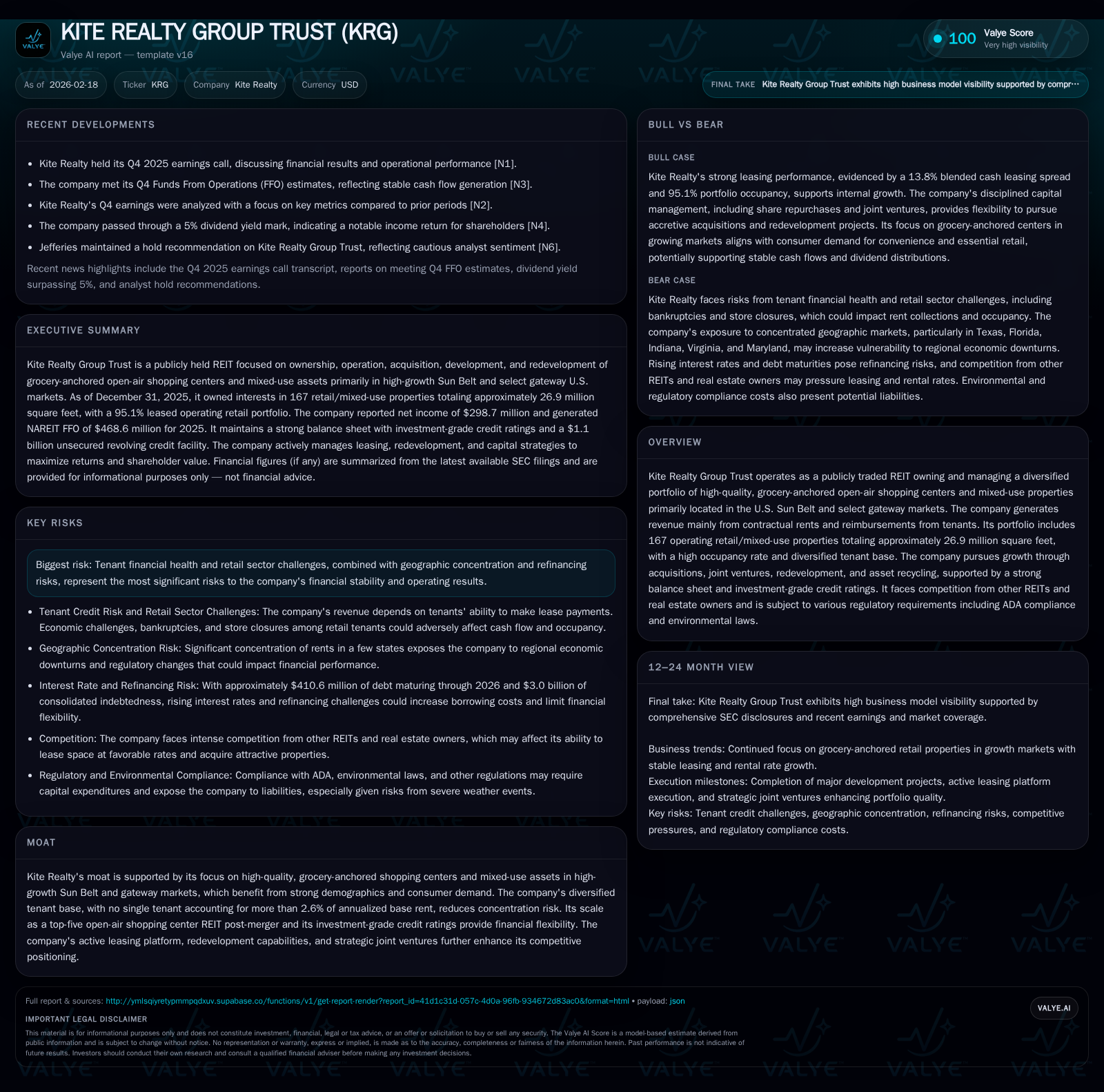
Kite Realty Group Trust (KRG), a top-five open-air shopping center REIT post-2021 merger, operates a high-quality portfolio primarily in the U.S. Sun Belt and gateway markets. Its 2025 financial performance showed modest revenue growth to $844 million with significant net income gains largely driven by operational execution and leasing spreads, supported by a diversified tenant base and investment-grade credit ratings. The company’s growth strategy hinges on selective acquisitions, joint ventures, and redevelopment while maintaining a strong balance sheet. Key risks include tenant financial health amid retail disruptions, geographic concentration, and a heavy near-term debt maturity schedule requiring careful liquidity management. Financial metrics such as ROE, cash flows, dividends, and buybacks align with prudent capital allocation practices.
Company Overview
Kite Realty Group Trust (KRG) is a publicly traded real estate investment trust specializing in ownership and management of open-air grocery-anchored shopping centers and mixed-use properties concentrated primarily across the U.S. Sun Belt and select gateway markets following its transformative merger with Retail Properties of America (RPAI) in October 2021. This consolidation elevated Kite into the top five open-air shopping center REITs by market capitalization. As of December 31, 2025, KRG's portfolio includes interests in 167 retail/mixed-use properties comprising approximately 26.9 million square feet, with an occupancy rate of roughly 95%. The company's strategic focus centers on acquiring quality assets situated in high-growth demographic corridors where consumer demand remains resilient.
Revenue generation is chiefly through contractual rents from tenants supplemented by expense recoveries.[S1][F1] The portfolio benefits from diversification both geographically—primarily Texas, Florida, North Carolina plus key gateway areas such as New York and Chicago—and across tenant categories. Notably, grocery-anchored centers represent about 79% of the operating portfolio’s annualized base rent (ABR), positioning KRG defensively against evolving retail sector dynamics.[S1][S9]
Historical Financial Performance
Over the four-year period ended FY2025, Kite Realty demonstrated consistent though modest topline growth accompanied by marked improvement in profitability metrics:
Historical performance (annual)
| FY | Rev ($mm) | Net ($mm) | CFO ($mm) | OpInc ($mm) | Rev YoY | Net YoY |
|---|---|---|---|---|---|---|
| 2025 | 844 | 299 | 430 | +0.3% | +7236.4% | |
| 2024 | 842 | 4 | 419 | 111 | +2.3% | -91.4% |
| 2023 | 823 | 47 | 395 | 152 | +2.6% | +475.9% |
| 2022 | 802 | -13 | 379 | 92 |
Note: Omitted columns lack sufficient annual XBRL coverage in the provided tags (need ≥2 annual points): Capex, FCF. Source: SEC companyfacts cache [F1].
Capital returns and efficiency (annual)
| FY | Div ($mm) | Buybacks ($) | ROE% |
|---|---|---|---|
| 2025 | 236 | 1339000 | 9.7 |
| 2024 | 222 | 907000 | 0.1 |
| 2023 | 211 | 767000 | 1.3 |
| 2022 | 180 | 1535000 | -0.3 |
Source: SEC companyfacts cache [F1].
*Operating income data for FY2025 was not fully available as of filing.[F1]
Net income volatility reflects improved leasing performance along with property revaluations and one-time items impacting prior years.[F1] Operating cash flow has steadily advanced alongside stable portfolio occupancy exceeding 95%, demonstrating reliable cash generation essential for REIT dividend distributions.[F1]
The company’s approximate return on equity for FY2025 is around 9.7%, calculated as net income over average equity,[F1] confirming profitable capital deployment.
Operational Highlights & Leasing Activity
In fiscal year 2025, Kite Realty reported a Same Property Net Operating Income (NOI) increase of approximately 2.9%, driven primarily by embedded contractual rent escalations and an active leasing platform that delivered positive new lease spreads averaging +20.3% on comparable new or non-option renewal leases.[S1][S9]
The company executed or renewed leases covering about 4.6 million square feet encompassing over 680 individual spaces, which contributed to strengthening average ABR per square foot — up $1.48 (+7%) year-over-year to $22.63.[F1][S9] Lease-ups of previously vacant units generated an estimated additional $37 million NOI expected to commence mainly in calendar year 2026.[S9]
Portfolio occupancy remains robust at approximately 95%, with anchors leased at nearly 97%, underscoring resilience despite broader retail headwinds related to inflationary pressures affecting tenant cost structures.[S9][S10]
Growth Prospects & Strategic Initiatives
Kite Realty's growth strategy blends selective acquisitions concentrated in Sun Belt metros exhibiting sustained job and population growth with proactive redevelopment efforts targeting enhanced asset utilization or repositioning underperforming properties.[S8][S18]
Recent portfolio-enhancing transactions include:
- Acquisition of Village Commons retail property near Miami for $68.4 million (January 2025).[S4]
- Formation of joint ventures with global investment firms—for example Legacy West mixed-use asset acquisition ($785 million gross) where Kite holds majority equity.[S4][S8]
- Redevelopment projects such as "The Corner—IN," transitioned from development into operating portfolio early in the year.[S4][S14]
- Disposition activity realizing proceeds close to $622 million from thirteen properties during the year to fund capital recycling toward higher-yielding assets or debt reduction.[S17]
Planned growth also includes tactical use of underutilized land for densification or alternative uses designed to maximize returns on invested capital while maintaining attractive leverage metrics.[S18]
Capital Allocation & Balance Sheet Management
As detailed in recent filings,Kite maintains an investment-grade balance sheet characterized by nearly $3 billion total consolidated debt as of December 31, 2025,[F1][S4][S6] balanced between fixed-rate instruments mitigating interest rate exposure and variable-rate tranches partially hedged via swaps.[S7][S13]
Key balance sheet highlights at FY-end include:
- Revolving credit facility availability of approximately $1 billion out of a $1.1 billion commitment,
- Approximately $410.6 million principal maturing within calendar year ’26,
- Cash on hand near $36.8 million plus restricted cash exceeding $440 million,
- Stockholders’ equity around $3.07 billion,[F1] reflecting solid capitalization,
- Common share repurchases totaling approximately $1.3 million in FY25 indicating limited buyback activity relative to dividends,
- Dividends declared totaled about $236 million or roughly $1.245 per share consistent with REIT distribution requirements.[F1][N4]
Capital allocation prioritizes financing redevelopments offering returns above the weighted average cost of capital combined with cautious reinvestment flexibility achieved via property sales targeting non-core holdings.[S17][S18] Share buybacks remain modest compared to dividend payments reflecting prudent capital preservation amid uncertain refinancing conditions ahead.
Risks & Challenges
Despite strong fundamentals, Kite Realty faces material risks intrinsic to real estate ownership sectors:[S10][N1][S25]
- Tenant Financial Health: Inflation-driven cost pressures such as labor shortages and supply chain constraints threaten timely rent payments or lease renewals potentially increasing vacancy or concessions.
- Geographic Concentration: Heavy exposure (~70%) to Sun Belt markets like Texas and Florida entails regional economic downturn or disaster exposure including hurricanes/flooding risks impacting assets; Tropical Storm Chantal notably caused property reclassification due to flooding-related disruptions.[S9][N1]
- Refinancing Risk: Near-term maturities totaling over $400 million require refinancing or repayment amidst uncertain interest rate environments despite hedging; covenant compliance remains critical.[S6][S7][S24]
- Regulatory Compliance: Obligations under ADA requirements plus environmental laws governing hazardous substance liabilities necessitate ongoing capital expenditures; failure may incur fines or restrictions.[S22][S23]
- Competitive Pressures: Rising e-commerce adoption continues pressuring brick-and-mortar formats necessitating offensive/defensive leasing strategies.
- Cybersecurity Threats: Increasing reliance on third-party IT vendors exposes KRG to potential breaches that could disrupt operations or cause financial harm.[S26]
What To Watch Next (Analysis)
Absent explicit forward guidance beyond published milestones,[N3] stakeholders will monitor:
- Debt refinancing progress avoiding rating downgrades or margin expansion.
- Leasing velocity trends especially small shop occupancy versus anchor space.
- Redevelopment pipeline progress beyond The Corner-IN completion.
- Same property NOI trajectory amid macroeconomic pressures.
- Tenant bankruptcy filings or rent collection issues signaling weakening fundamentals.
- Dividend sustainability relative to funds from operations amid potential capital demands.
Conclusion
Kite Realty Group Trust is strategically positioned as a focused REIT leveraging scale post-merger to capitalize on demographic tailwinds via premium grocery-anchored shopping centers augmented by mixed-use components fostering community engagement. Operational execution manifested through steady revenue growth offsetting challenging retail dynamics alongside impressive leasing spreads highlights management competency amidst evolving risks. The company’s capital structure reflects disciplined balance sheet management balancing liquidity reserves augmented by joint ventures mitigating concentration risk though upcoming debt maturities warrant vigilant refinancing execution amidst interest rate uncertainties. Ultimately, sustaining high occupancy coupled with selective redevelopment investments underpin medium-term prospects while navigating tenant solvency concerns and regulatory compliance costs remain critical ongoing challenges demanding adaptive management.
This analysis is based solely on publicly available information as of February 18, 2026 and does not constitute investment advice.
Disclaimer: This is research-only, informational analysis and not investment advice. It may include AI-generated interpretation and general industry context. Always verify important details using primary sources.

Comments