
Arthur J. Gallagher & Co.’s 2025 Growth: Acquisition-Driven Expansion and Capital Discipline
AJG’s record acquisition activity propels revenue growth while disciplined capital allocation supports financial stability.
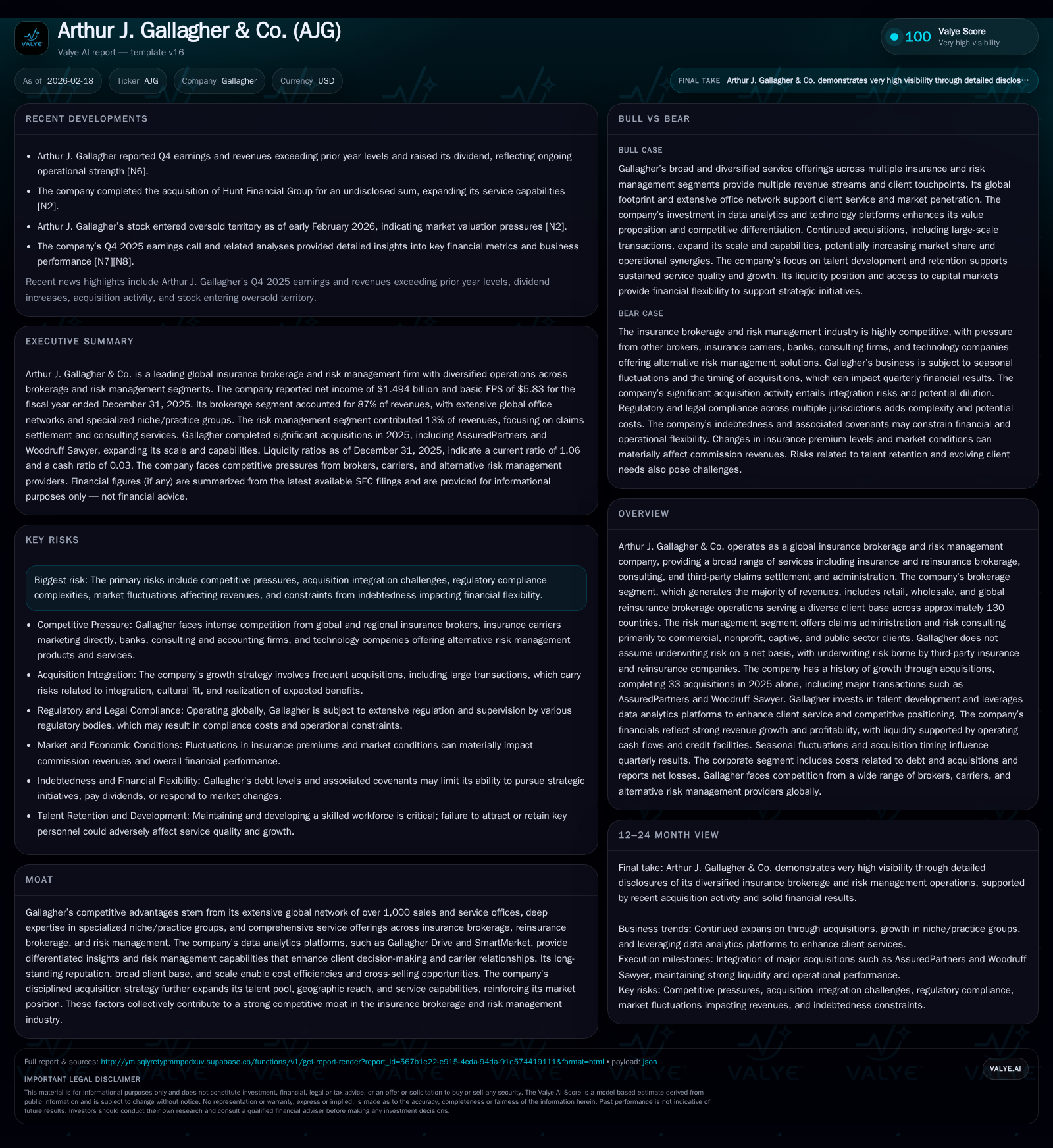
Arthur J. Gallagher & Co. reported robust 2025 revenue growth primarily driven by an aggressive acquisition strategy that included 33 deals, notably AssuredPartners and Hunt Financial Group, boosting its global brokerage footprint. The brokerage segment led with a 23% revenue increase, complemented by a 9% rise in risk management revenues. Despite a decline in operating cash flow, AJG maintained capital discipline evidenced by dividend increases and debt repayments, supporting an approximate 6.4% ROE. Looking forward, growth hinges on integration success amidst regulatory complexities and macroeconomic uncertainties.
Strong Revenue Gains Fueled by an Aggressive Acquisition Spree
Historical performance (annual)
| FY | Net ($mm) | CFO ($bn) | Net YoY |
|---|---|---|---|
| 2025 | 1494 | 1.9 | +2.1% |
| 2024 | 1463 | 2.6 | +50.9% |
| 2023 | 970 | 2.0 | -13.0% |
| 2022 | 1114 | 2.1 |
Note: Omitted columns lack sufficient annual XBRL coverage in the provided tags (need ≥2 annual points): Rev, OpInc, Capex, Buybacks, FCF. Source: SEC companyfacts cache [F1].
Capital returns and efficiency (annual)
| FY | Div ($mm) | ROE% |
|---|---|---|
| 2025 | 667 | 6.4 |
| 2024 | 525 | 7.3 |
| 2023 | 474 | 9.0 |
| 2022 | 430 | 12.2 |
Source: SEC companyfacts cache [F1].
Arthur J. Gallagher & Co.’s revenue surged to an adjusted $13.75 billion for fiscal year 2025, marking a compelling 23% increase over the prior year’s adjusted figure of approximately $11.4 billion [S1][F1]. This outsized growth was largely acquisition-driven; AJG closed 33 acquisitions in calendar year 2025 alone, including significant transactions such as the purchase of AssuredPartners and the Hunt Financial Group deal announced early in the year [N13][S1]. These deals expanded AJG’s brokerage footprint extensively across multiple geographies and niche practice groups.
While consolidation remains the most potent driver of headline revenue expansion, Gallagher also posted organic revenue growth of about 6% within its core brokerage operations and similar gains in its risk management segment [S1]. This mix underscores the company’s capability to augment underlying business strength even amid modest economic headwinds.
The breadth of services offered—including retail and wholesale insurance brokerage as well as specialized reinsurance placements—across roughly 130 countries underscores the scale effects realized from these acquisitions [S13]. This expansive network enhances cross-selling capacity as well as client retention prospects.
Segment Performance: Brokerage and Risk Management Contributions Explored
Dominating AJG’s top line is its brokerage segment which accounted for a robust $12.2 billion in revenues during fiscal 2025—a remarkable YoY jump of approximately +23% [S1][F1]. The risk management segment complemented this with revenues totaling around $1.6 billion, posting a solid +9% increase from the prior year [S1]. Together they constitute roughly 87% and 13%, respectively, of total revenues [S8][S12].
Profitability metrics reveal that the brokerage segment improved its adjusted EBITDAC margin to about 36.5%, gaining nearly 145 basis points versus prior-year margins [S1]. This suggests effective cost containment amid scale expansion and accretive contribution from recent purchases. Similarly, the risk management division lifted its EBITDAC margin to around 21.2%, slightly up by approximately half a percentage point despite intense competition from other third-party claims administrators [S1][S17].
However, net earnings margins showed minor compression: brokerage reported approximately a -14 basis points contraction reflecting integration costs and amortization pressures, while risk management saw a slightly larger decline due primarily to investments in capabilities and incremental staffing [S1]. Diluted net earnings per share for the combined segments rose roughly +10–12% on an adjusted non-GAAP basis, demonstrating underlying profitability progression despite rising acquisition-related expenses.
Strategic Use of Technology and Data Analytics Enhancing Differentiated Service Offerings
A pillar underpinning AJG’s competitive moat is its investment in proprietary data analytics platforms such as Gallagher Drive and SmartMarket [S1][S17]. These tools provide sophisticated underwriting analytics facilitating improved risk evaluation for clients while enabling closer insurer relationships via individualized reporting.
Within an industry where underwriting risk is transferred to third-party insurance carriers—as opposed to being retained on net by brokers—such differentiated technological capabilities offer critical advantages in loss control advisory services, premium financing optimization, and claims advocacy support [S17][S13]. Leveraging AI-driven insights increasingly positions Gallagher ahead vis-à-vis smaller brokers with limited data sophistication.
Capital Allocation Priorities: Dividend Increases, Cash Flows, and Debt Management
Despite heavy M&A activity weighing on free cash flow generation, AJG demonstrated disciplined capital stewardship through meaningful dividend expansion paired with continued debt reduction efforts [F1][S6][S7][S4]. Total dividends paid rose from approximately $525 million in FY2024 to about $667 million in FY2025—a +27% increase reflecting board confidence in sustainable cash generation capacity [F1][S6].
Operating cash flow contracted about -25% year over year ($2.58B to ~$1.93B), affected primarily by working capital fluctuations associated with acquisitions and integration timing [F1]. Capital expenditures remained stable near the historically low range (sub-$220 million), emphasizing limited capital intensity relative to EBITDA levels.
Notably, AJG made substantial principal repayments under credit facilities amounting to roughly $2.5 billion during the year that improved leverage metrics while keeping liquidity robust at nearly $2.5 billion available under committed lines [S4][S9][F1]. The company maintains full compliance with covenants on its senior notes and revolving credit agreement.
Share repurchases have been suspended since mid-2023 as management prioritizes debt repayment and acquisition funding; however, plans remain flexible contingent upon cash flow excesses later in the cycle.
Analyzing Future Growth Prospects Amid Regulatory and Market Risks
Looking ahead, sustained growth will hinge critically on successful assimilation of an unprecedented volume of acquisitions integrated within a complex global footprint [N6][N13][S10]. CEO remarks highlighted an active pipeline for additional tuck-in deals targeting niche practice groups where scale can be advantageously leveraged for enhanced profitability [N6].
On the regulatory front, multifaceted compliance obligations spanning anti-bribery statutes like the FCPA, evolving data privacy laws across jurisdictions including GDPR-like regimes outside Europe, alongside increasing cybersecurity scrutiny form material ongoing risks [S10][S16]. Market volatility linked to geopolitical tensions—particularly involving inflationary pressures and global protectionist trends—could dampen clients’ insurance purchase volumes or alter premium financing dynamics.
Integration delays or cultural misalignment could impair synergy realization timelines essential for earnings accretion following large mergers such as AssuredPartners.
Watchpoints: Upcoming Milestones and Earnings Indicators for Investors
The absence of explicit long-term guidance places emphasis on monitoring key operational metrics over upcoming quarters: organic revenue growth rates within both brokerage and risk management segments stand out as barometers for sustainable demand expansion post-acquisition cycles [N5][N6].
Additionally, progress against synergy targets from recent major deals will be closely watched for evidence that expected cost savings and cross-selling opportunities materialize timely without deleterious impacts on employee retention or client satisfaction [N7]. Margin trajectories particularly around EBITDAC percentages will indicate how efficiently Gallagher navigates inflation-sensitive expense lines amid stiffening competition.
Further updates on technology platform adoption rates could signal strengthening intangible asset leverage alongside enhanced pricing power.
Financial Health Snapshot: Liquidity, ROE, and Operational Cash Flow Trends
As of fiscal year-end December 31, 2025, AJG reported stockholders’ equity expanding markedly to approximately $23.3 billion up from $20.2 billion a year prior—a sign of capital base reinforcement attributable largely to retained earnings plus proceeds from equity offerings supporting acquisition funding [F1].
Net income grew moderately to nearly $1.49 billion (+2%) while return on equity settled at about 6.4%, a level consistent with industry expectations given elevated intangible amortization related to buyout accounting [F1].
Operational cash flows declined by more than one-fifth but still generated close to $2 billion annually—highlighting solid fundamental cash conversion; when adjusted for capex levels around $230 million (with some volatility) free cash flow remains robust at roughly $1.7 billion [F1].
Gallagher’s liquidity position remains sound with current assets balancing liabilities closely (current ratio ~1.06) ensuring near-term obligations are well covered amidst market uncertainties.
Risks to Monitor: Integration Complexity, Competitive Pressure, and Geopolitical Factors
Key risks documented extensively include integration complexity risks arising from rapid deal cadence which could create operational distractions or dilute sales force focus causing churn or underperformance relative to targets [S10][N11].
Competitive intensity persists not only from peer brokers but also from carriers engaging direct sales channels plus increasing fintech entrants developing alternative risk-transfer solutions encompassing parametric products or embedded insurtech offerings [S8][S10].
Moreover, geopolitical destabilization especially related to conflicts affecting supply chains or economic sanctions regimes pose latent threats affecting premium pricing environments as well as client willingness to undertake new policies [S10][S16]. Compliance lapses—whether via employee misconduct or vendor failures—could result in costly fines or reputational damage hurting client relationships across decentralized global operations.
Overall vigilance towards evolving legal frameworks regulating insurance advice provision and governing claims administration quality is required given potential penalties or restrictions on market practices impacting profitability.
Disclaimer: This report is prepared solely for informational purposes based on publicly available information as of February 18, 2026. It does not constitute investment advice or recommendations regarding securities or markets. Readers should conduct their own analysis before making any financial decisions.
Disclaimer: This is research-only, informational analysis and not investment advice. It may include AI-generated interpretation and general industry context. Always verify important details using primary sources.

Comments