
Hecla Mining’s Resurgence: Unpacking Strong Profit Growth and Risk Management
Hecla Mining posted a dramatic net income surge in FY2025, driven by increased production and savvy commodity hedging against metals price swings.
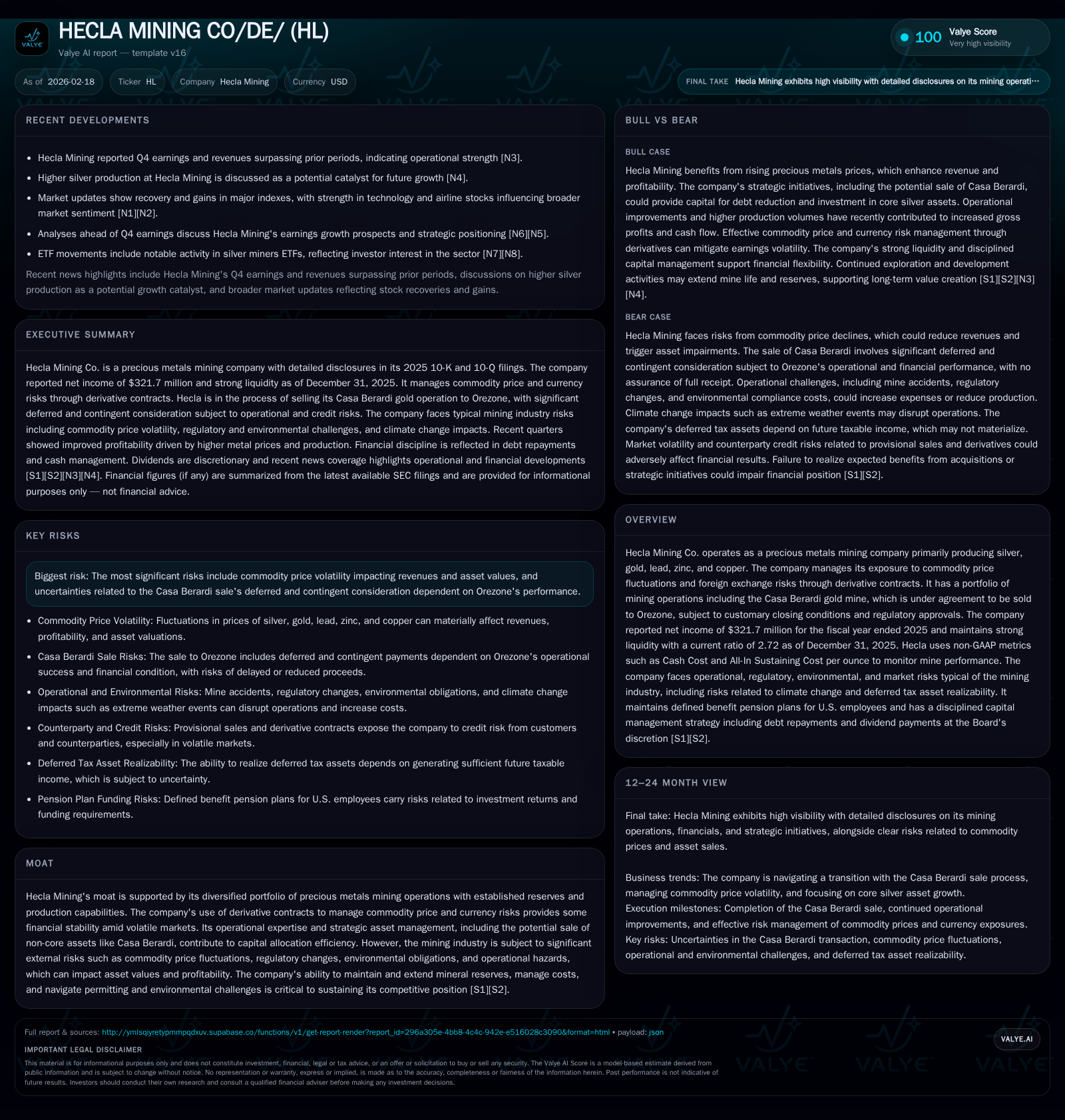
Hecla Mining Co. delivered a striking financial turnaround in fiscal year 2025, with net income escalating nearly eightfold to $321.7 million, alongside significant operating income and revenue growth. This resurgence was supported by enhanced silver and gold production, cost discipline, and an active commodity derivatives program that buffers metal price volatility. The pending sale of the Casa Berardi gold mine signals a strategic portfolio realignment to sharpen focus on core assets. Hecla’s disciplined capital allocation balances continued reinvestment in mining operations with modest dividends and limited share repurchases. Strong liquidity with a current ratio above 2.7 underpins the company’s financial flexibility amidst ongoing regulatory, environmental, and market risks typical of the mining sector.
From volatility to victory: Hecla’s recent earnings ramp-up
Hecla Mining Co.'s fiscal year 2025 performance marked a remarkable recovery following prior years of mixed results. Net income soared to $321.7 million—an almost eightfold increase compared to $35.8 million in FY2024—reflecting a potent confluence of operational improvements and favorable commodity markets [F1]. Operating income achieved a similarly impressive leap of approximately 384%, reaching $514.8 million versus just $106 million the year prior.
Revenue grew robustly by nearly 46% YoY to close around $975 million in FY2025. These gains were fundamentally driven by higher silver and gold production volumes paired with consistent cost containment efforts, underscoring management's ability to navigate cyclical headwinds that have historically challenged precious metals miners [F1][S2]. Specifically, increases in payable ounces sold at flagship mines contributed materially to revenue uplift.
The sharp rebound contrasts with the net loss reported in FY2023 ($84.2 million) and modest income in 2022 ($-37.3 million), evidencing the cyclical nature of metal markets but also highlighting Hecla's successful restructuring and efficiency initiatives during this period.
Historical performance (annual)
| FY | Net ($mm) | CFO ($mm) | OpInc ($mm) | Capex ($mm) | Net YoY |
|---|---|---|---|---|---|
| 2025 | 322 | 563 | 515 | 252 | +798.6% |
| 2024 | 36 | 218 | 106 | 214 | +142.5% |
| 2023 | -84 | 75 | -45 | 224 | -125.5% |
| 2022 | -37 | 90 | 12 | 149 |
Note: Omitted columns lack sufficient annual XBRL coverage in the provided tags (need ≥2 annual points): Rev. Source: SEC companyfacts cache [F1].
Capital returns and efficiency (annual)
| FY | Div ($mm) | Buybacks ($mm) | FCF ($mm) |
|---|---|---|---|
| 2025 | 10 | 1 | 310 |
| 2024 | 25 | 1 | 4 |
| 2023 | 16 | 2 | -148 |
| 2022 | 13 | 4 | -59 |
Source: SEC companyfacts cache [F1].
Note: Some annual revenue details for FY2023 are not available from provided tags.
Commodity derivatives as a hedge: Managing metals price exposure
Navigating volatile precious metals prices is quintessential for Hecla Mining’s revenue stability and margin preservation. The company employs an exhaustive commodity-price risk management program using financially-settled forward contracts covering silver, gold, zinc, and lead—metals fundamental to its product mix.
Under this disciplined policy framework approved by management and overseen at the board level, Hecla may cover up to three quarters (75%) of anticipated metal price exposures into five years ahead—a notably aggressive coverage horizon compared with some peers who hedge more conservatively or selectively [S1]. Contracts are held both on provisional concentrate sales pending final settlement pricing and forecasted production shipments.
As of December 31, 2025, Hecla had significant forward metal contract positions: approximately tens of millions of pounds of zinc and lead hedged at average prices near $1.33/lb for zinc and just over $1/lb for lead into calendar year settlements; silver ounces under contract also offset exposure related to concentrate shipments [S1][S27].
These derivative instruments create a ceiling effect on realized metal revenues but provide downside protection against adverse price moves during the lag between provisional sales recognition at shipment and final invoicing upon metal price settlement months later—a common practice within mining accounting protocols due to processing time lags.
However, such hedging programs simultaneously introduce counterparty credit risk should counterparties default when contracts are in-the-money for Hecla—and conversely impose opportunity costs if spot prices rally beyond contracted levels [S23]. Nonetheless, this approach enhances earnings predictability which aligns with investor preferences amid fluctuating commodity markets.
Operational building blocks: Asset portfolio and production trends
Hecla operates multiple mining assets spanning silver, gold, lead, zinc, and copper extraction—with primary sites including Greens Creek (a high-grade polymetallic silver-lead-zinc mine), Lucky Friday (currently suspended following a fire incident), Keno Hill (ramping up production), and Casa Berardi—the latter being a prolific gold mine currently targeted for sale [S2].
Operational metrics reveal incremental improvements contributing toward increasing payable metal output:
- The Casa Berardi mine saw gold payable ounces sold rise from approximately 65K oz in the first nine months of FY2024 to just over 71K oz for the same period in FY2025; silver ounces remained steady around the ~17K mark per nine-month snapshot [S2].
- Ore grades at Casa Berardi showed marginal increases or stability (e.g., gold ounce per ton inching from ~0.063 to ~0.069), reinforcing ore body consistency crucial for predictable mill throughput [S2].
- Despite Lucky Friday suspension impacts extending through mid-2024 due to infrastructure repairs after fire damage,[S14] Hecla's other sites offset lost capacity via ramp-ups, particularly Keno Hill.
Cost efficiency remains central; production costs per ton demonstrate controlled outlays benefiting margins even amid inflationary pressures on consumables and labor typically encountered across mining operations globally . The integrated use of all-in sustaining cost metrics including reclamation charges fortify internal monitoring capabilities that guide sustainable profit realization.
The Casa Berardi transition: Strategic asset realignment
Casa Berardi stands out as both a valuable contributor to Hecla’s gold segment earnings and a strategic asset earmarked for divestiture.
According to filings and disclosures updated well into early FY2026 periods,[S2][S25][S29] Hecla has reached an agreement to sell Casa Berardi to Orezone Resources Inc., subject to customary closing conditions encompassing regulatory approvals—a standard hurdle amid cross-border mineral asset transactions involving Canadian jurisdictions.
This decision aligns with broader industry trends favoring focused portfolios emphasizing core-producing assets with lower operational complexity or jurisdictional certainty while recycling capital into growth opportunities or debt reduction.
Contingent deferred payments linked to Orezone’s subsequent performance introduce uncertainties in ultimate transaction valuation that merit ongoing monitoring as the deal progresses toward closure.
The deal enhances Hecla’s capital allocation flexibility potentially enabling more concentrated investments in its high-margin silver-focused mines like Greens Creek while trim downsizing geographically dispersed assets balancing country-specific regulatory regime complexities.
Capital allocation essentials: Dividends, buybacks, and investment
Hecla demonstrates pragmatic capital deployment effectively balancing shareholder returns with productivity enhancements critical for long-term growth.[F1][S7]
Dividend payouts contracted markedly from $25 million+ levels in prior years down to approximately $10 million total paid during fiscal year ending December 31, 2025 reflecting cautious stance aligned with prevailing metal prices dynamics despite operating income acceleration.
Share repurchases have been sporadic at best totaling sub-million-dollar levels annually recently despite ample liquidity—reflective possibly of prioritization toward reinvestment rather than stock buybacks.[F1] Since June 2014 repurchase activity has been minimal indicating management preference for selective capital use rather than aggressive treasury stock strategies._
Capital expenditures grew steadily reaching $252 million in FY2025 compared with $214 million during the prior year.[F1][S9] Investments predominantly fund new equipment procurement plus infrastructure upgrades spanning extraction systems across major operating sites supporting enhanced throughput capacity aligned with rising ore grades at select deposits noted earlier.
With an approximate return on equity of around 12%, Hecla operates within competitive profitability bands typical among diversified mid-tier miners managing complex geologies yet generating free cash flow conversion exceeding $300 million net of capex expenditure underscoring operational efficiency gains[F1].
Balance sheet strength: Liquidity and debt landscape
Financial resilience underpins Hecla’s operational turnaround narrative.
As of December 31, 2025 data reveal cash plus cash equivalents at roughly $242 million alongside current assets exceeding liabilities enough to yield a robust current ratio of approximately 2.72—well above minimal safe liquidity thresholds recognized across mining sectors[F1][S4][S8]. This buffer provides considerable runway absorbing episodic shocks typical of commodity cyclicality or unexpected capital calls such as environmental reclamation costs ongoing beyond immediate fiscal horizons.
Total debt includes variable maturity senior notes partially redeemed during prior years augmenting manageable leverage structure conducive for upcoming spend waves around exploration or development projects. Floating rate interest conditions linked to SOFR expose finances moderately to broader macroeconomic shifts but are cushioned by no outstanding borrowings under revolving credit facilities as reported end-2025.
Long-term provisions include substantial accruals relating reclamation obligations estimated beyond next decades reflecting prudent compliance posture calculating life-of-mine liabilities, paramount given tightening ESG regulations globally.
What lies ahead: Future growth catalysts and market risks
Analysis indicates clear growth vectors complemented by embedded challenges requiring ongoing scrutiny:
- Higher realized silver production represents a pivotal catalyst underpinning future revenue expansion potential especially if sustained against high spot prices recorded recently around $83/oz[N8].
- Execution progress on ramping newer assets like Keno Hill poised to contribute increasing payable ounces can further solidify base case scenario financial forecasts absent unforeseen geological disruptions[S2].
- Regulatory burdens accentuated by environmental compliance intensify cost pressures necessitating agile management responses highlighted within risk disclosures[S15, S23].
- Market volatility influences on derivative contract renewals or resets remain material variables influencing near-term reported earnings variability,,[S16, S18, S26].
- Contingent consideration tied to Casa Berardi sale introduces valuation uncertainty requiring stakeholder attention until deal consummation finalized[S29].
- Exchange rate fluctuations between USD-CAD pose cost variability risk mitigated partially through active FX hedging programs described[S20,S26,S27].
- Deferred tax asset realizability highly dependent on sustained taxable income generation while impacted by underlying metal prices constitutes additional fundamental operating risk[S23].
Investor focus should encompass quarterly updates on mining volumes/payable ounces sold metrics combined with derivative position disclosures gauging hedge program efficacy relative spot market deviations moving forward.
Setting the benchmarks: Metrics to monitor post-2025
To appraise Hecla's continued ascent critically important metrics include:
- All-in Sustaining Cost per ounce mined (AISC), before and after by-product credits—a core industry benchmark reflecting total cost discipline inclusive of sustaining capex that determines margin sustainability[S14,S24]. Tracking downward trajectory or stabilization here signals operational excellence.
- Derivative contract utilization rates measured against total planned metal exposures illustrate hedging strategy balancedness between downside protection versus upside capture[S1,S27]. Opportunities exist optimizing this weighting dynamically adapting market cycles.
- Free Cash Flow Conversion Ratio capturing proportion of operating cash flow retained post-investment spending evidences capital efficiency crucial given sector’s cyclicality[F1].
- Progress on mineral reserve replenishment initiatives via exploration / acquisitions ensuring resource base longevity fundamental for long-term viability emphasized consistently across miner valuations[S22].
- Environmental liability trends gauged through annual reclamation provision changes inform compliance trajectory within widening ESG mandates[S12,S13,S15].
- Liquidity ratios alongside covenant adherence monitoring guard against refinancing risks amid evolving global credit conditions characteristic for natural resource companies[S4,S8,S10].
Monitoring these indicators collectively will provide comprehensive insight into whether Hecla can sustain its profit resurgence trajectory while stewarding risk exposures inherent in precious metals mining.
This analysis synthesizes publicly filed data alongside recent news disclosures without offering investment advice or recommendations concerning securities mentioned herein.
Disclaimer: This is research-only, informational analysis and not investment advice. It may include AI-generated interpretation and general industry context. Always verify important details using primary sources.

Comments