
Onity Group's Strategic Shift: Managing Client Loss and Refinancing for Growth
Onity Group accelerates debt refinancing and prepares operational resizing to counteract the loss of a major subservicing client.
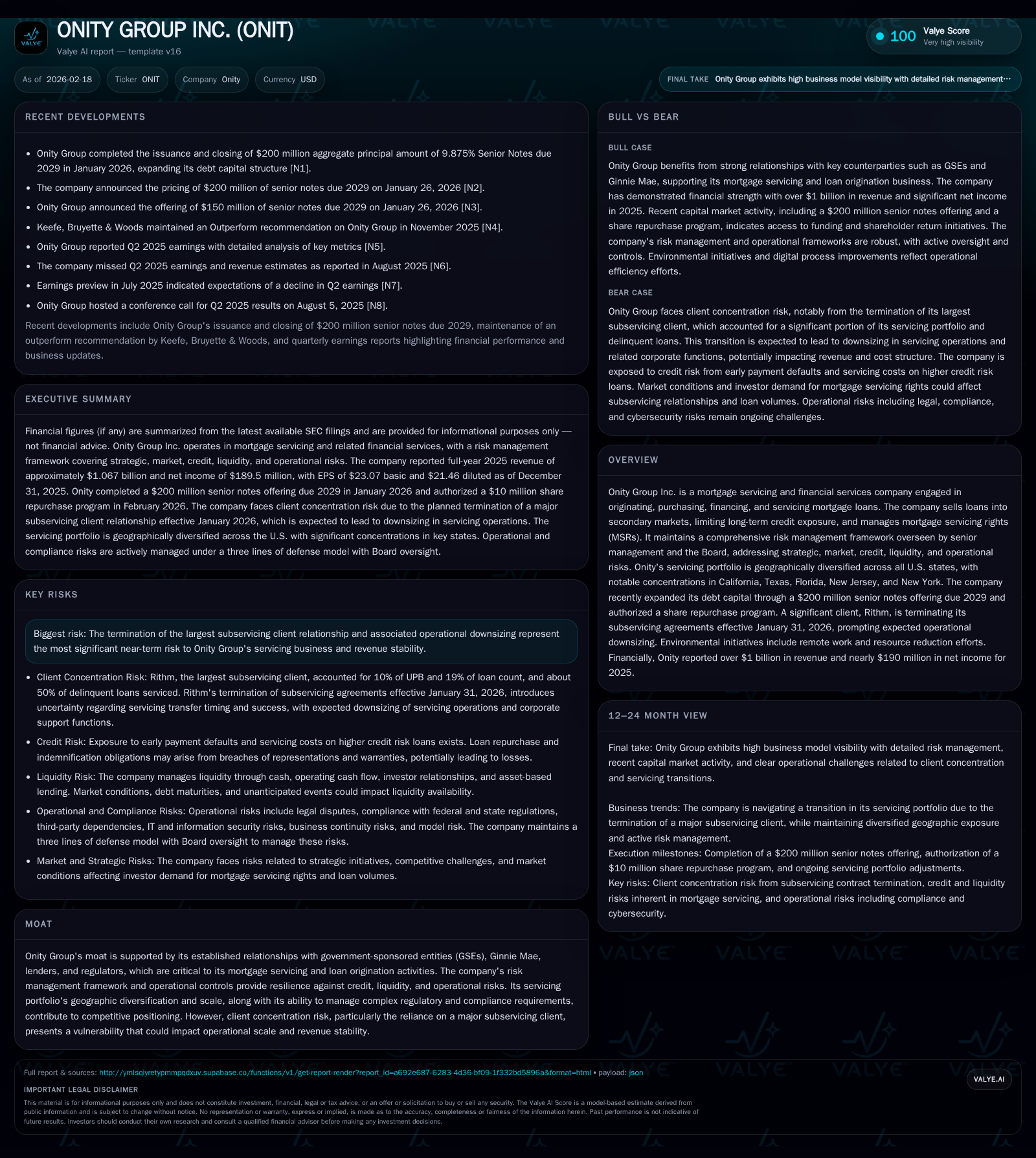
Onity Group Inc. has demonstrated a strong financial rebound through FY2025, highlighted by a 9.3% revenue increase and a significant net income turnaround from losses in preceding years. The company faces a material near-term headwind with the termination of its largest subservicing client, Rithm, responsible for 10% of portfolio UPB and half the delinquent loans. To bolster liquidity amid this transition, Onity issued $200 million in senior notes due 2029 and authorized a share repurchase program. Its comprehensive risk management framework, including active MSR hedging and robust cybersecurity governance, underpins operational resilience. Going forward, Onity’s growth prospects hinge on successful servicing transfers, new client acquisitions, and stable MSR market conditions, while capital allocation remains challenged by negative free cash flow despite solid return on equity levels.
Revenue and Profitability Recovery: Traction in Recent Years
Onity Group's financial trajectory displays notable improvement culminating in FY2025 results where revenues reached approximately $1.07 billion, marking a robust 9.3% year-over-year increase from $976 million in FY2024 [F1]. This reflects effective operational adjustments post-FY2023 when revenues plateaued relative to FY2022 levels. Concurrently, net income swung dramatically from a $63.7 million loss in FY2023 to a positive $189.5 million in FY2025, reflecting a remarkable turnaround with a 459% rise year-over-year [F1]. This profit resurgence owes partly to improved credit performance and cost controls amidst a recovering housing finance environment.
However, this growth contrasts with persistent challenges visible in operating cash flows—the company reported an operating cash outflow of $748 million for FY2025, deepening from a negative $574 million in FY2024 [F1]. This divergence underscores ongoing working capital demands intrinsic to mortgage servicing platforms—specifically the liquidity-intensive nature of servicing advances and float management associated with mortgage servicing rights (MSRs).
Historical performance (annual)
| FY | Rev ($mm) | Net ($mm) | CFO ($mm) | Capex ($mm) | Rev YoY | Net YoY |
|---|---|---|---|---|---|---|
| 2025 | 1067 | 190 | -748 | 3 | +9.3% | +459.0% |
| 2024 | 976 | 34 | -574 | 1 | -8.5% | +153.2% |
| 2023 | 1067 | -64 | 10 | 2 | +11.8% | -347.9% |
| 2022 | 954 | 26 | 173 | 6 |
Note: Omitted columns lack sufficient annual XBRL coverage in the provided tags (need ≥2 annual points): OpInc, Div. Source: SEC companyfacts cache [F1].
Capital returns and efficiency (annual)
| FY | Buybacks ($mm) | FCF ($mm) | ROE% |
|---|---|---|---|
| 2025 | -751 | 30.2 | |
| 2024 | -575 | 7.7 | |
| 2023 | 0 | 8 | |
| 2022 | 50 | 168 |
Source: SEC companyfacts cache [F1].
Note: Operating Income data insufficient for consistent annual series; Buybacks omitted due to sparse data.
Unpacking the Impact of Rithm's Subservicing Termination
The most pressing operational challenge stems from Rithm’s October 31, 2025 decision to terminate its subservicing agreement with Onity effective January 31, 2026, triggering material downstream effects [N1][N2][S5]. Rithm accounts for approximately $32.2 billion unpaid principal balance (UPB), roughly one-tenth of Onity’s overall servicing portfolio UPB, but disproportionately represents about half the delinquent loans serviced [S5]. The confluence of such concentration elevates client risk significantly.
This termination forces Onity into downsizing certain servicing segments concomitant with unwinding related corporate functions [S5]. Moreover, float balances—cash held temporarily as advances or fees—associated with the transferred loans will be refunded to Rithm upon transition completion, exerting liquidity pressure. While the servicing transfer process is slated for H1-2026 commencement, the full timeline hinges on trustee consents and other regulatory approvals, introducing execution uncertainty [S5]. The outcome will materially reduce servicing scale and revenue visibility around subservicing fees.
Capital Structure Evolution: Senior Notes Issuance and Liquidity Management
Responding proactively to these headwinds, Onity deployed $200 million principal amount of senior notes due in November 2029 with an interest rate near double digits (9.875%) in late January 2026 [N1][N2][N3][S4][S14][S15]. These notes constitute an incremental tranche to an existing $500 million issuance series from November 2024.
This capital gesture enhances Onity's liquidity buffer amid expected float repayments stemming from the Rithm exit and preserves flexibility across MSR financing avenues [S4]. Importantly, the company actively manages mark-to-market volatility on MSR valuations—which can affect borrowing capacity under asset-based lending facilities—through hedging mechanisms tapping into derivative instruments commonly deployed within mortgage servicing finance [S4][S14].
Internal processes continuously monitor liquidity needs against stress scenarios inclusive of loan prepayment shocks or delinquency-related advances.
Risk Management Framework Anchoring Operational Resilience
Onity maintains a detailed enterprise risk management architecture underpinned by layered controls addressing strategic risks alongside market exposures intrinsic to mortgage portfolios such as interest rate fluctuations impacting MSRs [S1][S7][S8][S12][S13].
Cybersecurity receives explicit Board-level scrutiny through the Risk and Compliance Committee which gets regular updates from the Chief Information Security Officer (CISO). Cyber risk operations are cultivated through coordinated efforts among CIO-led IT Risk Committee members including CISO and Chief Risk & Compliance Officer [S1][S12][S13]. Credentials for these leaders reflect substantial domain expertise blending finance with advanced technology security certifications—critical given sensitive borrower data handling.
Moreover, Onity enforces a "Three Lines of Defense" model where business units own first-line risk responsibilities; oversight functions provide independent second-line assurance; and Internal Audit offers third-line objective evaluations reported directly to the Audit Committee [S13].
Credit risk management is nuanced by their focus on originating loans compliant with agency standards aiming to limit repurchase exposures alongside oversight of counterparty creditworthiness for originators purchasing mortgages [S15].
Portfolio Diversification and Geographic Exposure Insights
Geographic seasoning within Onity’s portfolio reflects concentration risks warranting attention: the top five states—California at the forefront (14%), followed by Texas, Florida, New Jersey, and New York—comprise close to two-fifths (38%) of total serviced loans [S5]. This regional clustering subjects Onity’s servicing economics to localized economic conditions including housing market dynamics and state regulatory regimes which could impact mortgage default rates or investor sentiment impacting MSR valuations.
Forecasting Growth Amid Client Transition and Market Dynamics
Absent explicit forward guidance concerning core operating metrics or earnings forecasts [N1][N2][S5], future growth hinges on several vectors—framing this as scenario-dependent analysis rather than directional outlooks.
Key aspects include efficient orchestration of Rithm’s servicing portfolio migration without inducing outsized operational disruptions or loss of additional contracts; stabilizing or growing MSRs amid fluctuating investor appetites influenced by interest rate outlooks; and leveraging newly raised capital towards selective bolt-on origination initiatives or acquiring fresh subservicing mandates.
Market risk sensitivity will persist especially given current macroeconomic uncertainties influencing mortgage prepayment velocities which modulate MSR amortization trajectories.
Assessing Capital Allocation: Cash Flow, Buybacks, and Dividend Policy
Capital deployment remains conservative balancing liquidity preservation against shareholder returns prospects [F1][S16][S18]. Dividends appear absent from filings or disclosures within the observed period.
Earlier years featured sporadic share repurchases with meaningful buybacks noted only in FY2022 totaling approximately $50 million before suspending activity thereafter coincident with operational headwinds [F1]. A new authorization granted February 10, 2026 permits up to $10 million in open market share repurchases extending through August but execution discretion remains contingent on market conditions [S16][S18].
Return on equity calculated using reported net income over stockholders’ equity approximates a healthy ~30% for FY2025 despite mounting cash flow deficits due primarily to working capital intensiveness inherent in advance-related activities that exert strain on operational free cash flow (-$751 million) [F1]. Future capital returns may remain constrained pending normalization of cash flows post-subservicing transition.
Outlook: Key Milestones to Watch for Stabilization and Growth
The immediate horizon pivots on executing the planned subservicing handoff from Rithm effectively while maintaining service quality standards avoiding borrower disruption or litigation risks [N1][N2][S5]. Monitoring liquidity position through evolving debt facility utilization ratios as well as mark-to-market MSR valuations will be critical indicators of financial health.
Winner retention or replacement within subservicing roles alongside disciplined cost containment measures including staff resizing will shape medium-term profitability swings.
Additionally, progress monitoring regarding regulatory compliance adherence across diverse state jurisdictions where concentration resides remains salient given historic sector scrutiny trends.
In summation, Onity Group walks a strategic tightrope balancing mitigating concentrated client risk through capital market initiatives while seeking new growth avenues within an evolving mortgage servicing industry landscape marked by regulatory complexity and cyclical sensitivities.
This analysis is based solely on publicly available information as of February 18, 2026 derived from company filings ([F1],[S#]) and public news releases ([N#]). It does not constitute investment advice or recommendations but aims instead to provide an objective overview grounded strictly in published data.
Disclaimer: This is research-only, informational analysis and not investment advice. It may include AI-generated interpretation and general industry context. Always verify important details using primary sources.

Comments