
Belden Inc.'s Portfolio Synergy Fuels Earnings Growth and Operational Resilience
Integrated connectivity and automation offerings drive Belden’s expanding financial performance while underpinning a robust market stance.
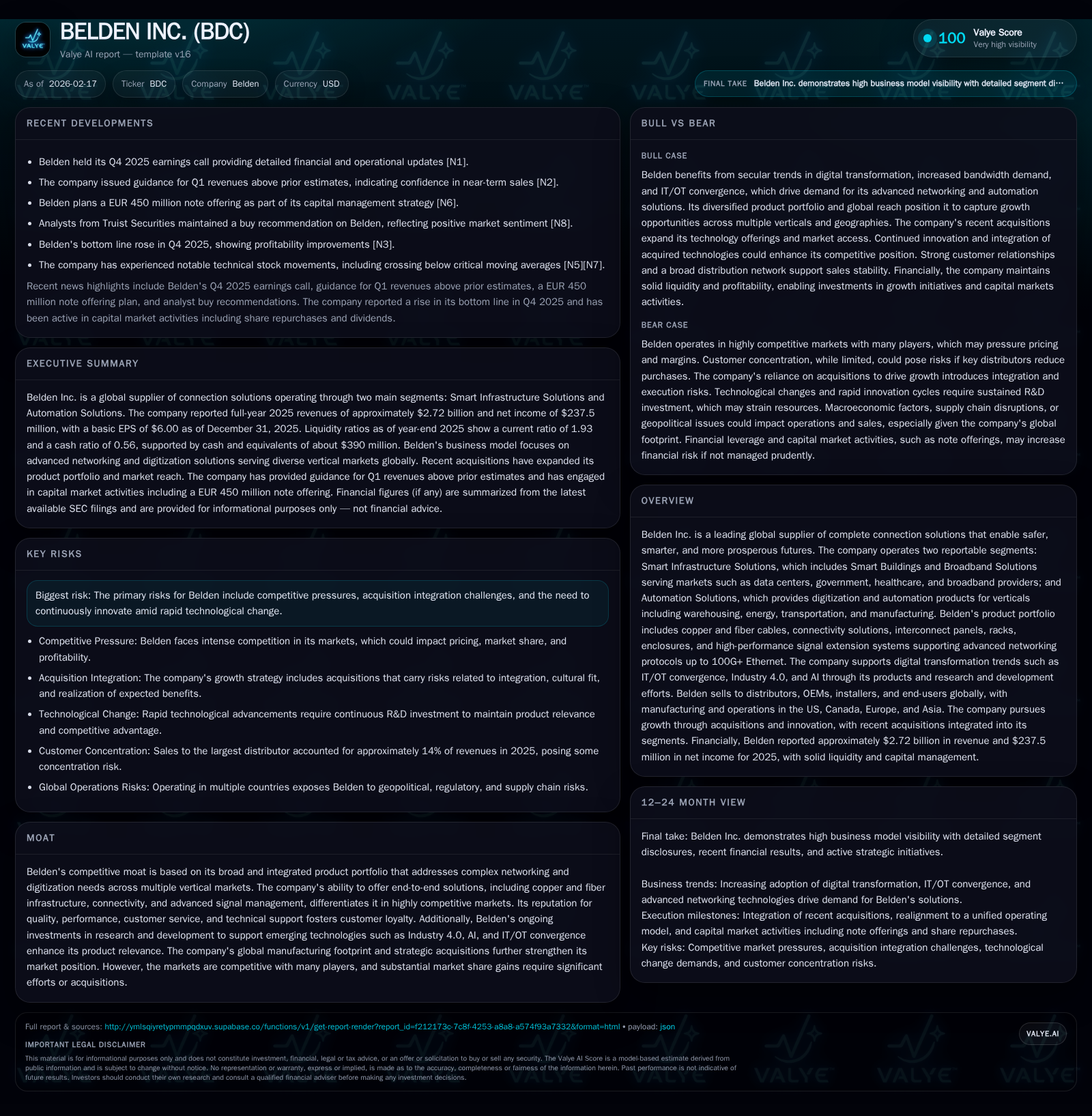
Belden Inc. leverages its dual-segment focus on Smart Infrastructure Solutions and Automation Solutions to meet evolving customer demands in digitization, IT/OT convergence, and Industry 4.0. From FY2024 to FY2025, the company recorded solid revenue growth of 10.3%, with operating income and net income rising by 18.5% and 19.7%, respectively, propelled by portfolio integration and strategic acquisitions. Continued investments in R&D foster advanced fiber optic and networking technologies supporting high-performance and secure digital infrastructures. Although competitive pressures and acquisition integration remain risks, Belden maintains healthy profitability metrics, an 18.8% ROE, strong operating cash flows, and manages capital allocation with dividends and measured capex.
Driving Forces Behind Belden’s Recent Revenue and Earnings Expansion
Belden Inc.'s latest annual results demonstrate meaningful progress fueled primarily by its cohesive product portfolio strategy and targeted acquisitions enhancing both Smart Infrastructure and Automation segments. In fiscal year 2025, the company posted revenue of approximately $2.72 billion, marking a robust year-over-year increase of 10.3% compared to $2.46 billion in 2024 [F1]. Operating income outpaced top-line growth with an 18.5% climb to nearly $316 million from about $266 million the prior year, driven by improved operational leverage and cost efficiencies within its integrated offerings.
Net income also displayed notable expansion, increasing nearly 20% to $237.5 million in 2025 from $198.4 million in 2024 [F1]. This surge highlights effective margin management alongside sales growth, potentially buoyed by synergies gained through recent acquisitions such as Precision Optical Technologies and CloudRail GmbH which enhanced high-value fiber optics and sensor-to-cloud capabilities.
These financial gains reflect Belden’s success in marrying legacy copper-based expertise with the rising demand for cutting-edge fiber systems capable of supporting high-bandwidth applications including next-gen broadband and smart building networks. Moreover, incremental margin improvements suggest disciplined operational execution amid varying raw material cost inputs.
Historical performance (annual)
| FY | Rev ($bn) | Net ($mm) | CFO ($mm) | OpInc ($mm) | Rev YoY | Net YoY |
|---|---|---|---|---|---|---|
| 2025 | 2.7 | 238 | 355 | 316 | +10.3% | +19.7% |
| 2024 | 2.5 | 198 | 352 | 266 | -2.0% | -18.3% |
| 2023 | 2.5 | 243 | 320 | 318 | -3.6% | -4.7% |
| 2022 | 2.6 | 255 | 281 | 363 |
Note: Omitted columns lack sufficient annual XBRL coverage in the provided tags (need ≥2 annual points): Capex, Buybacks. Source: SEC companyfacts cache [F1].
Capital returns and efficiency (annual)
| FY | Div ($mm) | FCF ($mm) | ROE% |
|---|---|---|---|
| 2025 | 8 | 219 | 18.8 |
| 2024 | 8 | 223 | 15.3 |
| 2023 | 8 | 203 | 20.8 |
| 2022 | 9 | 176 | 22.3 |
Source: SEC companyfacts cache [F1].
Note: Dividends paid (~$8 million yearly) and share repurchases are not included due to insufficient annual data post-2017.
Segment Spotlight: Smart Infrastructure vs. Automation Solutions Performance
Belden operates principally through two reportable segments that collectively address diverse markets demanding complex network solutions.
The Smart Infrastructure Solutions segment encompasses Smart Buildings (wired/wireless infrastructure, intelligent power/cooling management) and Broadband Solutions aimed at data centers, government facilities, healthcare institutions, hospitality venues, financial services firms, stadiums, educational campuses, military installations as well as broadband/wireless internet service providers [S19][S4][S6]. This segment’s product suite includes copper/fiber cables, interconnect panels, racks/enclosures alongside secure high-performance signal extension systems compliant with advanced Ethernet protocols up to beyond 100G.
Conversely, Automation Solutions is geared towards industrial digitization enabling IT/OT integration across sectors like warehousing logistics, energy production/transmission infrastructure, transportation networks and manufacturing environments [S19][S6]. The segment provides hardware/software building blocks that facilitate sensor-to-cloud data connectivity—a critical component supporting real-time analytics under Industry 4.0 frameworks.
Revenues have shifted somewhat as Automation Solutions enjoys increased demand reflecting accelerated factory automation needs worldwide while Smart Infrastructure continues to grow alongside the deployment of fiber optics/upgraded broadband infrastructure [S25]. The balance highlights Belden’s strategic positioning spanning both IT-driven building technologies and critical operational technology systems.
Capitalizing on Digital Transformation Trends to Extend Market Reach
Belden’s ongoing research emphasizes advancements tied closely to digital transformation imperatives such as AI integration powering smarter diagnostics/control loops within industrial settings or data center environments [S24]. The company’s R&D investments specifically hone fiber optic innovations that ease installation complexity while enhancing robustness for technicians—important given the pervasive push toward ubiquitous connectivity.
R&D also targets compatibility with emerging network paradigms including power-over-Ethernet enhancements vital for IoT proliferation inside smart buildings sustaining countless connected sensors/devices requiring simultaneous power/data flow without extensive wiring infrastructure upgrades [N1][S28]. By evolving a portfolio that supports this technological evolution—combined with flexible customization options—Belden asserts a differentiated competitive edge.
Furthermore, accelerated development continues around passive optical networks (PON), vital for broadband service providers upgrading subscriber access amid growing bandwidth consumption caused by streaming media and cloud services expansion [S24]. These initiatives enable Belden to capture a greater share of capex spending cycles driven by customers’ digital transformation roadmaps.
Upcoming Catalysts and Guidance: What Investors Should Monitor
Management's recent commentary highlights confidence entering Q1 2026 with revenue guidance exceeding consensus expectations—indicative of sustained demand momentum particularly within Smart Infrastructure markets facing upgrades around cloud access/data centers as well as ongoing broadband network deployments [N1][N4][N5].
However, watchpoints include potential supply chain uncertainties due to geopolitical tensions affecting tariffs on imported components; pricing pressures tied to raw materials may constrain margin performance over shorter-term intervals despite revenue growth drivers remaining intact [S8]. Competitor activity remains vigorous especially from large multinational electronics manufacturers investing heavily in similar connectivity/automation spaces.
Overall market attention should focus on quarterly order trends across verticals sensitive to economic cycles (e.g., commercial real estate versus manufacturing capital expenditures), plus the seamlessness of integrating acquired entities into existing operations—a factor crucial for maintaining scale economies.
Assessing Capital Allocation: Balancing R&D Investments, Dividends, and Debt Management
Financially disciplined capital deployment is evident through a modest but steady increase in capital expenditures totaling roughly $136 million in FY 2025 (+5.5%) focused on capacity expansion related primarily to fiber cable manufacturing and innovations supporting bandwidth-intensive applications [F1][S24]. Such investment aligns well with the company's strategy to underpin future growth opportunities arising from increased network complexity.
Operating cash flow remained stable at approximately $355 million in FY 2025 despite inflationary cost pressures—supporting a free cash flow profile near $219 million after accounting for capex outlays [F1]. Dividend distributions have hovered around $8 million annually over recent years denoting prudent cash return amidst reinvestment priorities; importantly though share repurchase programs have been limited or absent since mid-decade indicating preference for liquidity retention and reduced financial risk exposure [S22][S23].
Regarding debt structure management, Belden refinanced its revolving credit facility extending maturities to mid-2030 while maintaining senior subordinated notes totaling over €1 billion collectively due through early next decade—representing manageable leverage levels backed by solid earnings generation capacity [S7][S10][S11]. Liquidity remains bolstered by nearly $390 million cash equivalents at year-end.
Competitive Challenges and Integration Risks Amid Industry Innovation
The competitive landscape is highly fragmented populated by numerous global players ranging from niche connectivity specialists to broad-based electronics conglomerates vying for market share across overlapping domains [valye_report_excerpt; S8; S17; S21]. Key differentiators such as end-to-end solution capability coupled with technical support excellence help Belden carve out position but require continuous innovation investment given technology lifecycles are shortening due to AI-enhanced automation demands.
Integration challenges stemming from multiple recent acquisitions—while broadening technological depth—pose risks related to cultural alignment, standardizing processes across disparate systems,and retaining talent essential for product development scalability [valye_report_excerpt; S17]. Failure to navigate these could slow synergy realization thus limiting earnings accretion potential.
Moreover cybersecurity threats targeting OT networks introduce operational vulnerabilities where Breach events could cause reputational damage impacting customer trust—a scenario Belden actively mitigates through rigorous internal safeguards though residual risks persist given evolving threat vectors [S8].
Geographic Footprint and Customer Concentration: Insights into Global Operations
Geographically diversified operations provide competitive insulation against localized economic fluctuations: approximately 42% of sales derive from international markets including Canada, Europe (Germany primarily), China and other Asia-Pacific locations complemented by manufacturing presence spanning multiple continents enhancing flexibility and servicing efficiency [S6; S9; S13; S25; S26].
Customer concentration presents moderate risk profiles: the largest single distributor accounted for circa 14% of total consolidated revenues in FY 2025 while no other individual customer exceeded approximately a tenth of total sales—permitting some negotiation leverage yet requiring close monitoring of customer dependency dynamics especially under volatile demand conditions or distributor consolidation trends altering purchasing behavior patterns [S6; S9].
Distribution channels remain a mix of OEM direct sales complemented by installers/end-user intermediaries maintaining diverse touchpoints facilitating broad market coverage yet raising complexity around inventory management tied to multiple suppliers worldwide.
Financial Health Summary: Profitability Ratios and Cash Flow Dynamics
Belden exhibits robust profitability reflected by an approximate return on equity near 18.8%, calculated using latest net income over shareholders’ equity—which stood north of $1.26 billion as of FY 2025-end implying efficient use of invested capital aligned with strategic objectives [F1].
Liquidity metrics confirm operational soundness—the current ratio approximates a healthy level of about 1.93 indicating sufficient short-term asset coverage relative to liabilities bolstering working capital resilience especially important during supply chain fluctuations or geopolitical uncertainties affecting inventory sourcing [F1].
Consistent operating cash flow generation staying above $350 million annually supports internal funding requirements covering both dividend payouts (~$8M/year) and capex without resorting extensively to external funding sources—a sign of balanced cash flow stewardship preserving flexibility for opportunistic investments or deleveraging if necessary [F1].[F1]
This analysis reflects information publicly disclosed through SEC filings (10-Ks/Qs) as of February 17th, 2026 plus corporate news available through February 12th, 2026. This document is prepared solely for informational purposes without offering investment advice or recommendations.
Disclaimer: This is research-only, informational analysis and not investment advice. It may include AI-generated interpretation and general industry context. Always verify important details using primary sources.

Comments