
Affiliated Managers Group’s Partnership Model Drives Diversified Growth and Capital Discipline
AMG’s distinctive partnership structure fuels earnings resilience through affiliate autonomy and strategic capital deployment.
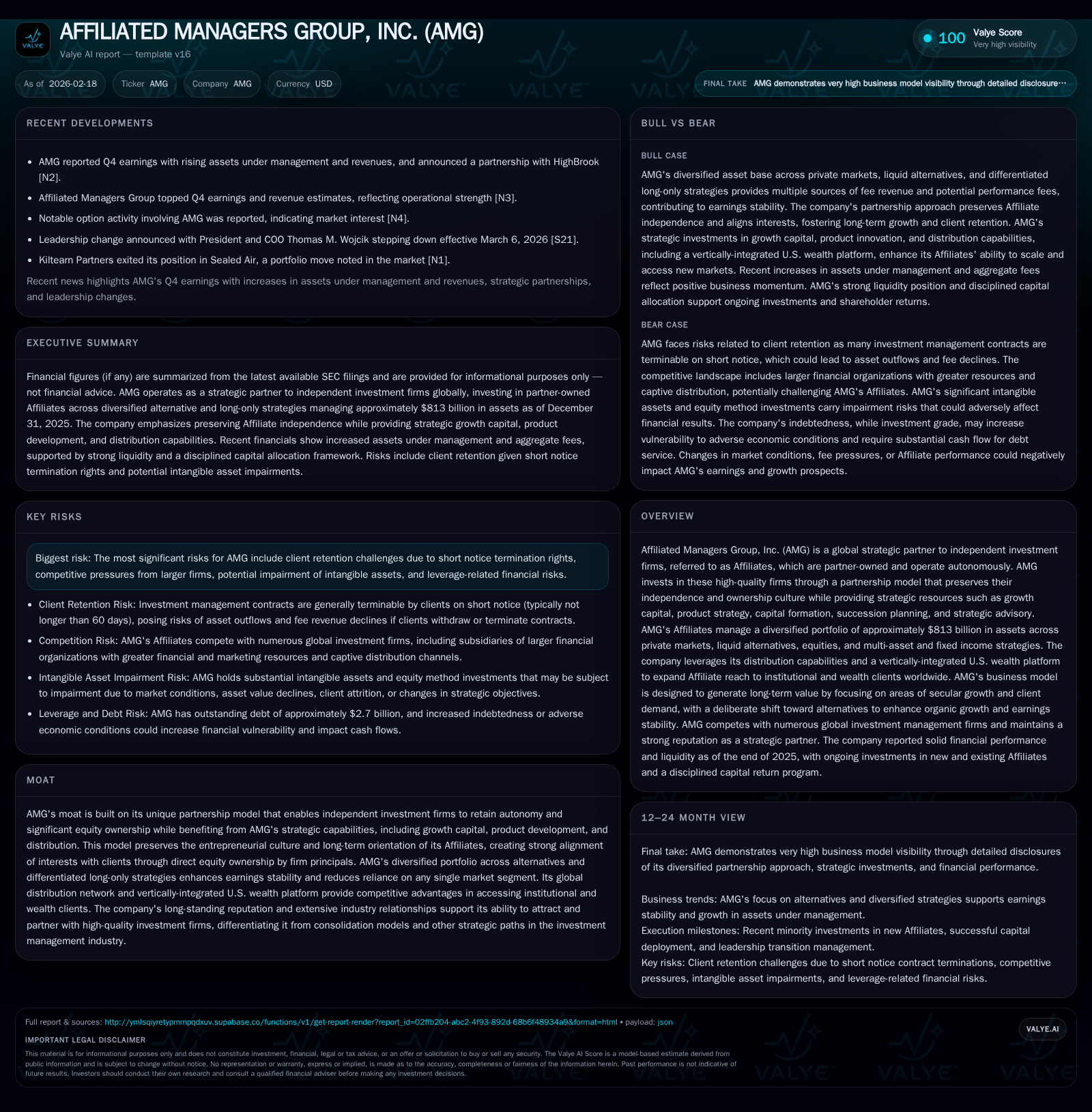
Affiliated Managers Group, Inc. (AMG) operates via a unique partnership model that maintains the independence and significant equity ownership of its investment firm Affiliates, simultaneously providing strategic resources to bolster growth. This structure underpinned AMG’s robust historical operating income and net income growth, with a notable 61.1% and 40.1% year-over-year increase in FY2025, respectively, driven by diversification across alternative and long-only asset classes. AMG’s capital allocation exhibits discipline, balancing investments in new and existing Affiliates with returning capital through share repurchases and dividends, supported by strong cash flow generation and a healthy return on equity around 22%. Ongoing challenges include client retention risks due to contractual termination rights and fee pressures amid rising competition from passive products.
A Track Record of Earnings Growth Rooted in Affiliate Autonomy
Affiliated Managers Group (AMG) has built its financial performance on a foundation of Affiliates that operate independently with significant equity ownership by their principals. This structure fosters entrepreneurial cultures aligned with client outcomes. AMG’s FY2025 operating income reached approximately $280 million (noting earlier years’ figures are from 2017 [F1]), but net income advanced robustly to $716.6 million in FY2025 up from $511.6 million in FY2024—a 40.1% year-over-year increase [F1]. Operating income itself rose 61.1% YoY over this period [F1]. The compositional diversity across private markets, liquid alternatives, equities, multi-asset, and fixed income strategies managed by Affiliates has enabled AMG to benefit from multiple secular growth vectors rather than depending on any single asset class or market cycle [S10][S26].
These autonomous firms maintain their own investment styles and client relationships but leverage AMG's resources for strategic growth capital infusion, product innovation, distribution support, and succession planning—key enablers behind this earnings trajectory [S9][S10]. Recent quarters highlighted the firm surpassing consensus estimates for revenue and earnings driven largely by asset growth within partners like HighBrook Income Partners stepping into new alternative product spaces [N1][N2].
Structural Advantages of AMG’s Partnership Model in Investment Management
AMG’s distinctive partnership approach allows Affiliates to remain independent partner-owned entities while benefiting from AMG’s capital formation expertise and strategic advisory services [S9][S10][S28]. This bespoke setup also includes equity incentive structures tailored to maintain principal alignment over the long term.
Such arrangements preserve investment-centric cultures that are essential for the differentiation of strategies offered. The ability to provide financing solutions enables Affiliates to seed innovative products like evergreen private equity funds or liquid alternatives—a factor often out of reach for standalone firms targeting institutional or wealthy individual investors [S9]. Succession planning solutions offered through AMG further secure continuity as next-generation principals take stewardship roles [S10]. This breadth of support reinforces autonomy while fostering scalable growth pathways.
This model also provides fee stability benefits uncommon among external asset managers whose compensation might be more exposed to short-term performance swings or less differentiated products [S9]. Maintaining such independence aligns AMG closely with its Affiliates' success over time.
Evolving Market Dynamics and Their Implications for AMG's Growth
The asset management industry faces notable headwinds including shifts toward passive investing instruments that typically command lower fees [S1][S4][S7]. Fee compression remains an ongoing concern particularly as institutions consolidate managers or opt for less costly index or ETF products [S4][S13]. Moreover, AMG’s contractual framework grants clients short notice termination rights which creates some uncertainty around fee continuity – a material risk given revenues derive predominantly from Affiliate asset- and performance-based fees [S1][S7][S12].
Competitive pressure is further heightened by larger financial groups leveraging captive distribution capabilities or regulatory arbitrage opportunities that may limit agility for independent affiliations [S4][S13]. Technology trends such as AI-enhanced portfolio management also present mixed implications—the potential for improved efficiency could simultaneously lower demand for high-fee traditional advice or specialized strategies [S13]. Nevertheless, AMG’s structural diversification across asset classes mitigates dependence on any one market segment while enabling nimble reallocation toward secular growth areas within alternatives [N8].
Recent Financial Results: Outperforming Amid Industry Headwinds
In Q4 2025 results reported in early February 2026, AMG delivered earnings above expectations bolstered by rising assets under management reflecting strong client inflows across affiliates [N1][N2]. The company also expanded its affiliate roster with the HighBrook partnership announcement exemplifying active deployment into specialized credit strategies aligned with structural market demands [N1]. This contrasts peers like PennantPark whose misses underscore sector bifurcation amid macroeconomic uncertainty [N3].
Rising revenue figures alongside disciplined expense management yielded significant margin improvement illustrating operational leverage despite challenging industry tides [N2][N4]. Such outcomes underscore how AMG’s partnership model contributes not only to top line expansion but bottom line resilience by aggregating diverse return streams.
Capital Deployment: Balancing Growth, Returns, and Shareholder Rewards
AMG demonstrates consistent capital discipline with operating cash flows growing moderately to approximately $973 million in FY2025—up 4.4% YoY—and capital expenditures remaining minimal at roughly $6.1 million despite a near doubling from prior year levels consistent with ongoing platform investments [F1]. Free cash flow is similarly robust at around $967 million supporting both organic investment initiatives and shareholder returns.
In FY2025 alone, share repurchases amounted to about $706 million while dividends continued on a moderate scale reflecting balanced priorities between reinvesting in Affiliate growth opportunities and rewarding shareholders steadily [F1][S27]. Return on equity measures near 22% mark efficient equity utilization consistent with value creation amid scaling business segments [F1]. Maintaining an investment-grade credit profile rated A3/BBB+ enables favorable access to debt markets complementing internal cash flow funding needs without excessive leverage risks [S5][S6][S8].
Risks Associated with Retention and Competitive Pressures within AMG’s Ecosystem
Client retention risk is prominent due to contractual structures permitting clients relatively short notice termination rights potentially leading to abrupt declines in assets under management—and thus fees—if client preferences shift unexpectedly or competitors gain traction [S1][S7][S18]. This volatility is compounded by increasing competition from lower-fee passive products eroding traditional active management margins [S4][S13].
Moreover, goodwill and intangible asset impairments represent balance sheet risks if underlying Affiliate valuations decline materially during market stress episodes given significant intangibles recorded related to these partnerships [S12][S29]. Regulatory developments increasing compliance burden or constraining operations—especially concerning valuation transparency or use of AI tools—could pressure costs or limit flexibility over time as well [S12][S19]. Overall legal/regulatory contingencies necessitate constant vigilance given expanding enforcement focus within alternative asset space globally [S7][S14][S25].
Key Performance Metrics: Operating Income, Net Income, Cash Flow, and ROE Trends
Historical performance (annual)
| FY | Net ($mm) | CFO ($mm) | Capex ($mm) | Net YoY |
|---|---|---|---|---|
| 2025 | 717 | 973 | 6 | +40.1% |
| 2024 | 512 | 932 | 3 | -24.0% |
| 2023 | 673 | 874 | 12 | -41.3% |
| 2022 | 1146 | 1055 | 11 |
Note: Omitted columns lack sufficient annual XBRL coverage in the provided tags (need ≥2 annual points): Rev, OpInc, Div. Source: SEC companyfacts cache [F1].
Capital returns and efficiency (annual)
| FY | Buybacks ($mm) | FCF ($mm) | ROE% |
|---|---|---|---|
| 2025 | 706 | 967 | 22.1 |
| 2024 | 710 | 929 | 15.3 |
| 2023 | 342 | 862 | 18.8 |
| 2022 | 714 | 1043 | 35.5 |
Source: SEC companyfacts cache [F1].
*Revenue not provided; dividend data only partial; operating income series limited post-2017; ROE derived approximately (Net Income / Equity). Indicative trends show recovery from mid-2010s lows in operating income accompanied by strong net income rebounds aligning with affiliate expansions and industry cycles.
Future Outlook: Areas to Monitor for Sustainable Value Creation
While explicit forward guidance is sparse in public disclosures, key metrics warrant close attention moving forward:
- Organic AUM growth rates across private markets versus liquid alternatives will signal traction amid evolving investor appetites given secular tailwinds toward alternatives cited by the company [N5][S21].
- Progress integrating recent minority investments such as HighBrook and Verition Funds offers insight into AMG's capacity to capitalize on emerging niches aligned with durable client demand trends.
- Monitoring margin resilience remains critical as fee compression pressures intensify amid competitive landscape shifts toward passive vehicles or consolidated investment platforms [N8][N9].
- Regulatory developments affecting valuation methodologies or AI tool use pose operational cost implications that need continuous evaluation against strategic initiatives.
- Return metrics relative to ongoing capital allocation choices between buybacks/dividends versus seeding new affiliate growth reflect management’s balancing act between shareholder rewards and future growth orientation.
AMG's partnership model coupled with a vertically integrated distribution platform positions it well within a complex yet opportunity-rich environment; however sustained performance depends on maintaining Affiliate alignment amid intensifying competitive dynamics.
This analysis synthesizes publicly available information including SEC filings and recent news releases without extending into personalized investment recommendations or predictions about future stock performance.
Disclaimer: This is research-only, informational analysis and not investment advice. It may include AI-generated interpretation and general industry context. Always verify important details using primary sources.

Comments