
Fluor Corporation's Multisector Approach to Engineering and Project Excellence
Fluor Corp’s broad industry reach and integrated EPC model underpin resilience despite recent financial pressures.
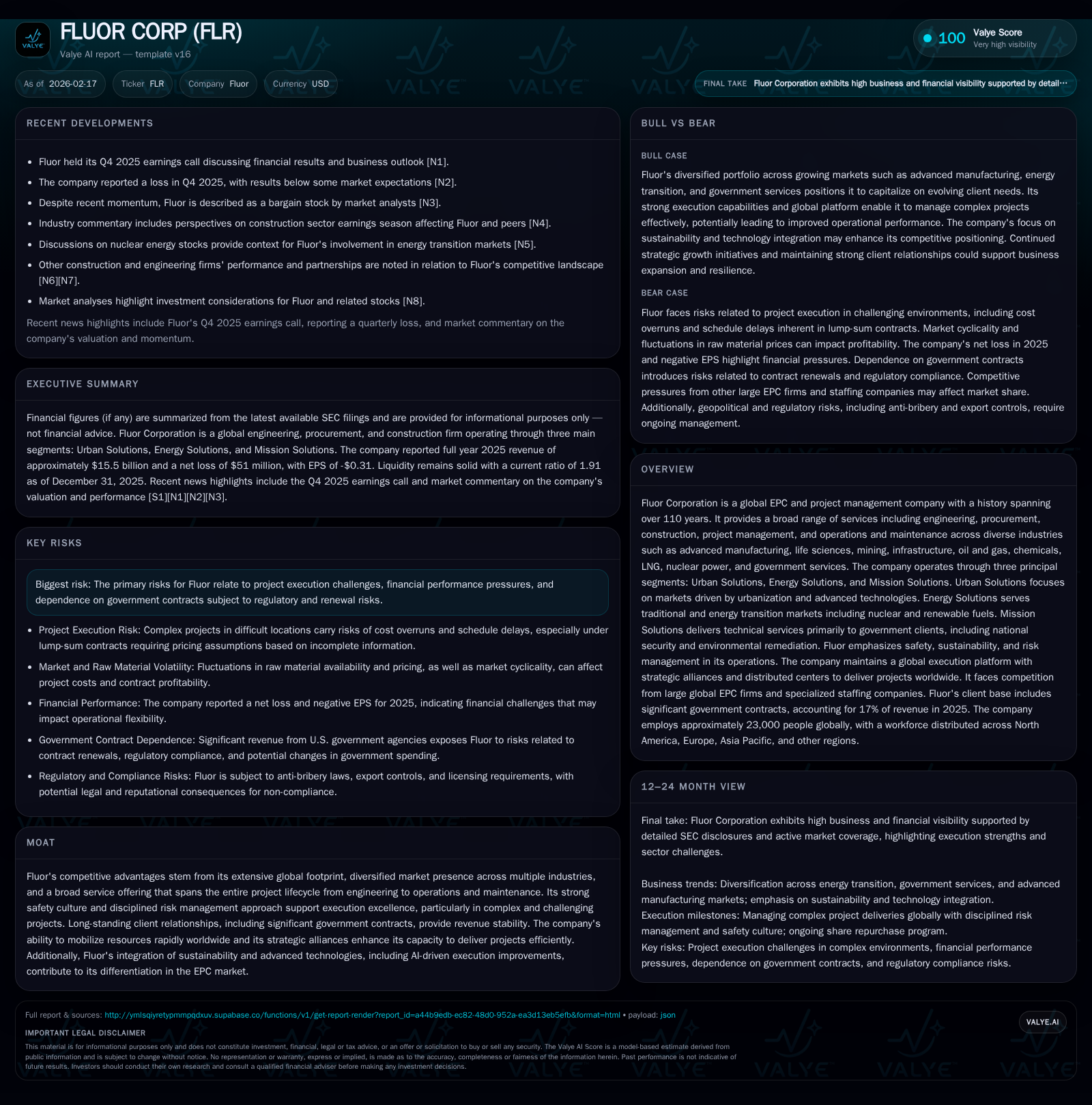
Fluor Corporation operates across diverse sectors through three main segments—Urban Solutions, Energy Solutions, and Mission Solutions—leveraging a global footprint and comprehensive project lifecycle services. While the company reported $15.5 billion in revenues for 2025, it faced a net loss of $51 million due to project execution challenges and cost pressures. Fluor’s strengths lie in its safety culture, longstanding government relationships, and technology adoption such as AI-driven project management. Market risks include cyclicality, project complexity, and government contract dependencies, but ongoing sustainability initiatives and energy transition efforts offer growth avenues.
Versatile Presence Across Urban, Energy, and Mission Solutions
Fluor Corporation’s operations are strategically organized into three principal segments—Urban Solutions, Energy Solutions, and Mission Solutions—that collectively cover a broad spectrum of industries and geographies [S4][S5][S6][S7]. Urban Solutions serves markets adapting to rapid urbanization and advanced manufacturing needs including semiconductors, data centers, life sciences, mining, metals, infrastructure projects, and professional staffing. This segment benefits from long-term engagements such as a single major customer that contributed to 15% of company revenue in 2025 [S7], highlighting both revenue concentration opportunities and related client dependency risks.
Energy Solutions encompasses traditional oil & gas projects alongside energy transition efforts like nuclear power development and renewable fuels [S25]. Here Fluor offers full EPC services including front-end engineering through commissioning. The diversity ranges from upstream exploration facilities to downstream petrochemicals upgrades. Notably the segment includes small modular reactor power plants – a growing niche aligned with global decarbonization trends [S25].
Mission Solutions focuses primarily on government clients delivering technical services supporting national security missions, environmental remediation particularly at nuclear sites under DOE contracts, disaster recovery efforts with FEMA partnerships, secure facility construction for intelligence agencies—all requiring cleared personnel with specialist expertise [S25][S4]. Government agencies generated around 17% of total company revenue in 2025 via direct contracts or joint ventures [S7]. This stable client base differentiates Fluor from peers by anchoring recurring revenues even amid market cyclicality.
Geographically Fluor maintains robust presence across North America (58% workforce), Europe/Africa/Middle East (17%), Asia-Pacific (20%), Central/South America (5%) [S18]. This allocation supports local execution combined with rapid global resource mobilization – crucial for projects requiring tight schedule adherence over dispersed sites.
Financial Performance: From Revenue Growth to Pressing Net Losses
In the fiscal year ending December 31, 2025 Fluor posted revenues of $15.5 billion but reported a net loss of $51 million after the fourth quarter incurred setbacks tied to project overruns [F1][N1][N2]. Despite healthy top-line scale the firm's margins came under pressure reflecting execution complexities typical in EPC industries especially on lump sum or fixed-price contracts where cost overrun risks are elevated [S13]. Approximately 81% of backlog comprises reimbursable contracts which generally mitigate some margin volatility; however fixed-price contracts remain in select scopes where Fluor maintains technical confidence [S21].
Liquidity remains adequate with cash & equivalents totaling $2.15 billion and a current ratio near 1.91 indicating comfortable short-term balance sheet health [F1][S8][S16][S20]. Capital management included share repurchases under longstanding buyback programs while preserving conservative leverage (senior notes due 2028 & 2029) [S8][S20]. Challenges mainly arise from delayed client payments or change order negotiations impacting cash flow timing.
Operationally certain large-scale or multinational projects encountered unforeseen scope expansions or supply chain interruptions that exacerbated costs [N2][S9]. Cost inflation on raw materials further complicated gross margins despite contract clauses designed for balanced risk sharing between Fluor and clients [S7]. Management emphasizes continued focus on disciplined financial governance aimed to restore profitability amid volatile macroeconomic conditions.
Deepening Client Relationships with Government and Strategic Allies
Government contract work underpins nearly a fifth of Fluor’s revenues providing stable demand for specialized mission-critical projects [S7][N4]. The company regularly delivers classified technical services requiring clearances while partnering through joint ventures enhancing competitive positioning in federal procurements [S4][N4]. Such alliances enable winning large multi-year awards through demonstrated past performance credentials crucial when competing against entrenched defense contractors.
Customer concentration is notable with one Urban Solutions client accounting for about 15% revenue; managing these dependencies demands strong relationship management policies [S7]. However diversification across commercial sectors offsets the reliance ensuring no single exposure dominates overall risk profile.
Competition remains fierce from firms like Jacobs Solutions or KBR who also service federal agencies but Fluor leverages both unionized labor talent pools and open shop flexibility to optimize labor deployment per project requirements enhancing proposal competitiveness [S4][N4]. Furthermore technical breadth helps tailor unique solutions fitting client mandates especially in nuclear remediation or unconventional infrastructure challenges.
Leveraging AI and Technology in EPC Project Execution
Fluor increasingly integrates AI-driven tools within its EPC workflows to drive enhanced project controls particularly focused on schedule adherence cost containment and risk mitigation [N12]. These state-of-the-art platforms support predictive analytics enabling earlier identification of potential bottlenecks allowing team interventions before escalation.
Technologies include interactive 3D modeling process simulations automation interfaces plus advanced procurement analytics improving supply chain efficiencies critical when sourcing volatile raw materials [S14]. By digitizing key phases from front-end engineering design through commissioning the company gains insights supporting faster decision-making ultimately reducing exposure to overruns.
Such innovations represent strategic differentiators when competing globally given that many EPC peers are still evolving their digital maturity levels. This technological adoption complements Fluor’s emphasis on operational excellence underscored by a systematic approach towards high performance project delivery stressing quality without compromise on deadlines or budgets.
Risk Mitigation Through Safety Culture and Contractual Strategies
Safety is entrenched as one of Fluor’s core values directly influencing every operational aspect [S12]. Robust safety protocols consistently reduce workplace incidents helping maintain productivity morale client trust while avoiding costly disruptions. Safety KPIs form part of project milestones monitored continuously.
From a commercial standpoint contractual risk is carefully balanced between reimbursable pricing models favored by the company—which limit downside—with more aggressive fixed-price approaches selectively used only where project parameters are well-defined enabling confident cost estimations [S13][S21]. Guaranteed maximum price contracts also appear where capped financial exposure aligns interests between client and contractor.
Special attention is paid to inflationary pressures affecting materials costs—structural steel concrete electrical components—and logistics complexities arising from global supply constraints requiring supplier diversification strategic inventory positioning accelerated expediting practices mitigating order fulfillment timing risks [S7].
Raw Material Sourcing and Procurement Dynamics in a Volatile Market
The principal raw inputs—steel plates structural metals concrete cable electrical/mechanical components—are susceptible to volatile pricing driven by fluctuating commodity markets aluminum copper nickel iron ore plus disruptions from logistical bottlenecks affecting deliverability schedules [S7]. EPC firms increasingly invest in advanced procurement planning systems leveraging bulk purchasing leverage multiple global suppliers mitigating shortages while contractual pass-through clauses allocate part of the price risk back to clients preserving margin integrity.[/analysis]
Fluor’s supply chain expertise coupled with real-time material availability monitoring enables proactive mitigation though sustained inflationary environments still challenge unit costs prompting occasional adjustments in subcontracting scope or phase sequencing to optimize capital deployment.
Comparative Insight: Fluor Within the Global EPC Peer Set
Among large EPC firms including Jacobs Solutions KBR BWXT Technologies Bechtel Group Black & Veatch Fluor stands out for its segmented strategy addressing broad verticals rather than concentrating solely on energy or infrastructure alone enabling diversified earnings streams reducing cyclicality impacts [S4][N4]. A labor strategy mixing unionized workforces for high-skill trades with open shop flexibility allows optimized operational efficiencies tailored regionally.[/analysis]
Its history of long-term government partnerships places it favorably against competitors lacking such credentials. Peers often struggle winning classified mission services without extensive security-credentialed personnel pools which Fluor sustains.[/analysis] The integration of advanced tech including AI also positions Fluor ahead amid digital transformation waves sweeping the sector.
Outlook: Sustainability Initiatives and Energy Transition Opportunities
Looking forward Fluor emphasizes sustainability embedded within all operations acting through social economic environmental lenses aligned with market-driven ESG imperatives [N10][N11][N12]. Energy Solutions increasingly targets renewable fuels low-carbon chemicals small modular reactors aiming at markets forecast for robust growth catalyzed by policy support toward decarbonization.
Urban technology developments focus on building smart manufacturing clean infrastructure data center expansion consistent with urbanization trends. These areas benefit from regulatory mandates incentivizing greener construction processes integrated carbon capture/utilization technologies bolstering competitiveness.
Backlog quality improvement prospects hinge on securing projects featuring sustainable design elements along with contractual terms supporting fair cost-risk allocations facilitating predictable returns even amid macroeconomic uncertainties.
Disclaimer
This analysis provides an overview of Fluor Corporation’s business operations industry context financials competitive positioning and strategic outlook based on available data through early 2026. It does not constitute investment advice or recommendations. Readers should consider seeking personalized professional guidance before making any investment decisions.
Disclaimer: This is research-only, informational analysis and not investment advice. It may include AI-generated interpretation and general industry context. Always verify important details using primary sources.

Comments