
Research Solutions Inc’s AI-Driven Research Workflow Pivot Amid Financial Headwinds
RSSS is navigating its transition to an AI-centric research workflow platform while managing liquidity constraints and competitive pressures.
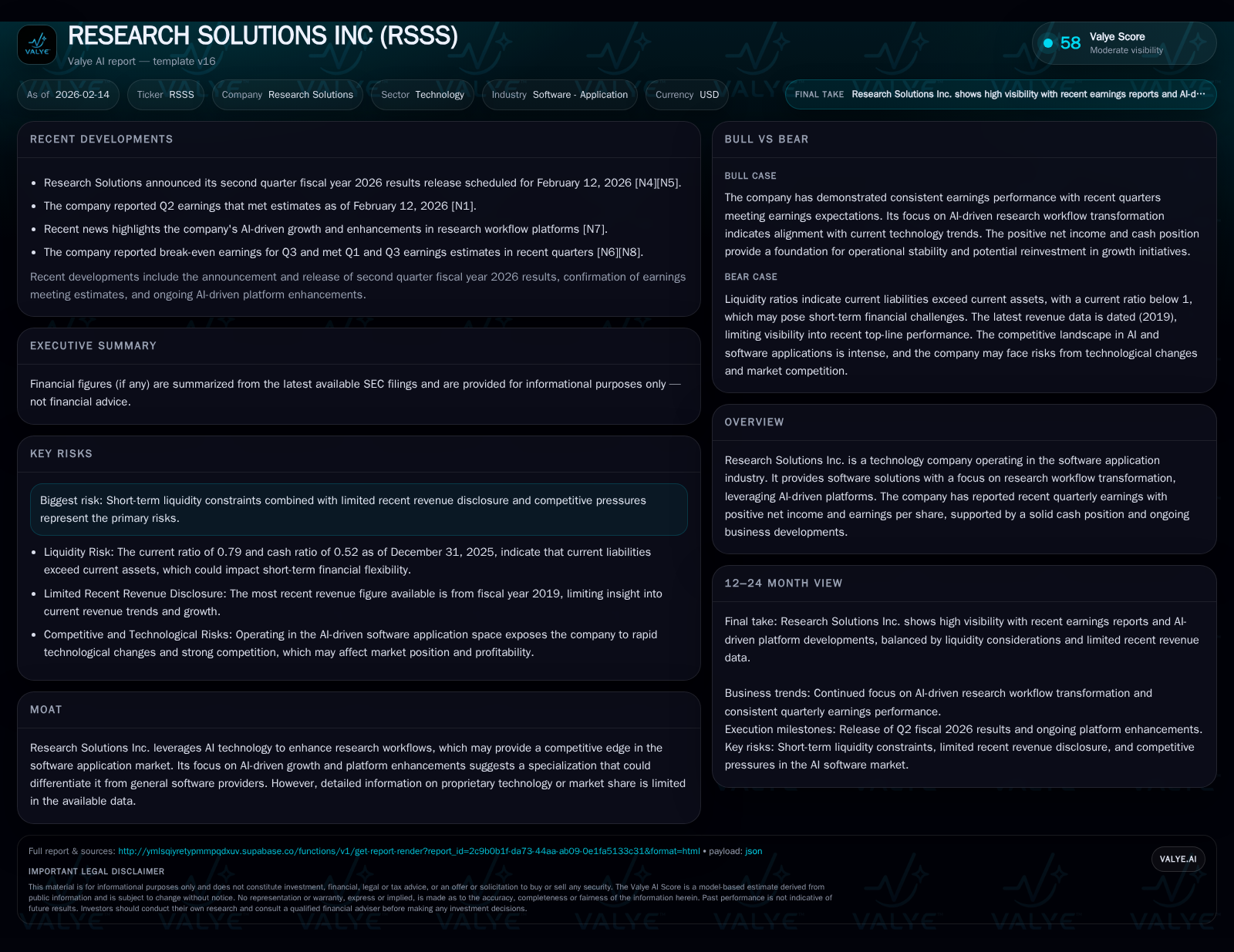
Research Solutions Inc. (RSSS) is reshaping its technology footprint by emphasizing AI-enhanced software solutions targeting research workflows, positioning itself within a specialized niche of the broader application software market. Its recent quarterly earnings evidenced modest net income and EPS gains that met market expectations, though revenue details remain opaque. Despite a solid cash position, the firm confronts notable short-term liquidity challenges reflected in a sub-1 current ratio, juxtaposed against ongoing investments in AI capabilities. Competitive forces and limited transparency on proprietary technology add complexity to RSSS’s path forward as it balances innovation ambitions with pragmatic financial stewardship.
From Traditional Software to AI-powered Innovation: RSSS’s Evolution
Research Solutions Inc. has embarked on a significant business model pivot, redirecting focus from generalist software provision toward highly specialized AI-enhanced platforms aimed at streamlining and transforming research workflows. This strategic recalibration situates RSSS within a distinct niche of the software application industry—a space demanding integration of artificial intelligence for contextualizing and optimizing scholarly data management. Recent analyses emphasize this evolution as a core facet of RSSS's growth narrative [valye_report_excerpt; N9]. The company’s platform enhancements leverage machine learning and natural language processing techniques to aid researchers in synthesizing complex information rapidly, potentially enabling customers such as academic institutions or corporate R&D divisions to accelerate knowledge discovery cycles [N10; N11]. Though this transition aligns with broader industry trends favoring AI integration, explicit details about proprietary algorithms or platform exclusivity remain limited in public disclosures.
This strategic shift reflects recognition that generic software solutions face margin erosion amid commoditization; instead, embedding AI capabilities tailored to research workflows can drive differentiation through increased value-add and customer stickiness. Nonetheless, the challenge lies in scaling these offerings effectively while sustaining innovation momentum amid resource constraints.
Unpacking the Latest Earnings: Meeting Expectations Amidst Market Skepticism
In its Q2 fiscal 2026 earnings release dated February 12, 2026, RSSS reported net income of approximately $547K alongside earnings per share gains that met consensus analyst estimates [N1; F1]. These results uphold continuity in profitability after periods of break-even outcomes reported previously [N6]. However, the company has not disclosed comprehensive revenue figures for the updated quarter beyond historical data from mid-2019 pegging revenues near $28.8 million [F1], complicating granular assessment of topline performance trends.
Despite meeting earnings benchmarks, market reaction remained muted—reflective perhaps of underlying apprehensions regarding top-line growth durability and liquidity dynamics. The continuity in net income confirms operational stabilization at minimum but does not yet signal robust expansion or margin enhancement explicitly tied to new AI platform deployments [S2]. As such, while meeting expectations might reassure investors about management’s execution capability, lingering doubts about growth trajectory persist given the absence of detailed revenue guidance or customer metrics.
This performance snapshot underscores how incremental earnings achievements can bolster credibility but are insufficient alone to dispel concerns anchored on market competitiveness and financial health.
The AI Advantage: Evaluating Research Solutions’ Technological Moat
RSSS’s competitive moat predominantly rests on its ability to harness artificial intelligence to transform research workflows—an element increasingly critical amidst intensifying demands for data-driven insights in academia and industry sectors [valye_report_excerpt.moat; N10; N11]. By embedding machine learning algorithms capable of contextualizing citations and automating literature synthesis tasks, RSSS stakes out differentiation from broader software vendors whose platforms often lack specialized research workflow focus.
This specialized orientation likely affords barriers to entry rooted in domain expertise amalgamated with evolving AI models that continual training datasets enhance. Nevertheless, the publicly available information does not elaborate on patents or unique technology pathways securing defensibility beyond product-market fit narratives. Given this, sustainability of the moat may hinge not solely on AI deployment per se but also on excelling at customer integration and expanding ecosystem partnerships.
The moat also confronts headwinds as larger established software providers intensify investments into AI modules targeting knowledge management domains broadly, heightening competitive pressure [analysis]. Thus, while the firm’s niche focus may provide initial differentiation benefits, continuous innovation and demonstrable efficacy remain imperative for maintaining technological edge.
Financial Foundations: Cash Position, Liquidity Challenges, and What They Mean
Examining RSSS’s recent financial filings reveals a somewhat paradoxical state: steady net income generation contrasts with constrained liquidity metrics that signal near-term risks [F1; S2]. At December 31, 2025, the company held approximately $12.3 million in cash and equivalents against total current assets of roughly $18.7 million. Meanwhile, current liabilities stood at around $23.6 million resulting in a calculated current ratio of 0.79—below the conventional threshold of 1 signaling potential short-run solvency concerns.
This structural imbalance suggests that despite operating profits, RSSS faces liquidity tightness possibly exerted by accruals or short-dated obligations exceeding readily available assets. Such conditions necessitate vigilant cash flow management or accessing external financing sources to bridge gaps.
The Valye report flags these short-term liquidity issues as among the foremost risks confronting RSSS alongside revenue opacity [valye_report_excerpt.risks]. The confluence of positive net income but elevated current liabilities highlights the operational tightrope where strong earnings alone cannot fully insulate from working capital pressures.
Investors evaluating these financial foundations must consider how future cash flow generation aligns with planned R&D spending for AI enhancements and if balance sheet optimization measures are underway. The prevailing situation calls for prudent capital allocation balancing growth initiatives against fortifying liquidity buffers.
Competitive Landscape: Where Does RSSS Stand in the Application Software Industry?
Within the broader application software ecosystem where firms like Crown Holdings (CCK) have recently surpassed earnings and revenue expectations [N2], RSSS occupies a comparatively modest scale and distinct niche specializing in research workflow solutions bolstered by AI integration. While Crown Holdings operates more broadly across industrial packaging applications and Unifi (UFI), despite reporting losses though topping revenue estimates [N3], caters to textile sectors—each company's market context differs markedly.
RSSS faces competition both from large-scale IT enterprises incorporating expansive AI capabilities into knowledge management suites and smaller specialized vendors focusing on scholarly communication tools. This dual pressure creates challenges related to industry maturity where generic solutions proliferate but true domain-specialized platforms remain relatively scarce yet under constant threat from technological advancements among incumbents [valye_report_excerpt.moat].
Navigating this environment requires maintaining uniqueness through continuous feature improvements tied directly to research community needs while scaling marketing efforts effectively within constrained resources. Sustaining relevance within this fragmented competitive landscape further depends on proving measurable customer impact differentiators absent commoditization threats seen elsewhere.
Risks Ahead: Short-term Liquidity and Revenue Transparency Concerns
Key risks identified stem predominantly from financial stresses marked by liquidity shortfalls combined with limited recent disclosures surrounding topline dynamics creating uncertainty over sustainable growth pathways [valye_report_excerpt.risks; F1; N12]. A current ratio below unity coupled with relatively thin margins restricts flexibility especially as ongoing investment into advanced AI platform capabilities may require increased R&D expenditures or hiring costs.
Additionally, scarcity of recent revenue detail impairs external ability to verify organic growth versus episodic contract wins or renewals—factors crucial for confidence building among investors sensitive to volatility within tech-focused small caps. This opacity can exert downward pressure on valuation multiples independent of underlying technological progress.
Given these headwinds, stakeholders face heightened risk scenarios necessitating close monitoring of subsequent quarterly releases for clearer articulation on revenue composition alongside proactive steps management might employ toward enhancing balance sheet resilience.
Looking Through the Lens of Valye Report Insights
Valye’s assessments articulate a nuanced view encapsulating both technological promise embedded within RSSS’s AI specialization along with prudent caution due to evident financial exposures [valye_report_excerpt; valye_report_excerpt.moat; valye_report_excerpt.risks]. The report underscores how AI-enabled workflow transformation presents an attractive competitive angle but simultaneously emphasizes real-world constraints imposed by liquidity imbalances and constrained disclosure breadth.
Integrating these expert perspectives grounds our analysis within a balanced framework recognizing innovation trajectories concurrently challenged by operational funding limitations—a dynamic commonly encountered by smaller tech firms transitioning their go-to-market strategies while sustaining disruptive R&D agendas.
Such insight serves as an anchor for interpreting emerging news flow critically instead of defaulting toward pure optimism over technology or pessimism over finance alone.
Investor Sentiment and Valuation Discrepancies
Post-earnings reactions indicate that although reported results met baseline expectations (net income positive with EPS gains), shares trade significantly below intrinsic value propositions modeled by certain analysts suggesting discounts exceeding 40% [N12; N1; F1]. This disconnect reflects skepticism driven principally by uncertainties outlined earlier—namely revenue transparency gaps and liquidity hurdles.
Such valuation discrepancies are typical where small-cap technology stocks navigate transitions amid mixed signals concerning near-term scalability alongside long-term potential growth engines. The current pricing environment arguably embeds a risk premium reflective not just of company-specific factors but also general market caution regarding mid-tier software players without dominant franchise status or clear multi-year forward visibility.
For analysts reviewing this juxtaposition between fundamentals achieved versus stock price valuations assigned by the market invites reflection on risk tolerance levels appropriate for exposure to firms like RSSS balancing early-stage innovation with tangible financial fragilities.
Strategic Pathways Forward: Growth, Innovation, or Consolidation?
Looking ahead, plausible strategic options for Research Solutions Inc revolve around three broad pathways informed by existing trade-offs: firstly prioritizing sustained R&D investment focused on maturing its AI-driven platform capabilities potentially entailing higher upfront costs; secondly exploring mergers or acquisitions either as acquirer or target aiming to consolidate complementary technologies reducing competitive fragmentation; thirdly enhancing operational efficiencies through cost management optimizing cash burn profiles amidst liquidity constraints [valye_report_excerpt; N9; N10].
Choosing among these routes necessitates deliberate balancing where doubling down on innovation promises longer-term differentiation but requires healthy financing flexibility conversely pursuing consolidation could deliver scale benefits mitigating external competition albeit potentially diluting core focus areas.
Executing any scenario demands transparent communication strategies addressing investor concerns around financial health while showcasing credible growth pathways supported by tangible technology milestones realized during implementation phases.
Concluding Takeaway: Balancing Potential and Pragmatism
In sum, Research Solutions Inc presents an intriguing case study at the crossroads between technological evolution anchored in artificial intelligence targeted at enhancing research workflows juxtaposed against immediate financial realities characterized by liquidity pressures and disclosure limitations. The company’s ability to carve out differentiated positioning through specialized AI applications aligns well with industry demand vectors favoring data-centric knowledge tools yet is tempered by operational funding challenges restraining rapid scale-up possibilities.
Accordingly, stakeholders should approach RSSS overlaying enthusiasm for its innovation trajectory with disciplined appraisal of balance sheet metrics ensuring sustainability imperatives are met without compromising transformational ambitions. This dynamic underscores a central theme prevalent across emerging tech firms today—the imperative interplay between visionary growth strategies powered by AI advances coexisting with pragmatic capital stewardship shaping achievable outcomes within competitive software markets.
This analysis is intended solely for informational purposes reflecting publicly available data up to February 14, 2026, without offering investment advice or recommendations regarding buying or selling securities related to Research Solutions Inc.
Disclaimer: This is research-only, informational analysis and not investment advice. It may include AI-generated interpretation and general industry context. Always verify important details using primary sources.

Comments