
PodcastOne's Balancing Act: Content Strength Amid Financial Constraints and Industry Pressures
PodcastOne leverages standout True Crime content while navigating persistent operating losses and LiveOne-imposed financial restrictions.
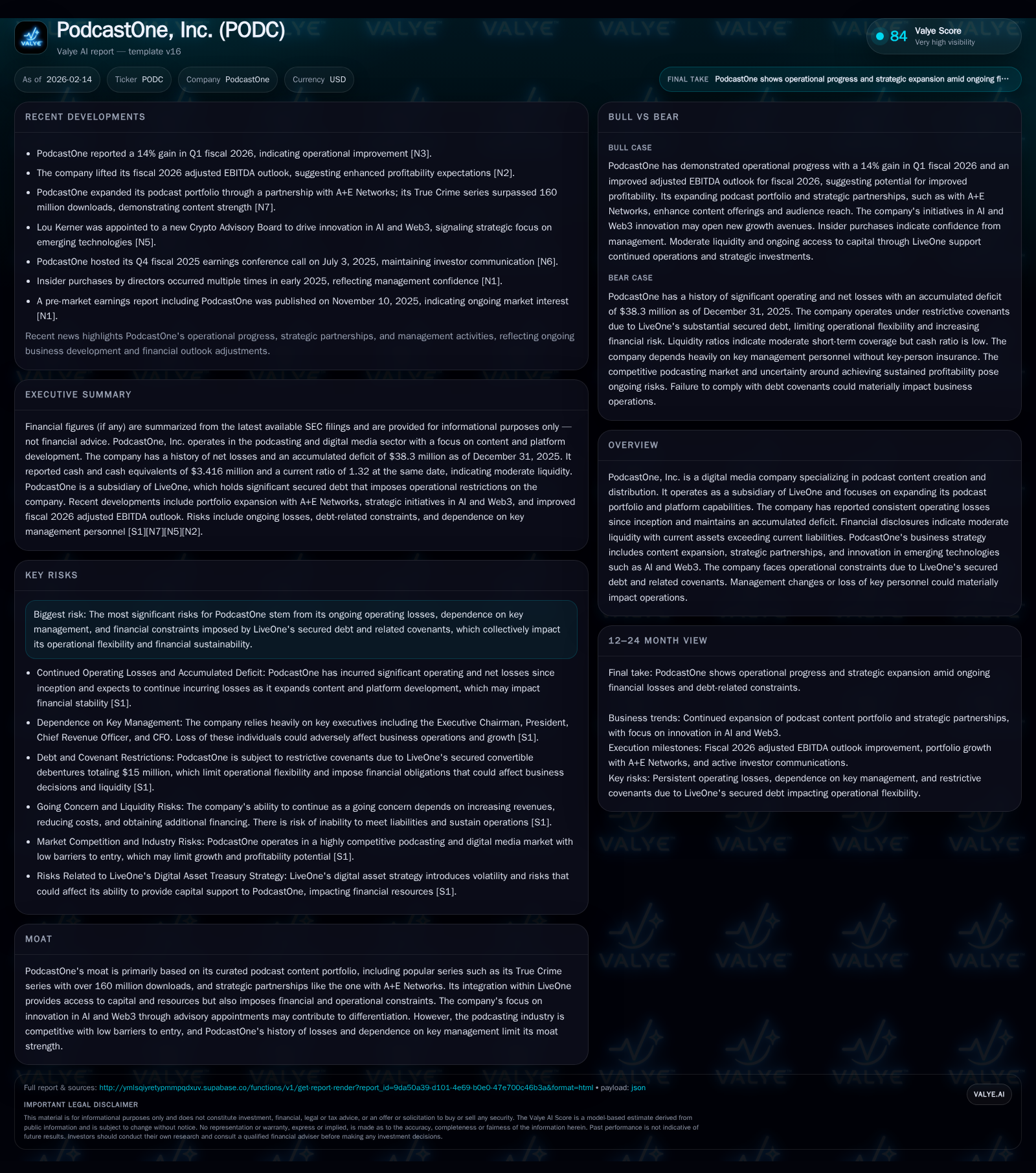
PodcastOne stands out in the podcast ecosystem through a robust portfolio anchored by its popular True Crime series, which has amassed over 160 million downloads. Despite this content-driven footprint, the company grapples with recurring losses exceeding $6 million annually and an accumulated deficit north of $38 million. Being a subsidiary of LiveOne offers capital access but imposes debt-related covenants that restrict operational flexibility. PodcastOne’s strategic exploration into AI and Web3 signals attempts at differentiation, though competitive pressures and financial hurdles keep its path to sustainable profitability uncertain.
Curating a Podcast Portfolio: Spotlight on True Crime and Content Assets
PodcastOne has meticulously crafted a podcast portfolio that strategically leans on highly engaging content genres, none more prominent than its True Crime series. Amassing over 160 million downloads, this flagship offering not only defines PodcastOne's identity but also anchors its moat in an industry flooded with newcomers. Such listenership volume exemplifies meaningful audience engagement—a vital currency given advertising-driven revenue models prevalent in the podcast space. This curated content roster showcases PodcastOne’s capacity to secure loyal listeners and generate recurring consumer interest despite intense competitive noise.
Yet, beyond this signature niche, PodcastOne's diversified slate includes varied shows designed to attract different demographic slices. The cumulative effect fortifies brand recognition and platform stickiness; however, these assets are vulnerable to shifts in listener preferences and rival offerings’ quality improvements. Maintaining relevance demands constant content refreshment and investment.
Navigating Growth amid Recurring Losses: The Financial Narrative
Repeated operating deficits underscore PodcastOne's challenging path to sustainable profitability. For fiscal year 2025, the company reported net losses totaling $6.5 million, consistent with its historical pattern of annual operating shortfalls since inception [S2]. These losses coexist with constrained liquidity: working capital was recently measured at $2.8 million as of December 2025 [S2], indicating only moderate cash runway.
The limited positive cash flow from operations—$2.4 million during the nine months ended December 2025—contrasts sharply with past negative operational cash trends [S2]. This suggests intermittent improvements yet underscores an underlying struggle to convert compelling content into steady financial gains. Revenue levels remain modest relative to expenses tied to content production, platform enhancements, and public company overheads.
Consequently, the company's accumulated deficit totals approximately $38.3 million [S2], highlighting persistent cash burn that impedes aggressive scaling without supplementary capital infusions or margin improvements. Management candidly acknowledges that ongoing expansion efforts presage further elevated costs, increasing pressure on future earnings profiles.
The LiveOne Influence: Strategic Benefits and Operational Constraints
As a subsidiary of LiveOne since mid-2020, PodcastOne accesses enhanced capital resources unavailable prior [valye_report_excerpt]. LiveOne’s backing facilitates intercompany loans and equity raise opportunities crucial for financing ongoing development projects including content acquisition and technological innovations.
However, this association comes tethered to financial covenants tied to LiveOne’s secured debt facilities [S2]. These arrangements impose operational constraints that curtail PodcastOne's strategic freedoms—ranging from mitigated risk appetites to meticulous scrutiny over expenditures and acquisitions. Such regulation can hamper agile responses in a fast-evolving media ecosystem where speed often dictates competitive advantage.
This symbiotic relationship generates trade-offs wherein capital availability tempers but does not eliminate growth frictions caused by borrowing limits and governance oversight embedded within LiveOne's broader corporate financing structure.
Innovation Horizons: AI and Web3 as Differentiators or Diversification?
In seeking footholds beyond traditional podcasting models, PodcastOne has actively pursued innovation channels such as artificial intelligence advisory appointments and exploratory ventures into Web3 technologies [valye_report_excerpt]. These initiatives aim at enhancing content personalization, improving production workflows, or unlocking novel monetization mechanisms via decentralized platforms.
While still nascent within their operational impact, these explorations hint at forward-thinking adaptability designed to offset commoditization risks intrinsic to audio entertainment markets dominated by giants like Spotify and Apple Podcasts. Pragmatically, these investments could yield incremental advantages that amplify user engagement or streamline costs if integrated effectively.
Nevertheless, their current contribution remains supplemental rather than foundational, necessitating prudent resource allocation so these emerging tech experiments do not detract from core portfolio strengthening efforts.
Competitive Landscape: Low Barriers but High Stakes
Podcasting presents an alluringly low barrier-to-entry environment; relatively modest initial infrastructure requirements attract countless independent creators alongside well-funded incumbents. This dynamic fuels relentless competition for audience attention and advertiser dollars alike.
PodcastOne attempts differentiation through curated premium content partnerships—for instance, ties with A+E Networks—and exclusive intellectual property rights [valye_report_excerpt]. Nonetheless, these alliances offer only partial insulation against genre fragmentation and listener attrition caused by prolific alternative shows flooding discovery platforms daily.
The resultant moat reflects both opportunity and fragility: while proprietary podcasts engender listener loyalty difficult to replicate immediately elsewhere, the fluid consumer behavior patterns characteristic of streaming medium challenge long-term defensibility absent continuous innovation or exclusive deals.
Risks Under the Microscope: Management, Debt, and Operational Flexibility
Delving deeper into risk exposures reveals acute vulnerabilities stemming primarily from managerial dependencies and financial rigidity imposed by LiveOne’s secured loan covenants [S2]. Leadership stability is critical given the creative-driven nature of podcasting; loss of key personnel risks derailment of ongoing content projects or strategic initiatives.
Meanwhile, indebtedness restricts flexibility around capital expenditures or aggressive market maneuvers needed for scaling quickly or acquiring complementary assets—actions commonly required in rapidly evolving entertainment sectors [S2].
Additionally, sustained operating losses erode buffer capacity against unexpected business disruptions or macroeconomic headwinds affecting advertising budgets—a principal revenue driver for podcasts.
Such factors collectively frame a precarious operational profile where missteps could compound existing financial pressures substantially.
Outlook and Strategic Pathways: Will Profits Ever Materialize?
Looking ahead, PodcastOne faces a complex decision matrix balancing continued investment in expanding an already resonant content portfolio against tightening cost controls imperative for moving toward profitability [S2][valye_report_excerpt]. Revenue growth must outpace escalating expenditure linked with platform enhancements and innovation pursuits like AI/Web3 integration.
Achieving meaningful margin improvement demands either substantial increases in advertising monetization efficacy or diversification toward higher-margin subscriber or licensing models uncommon currently but potentially viable with technological leverage.
Alternatively, strategic acquisitions financed under LiveOne's structure might accelerate scale yet add integration risks within existing debt-imposed constraints.
Ultimately, whether consistent profits are attainable remains an open question hinging on execution excellence amid external competitive pressures plus internal structural limitations. Stakeholders may consider multiple outcomes plausible—from eventual break-even driven by flagship series dominance fortified by tech advances to continued funds consumption requiring periodic capital injections from parent entity.
Disclaimer: This analysis synthesizes company disclosures and sector context without providing investment recommendations. Readers should conduct independent research considering their unique objectives.
Disclaimer: This is research-only, informational analysis and not investment advice. It may include AI-generated interpretation and general industry context. Always verify important details using primary sources.

Comments