
Dover Corporation's Strategic Innovation and Sustainability Drive Through Cyclical Industrial Markets
Dover Corp navigates complex industrial cycles with diversified operations, a robust recurring revenue model, and a forward-looking emphasis on clean technologies.
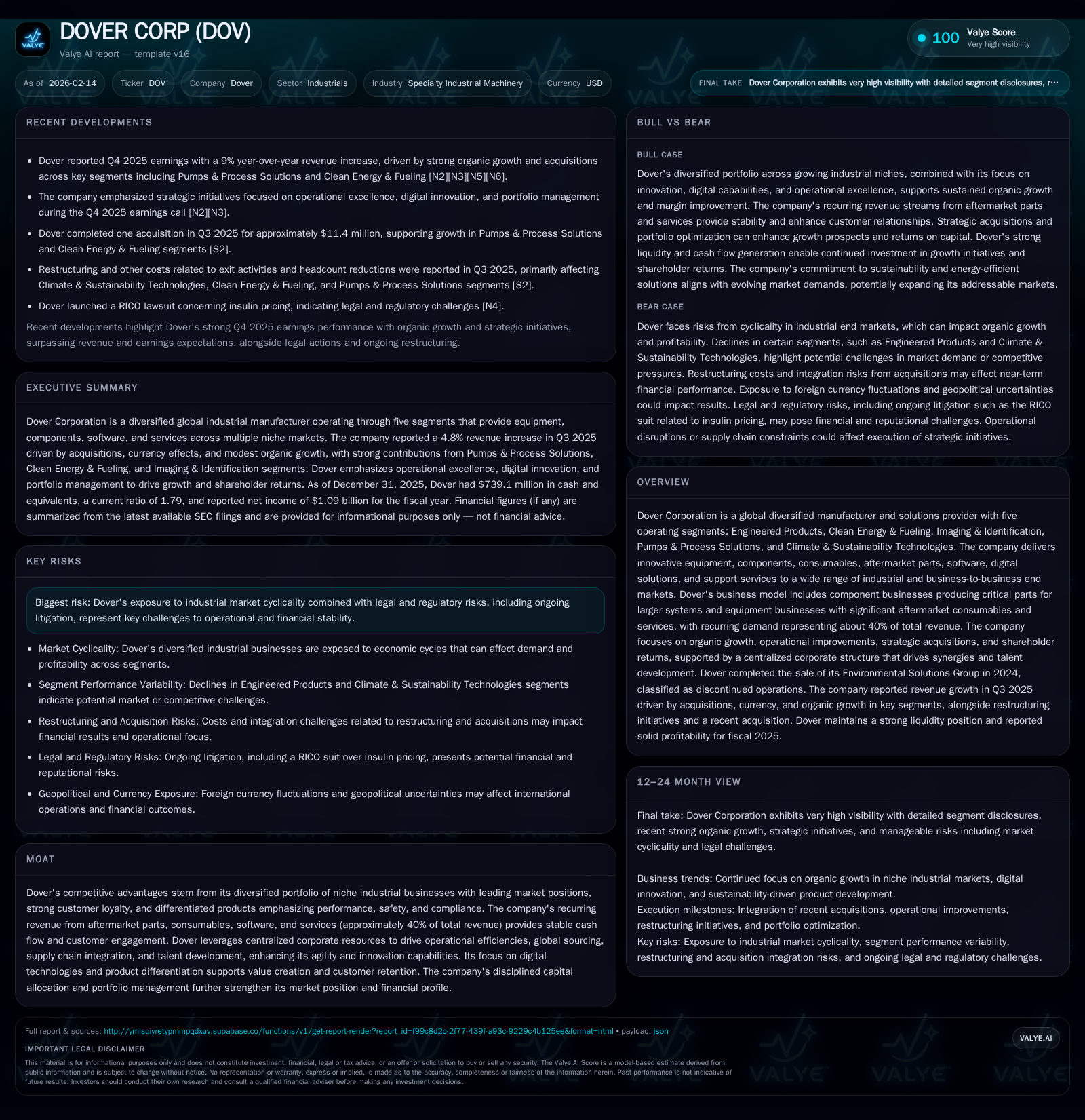
Dover Corporation, a diversified specialty industrial machinery player, balances solid recent earnings with macroeconomic and geopolitical challenges by leveraging its five distinct operating segments. With approximately 40% of its revenue stemming from resilient aftermarket parts and software services, Dover cushions cyclicality inherent in its markets. The company’s centralized corporate infrastructure underpins operational efficiencies while targeted investments in climate and sustainability technologies signal strategic adaptation to evolving global demands. Nonetheless, legal, regulatory, and labor risks remain persistent headwinds the company must manage carefully as it maps out growth and capital deployment plans for 2026.
Dover’s Multifaceted Industrial Mosaic: A Segment-by-Segment Look
Dover Corporation’s five-segment structure is a deliberate orchestration of businesses unified by shared manufacturing characteristics and end-market synergies but distinguished by their specialized industrial roles. The Engineered Products segment caters to vehicle aftermarket solutions, aerospace components, defense equipment, industrial hoists, precision soldering tools, and fluid handling—markets that demand high-performance niche products deeply embedded in customers’ value chains.
In contrast, the Clean Energy & Fueling business unit operates at the nexus of traditional fuels and emergent clean fuel technologies including hydrogen and liquefied natural gas (LNG), alongside electric vehicle charging infrastructure. This segment’s comprehensive suite—spanning equipment, software for remote monitoring, dispensing systems for hazardous materials, and retail fueling operation solutions—positions Dover advantageously amid a global energy transition.
Imaging & Identification delivers marking, coding, traceability solutions plus digital textile printing—critical in regulated sectors like pharmaceuticals as well as consumer packaged goods where brand protection reigns paramount. Pumps & Process Solutions serves an even broader industrial spectrum covering specialty pumps for biopharmaceutical single-use applications to polymer processing equipment supporting chemical manufacturing processes.
Last but not least is Climate & Sustainability Technologies which targets commercial refrigeration, heating/cooling systems, and beverage can-making machinery—segments undergoing transformation driven by efficiency mandates and environmental regulations. Notably, Dover divested its Environmental Solutions Group in late 2024 for $2 billion [S1], signaling its focus on core segments exhibiting stronger growth and strategic fit.
This multifaceted portfolio collectively addresses diverse but interconnected industrial niches that enable cross-segment innovation sharing while maintaining autonomy where specialized expertise is essential.
The Pulse of Recurring Revenues: Aftermarket Resilience
Amid volatile industrial capital expenditure patterns—vulnerable to geopolitical shocks or raw material price swings—Dover’s recurring revenue base is foundational. Approximately 40% of the firm’s revenues derive from consumables such as aftermarket parts, replacement components, digital software updates, and service contracts [S1]. This steady stream not only cushions earnings against cyclical downturns but fosters ongoing customer engagement crucial for market share defense.
Recurring demand typically arises because customers require continuous maintenance or upgrades to existing installed base equipment—a classic defensive moat especially pivotal in highly regulated or safety-critical industries. This mattress-like stream provides cash flow visibility supporting tactical capital allocation decisions. Furthermore, it incentivizes Dover’s innovation pipeline towards enhancements that extend product life cycles or integrate new digital capabilities ensuring stickier client relationships.
Driving Growth through Organic Innovation and Strategic Acquisitions
Dover has recently emphasized a dual-path growth approach combining vigorous organic R&D with selective acquisitions targeting niche technologies or geographic expansion. Q4 2025 earnings highlighted robust organic growth coupled with margin improvements attributed largely to operational efficiencies combined with premium product introductions [N1][N2].
Management articulated confidence in ongoing innovation thrusts particularly within Clean Energy & Fueling—such as advanced hydrogen dispensing solutions—and progressive software platforms enabling real-time fuel supply chain analytics [N5]. Meanwhile strategic acquisitions act as accelerators filling portfolio gaps or amplifying technological leadership without diluting focus.
This balanced strategy mitigates overreliance on macro-driven capital investments prone to sudden contraction while enabling scale benefits derived from complementary asset integration. Importantly Dover exercises discipline avoiding acquisitive bloat ensuring new units align closely with existing operating models enhancing synergy realization prospects.
Navigating Market Cyclicality and Geopolitical Crosswinds
Dover operates within an inherently cyclical industrial environment where recessions or market contractions can rapidly erode top-line momentum [S1]. Past experience indicates downturn-induced restructuring measures such as workforce consolidation or facility rationalization may be necessary but complex with benefits potentially delayed.
Adding layers of complexity are geopolitical risks including tariffs regimes impacting supply chain cost structures or international trade flows [S1][N13]. With about 46% of revenues generated outside the U.S., political instability or sanctions impose operational volatility requiring active hedging through diversified regional footprints.
Trade tensions escalate input costs unpredictably while logistic disruptions impinge delivery schedules undermining customer satisfaction. Hence agility derived from centralized governance coupled with decentralized operational execution becomes a key buffer.
Infra to Talent: The Backbone of Dover’s Centralized Synergies
Underpinning Dover’s operational prowess is a centralized corporate framework orchestrating global sourcing strategies optimized for cost-effectiveness alongside integrated supply chain controls enhancing inventory turns [S1]. This centralized model drives scale economies while preserving business unit autonomy critical for tailored market responsiveness.
Talent development forms another pillar where competitive labor markets heighten recruitment challenges especially for high-skill manufacturing roles [S1]. Labor unions spanning multiple locations introduce risks tied to work stoppages or wage pressures which must be delicately managed via proactive engagement initiatives.
Concerted focus on professional development pipelines aims to curtail attrition thereby sustaining continuity for innovative projects essential under rapid technological evolution. The interplay between centrally coordinated resources and nimble talent deployment enables efficient adaptation across varied regulatory landscapes globally.
Climate, Sustainability & Next-Gen Technologies: Dover’s Future Bet
The accelerating momentum towards carbon neutrality worldwide places special emphasis on Dover's Clean Energy & Fueling as well as Climate & Sustainability Technologies segments. These businesses provide equipment integral to cleaner energy distribution networks—including hydrogen infrastructure—and energy-efficient commercial refrigeration systems mandated by tightening environmental regulations [S1][N1].
Investments here illustrate Dover’s commitment to embedding sustainability deep within its product offerings rather than peripheral CSR gestures. For example, advanced thermal management technologies combined with IoT-enabled energy monitoring create differentiated value propositions addressing both regulatory compliance and customer operating cost reductions.
Such innovations are expected not only to drive incremental revenue growth but help future-proof the company against hardening emission standards increasingly prevalent across primary end markets worldwide.
Balancing Act: Managing Litigation, Regulatory Pressures, and Labor Risks
Legal exposures loom large within Dover's risk landscape given its extensive global footprints encompassing diverse compliance regimes [S1]. Anti-bribery laws, intellectual property protections, environmental standards compliance failures could trigger costly investigations or fines damaging reputation as well as financial health.
Additionally labor relations risk underscored by collective bargaining agreements calls for continuous negotiation efforts mitigating potential work stoppages that could disrupt production lines [S1]. Increasing labor costs prompted by tight talent pool conditions also translate into heightened operational expenses necessitating offsetting productivity initiatives.
While these factors represent tangible threats capable of unsettling financial performance if unchecked they are integrated into Dover’s risk management matrix emphasizing early detection mechanisms coupled with swift response capabilities aiming to minimize impact magnitude.
Financial Fortitude: What the Numbers Reveal About Stability and Growth
Empirical data grounding this strategic narrative underline Dover's solid financial footing post-2025 fiscal year-end: net income surpassed $1 billion illustrating profitability resilience [F1]. Liquidity remains strong with cash plus equivalents well above $700 million though slightly dated figures call for cautious interpretation [F1]. The current ratio stands at healthy ~1.79 reflecting comfortable short-term asset coverage over liabilities underpinning operational flexibility [F1].
Revenue trajectory remained on an upward course spurred by 9% year-over-year increases reported in Q4 2025 confirming effective execution despite challenging macro context [N6][N9]. Margin expansion derived partly from operational enhancements validates management’s focus on efficiency alongside top-line growth drivers.
Capital deployment adheres to disciplined frameworks balancing reinvestment in organic capabilities against opportunistic M&A complemented by shareholder-friendly distributions reinforcing long-term value orientation [N9][S1].
Looking Ahead: Market Positioning and Capital Priorities for 2026
As Dover charts its course through 2026 the company signals continued commitment toward reinforcing its leadership across core segments whilst scaling emerging clean energy platforms aligned with shifting industry paradigms [N12][S1]. Fiscal guidance indicates expectations of sustained revenue growth underpinned principally by organic momentum coupled with accretive acquisition effects where strategically vetted [N9][N12].
Portfolio rationalization evidenced by prior disposal of ESG exemplifies active capital redeployment prowess designed to sharpen enterprise focus facilitating agile responses in evolving competitive landscapes. Shareholder returns remain an integral component embedded within capital allocation policies balancing prudent leverage targets against growth investments ensuring holistic financial health preservation [S1].
In sum, Dover positions itself not merely as a machinery manufacturer but as an adaptive solutions orchestrator proficiently navigating sectoral transformations fueled by technology innovation alongside sustainability imperatives carving durable pathways amidst entrenched cyclicality.
This analysis synthesizes publicly available information from recent earnings releases, SEC filings including the latest 10-K report dated February 13th, 2026 [S1], company facts [F1], and pertinent industry news sources cited accordingly. It does not constitute investment advice but aims to provide an informed viewpoint on Dover Corporation's strategic trajectory within the specialty industrial machinery sector amidst contemporary market dynamics.
Disclaimer: This is research-only, informational analysis and not investment advice. It may include AI-generated interpretation and general industry context. Always verify important details using primary sources.

Comments