
HA Sustainable Infrastructure Capital’s Disciplined Strategic Evolution in a Rapidly Changing Market
HASI’s pivot from REIT to C-Corp and selective partnerships underpin its resilience amid sector headwinds.
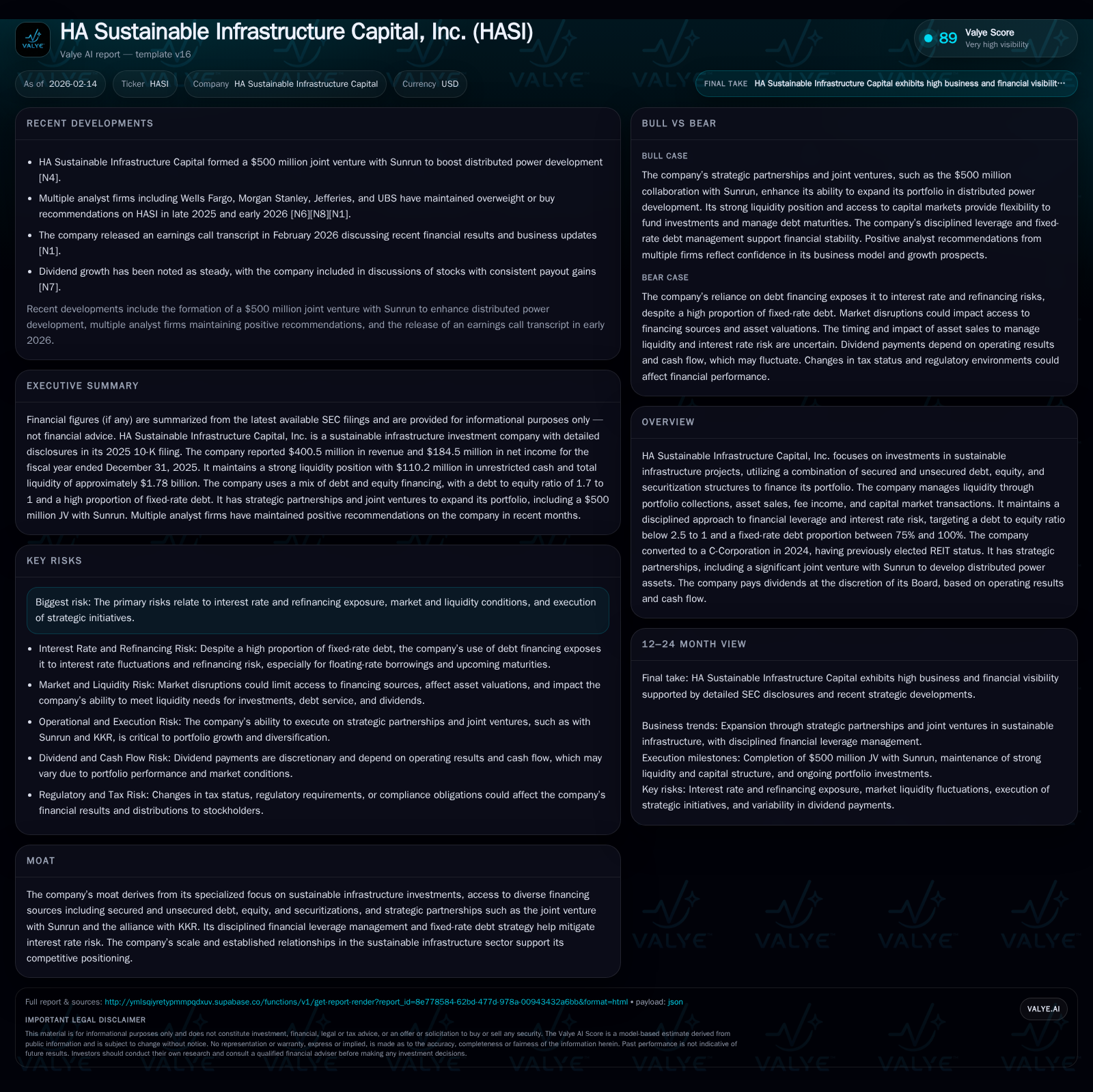
Originally structured as a REIT, HA Sustainable Infrastructure Capital, Inc. (HASI) has methodically transitioned to a C-Corporation model, enhancing capital flexibility crucial for scaling in sustainable infrastructure investments. The company’s judicious financial leverage combined with substantial fixed-rate debt shields it from rising interest rate volatility while preserving liquidity strength through diverse capital markets actions in 2025. Strategic alliances, most notably with Sunrun and KKR, amplify HASI’s niche in distributed clean energy development. Despite these strengths, HASI remains exposed to cyclical market, refinancing risks, and emerging cybersecurity challenges—all actively managed through disciplined governance and strategic risk oversight.
From REIT to C-Corp: A Strategic Transformation
HA Sustainable Infrastructure Capital’s metamorphosis from a Real Estate Investment Trust (REIT) into a C-Corporation in 2024 marks a deliberate recalibration of its capital structure philosophy. The previous REIT designation inherently imposed constraints on dividend distribution and tax treatment optimized for stable income properties. By embracing the C-Corp form, HASI has unlocked broader strategic latitude—fundamentally enabling more aggressive participation in joint ventures and investment vehicles that may have been less feasible or efficient under REIT tax code stipulations.[F1][valye_report_excerpt]
This transition aligns with the firm's strategic shift towards distributed power assets and sustainable infrastructure projects where ongoing capital requirements often outstrip incremental equity raises typical under a REIT model. The adjustment also signals recognition that evolving sustainable infrastructure financing demands flexibility beyond traditional yield-driven asset wrappers.
However, this reclassification introduces new tax considerations at the corporate level potentially affecting after-tax earnings distributions and shareholder return profiles—tradeoffs management appears comfortable navigating given anticipated long-term growth opportunities.
Structured Finance: Navigating Leverage and Interest Rate Risks
Central to HASI’s financial stewardship is its disciplined approach to leverage management. The company targets maintaining its debt-to-equity ratio below 2.5:1—a ceiling that balances prudent risk posture with adequate leverage capacity to fuel asset acquisition growth.[valye_report_excerpt][S1][F1]
Equally significant is the emphasis on predominantly fixed-rate debt, ranging between 75% and 100%, effectively insulating HASI from the vagaries of rising interest rates that challenge many infrastructure financiers amid tightening monetary conditions. This mitigative stance is supported by diverse debt instruments including secured loans, unsecured senior notes maturing between 2031 and 2035, junior subordinated notes issued in 2056 viewed partly as equity under credit rating methodologies, as well as revolving credit facilities.[S1]
Such structural layering extends financial flexibility allowing opportunistic refinancing moves—evident during 2025 when HASI executed tender offers repurchasing near-term notes due in 2026 and 2027 to smooth maturity profiles.[S1] The cautious but proactive management of financing costs therein underscores HASI's adeptness at managing capital markets complexities encompassing both cost control and duration extension.
Liquidity Strength and Capital Market Maneuvers in 2025
Liquidity forms the backbone supporting HASI's operational cadence. As of December 31, 2025, unrestricted cash surpassed $110 million complemented by nearly $1.8 billion in unused borrowing capacity predominantly via an expanded unsecured revolving credit facility backed by five additional banking partners.[S1]
The company exhibited notable capital markets activity throughout the year: issuing $600 million senior notes due 2031 alongside another $400 million due 2035; conducting targeted tender offers; issuing $500 million junior subordinated notes enhancing implicit equity buffers; retirement of $220 million convertible notes; plus raising approximately $237 million in equity proceeds via an at-the-market offering program.[S1]
In November 2025, HASI secured a delayed-draw term loan facility up to $250 million poised for draws in early 2026—a ready source of near-term liquidity enhancing nimbleness for discrete investment deployments or opportunistic balance sheet needs.[S1]
Collectively these maneuvers illustrate a multi-pronged liquidity framework leveraging cashflow from portfolio collections, asset sales, fee income streams alongside proactive engagement across debt and equity capital markets channels.
The Power of Partnerships: Sunrun JV and KKR Alliance
Strategic partnerships constitute cornerstones of HASI’s competitive differentiation within sustainable infrastructure sectors. Foremost is the $500 million joint venture formed with Sunrun announced in early January 2026 targeting accelerated development of distributed power assets—largely residential solar installations integrating modern grid technologies.[N4][valye_report_excerpt]
This alliance harnesses complementary capabilities—Sunrun’s operating experience coupled with HASI’s capital structuring expertise—positioning them advantageously amidst rising consumer preference for decentralized renewable generation.
Additionally, cooperation with global investment giant KKR broadens access not only to alternative funding avenues but also operational know-how essential for scaling complex infrastructure initiatives beyond mere financing aspects.[valye_report_excerpt]
Such partnerships extend beyond transactional dynamics into collaborative ecosystems allowing enhanced risk sharing, innovation diffusion, and accelerated deployment timelines—imperatives given sector competition intensity.
Sustainable Infrastructure Moat: Specialized Focus and Financing Access
HASI's moat increasingly centers on its dedicated focus exclusively on sustainable infrastructure investments supported by sophisticated access across secured/unsecured debt instruments, equity placements, securitizations, and co-investment structures.[valye_report_excerpt]
The firm’s scale cultivates entrenched industry relationships affording insight advantage during project origination while disciplined financial leverage practices help maintain investment-grade credit ratings attracting new funding sources with favorable terms.
This synthesis of domain specialization integrated financing options effectively raises entry barriers deterring less-capitalized competitors who might lack either balance sheet heft or nuanced structuring capabilities essential in an evolving regulatory backdrop prioritizing green infrastructure commitments.
Risk Management Spotlight: Interest Rates, Market Liquidity, and Cybersecurity
Recognizing intrinsic vulnerabilities inherent in both macroeconomic cycles and operational domains, HASI applies layered risk management frameworks addressing interest rate fluctuation exposure through fixed-rate predominance alongside vigilant refinancing strategies sensing market liquidity shifts.[S1]
Cybersecurity emerges as a consequential risk vector commanding board-level attention via oversight led by the Finance and Risk Committee empowered to evaluate ongoing threat assessments.[S1] A seasoned Chief Information Security Officer (CISO)—boasting two decades of industry leadership—directs comprehensive cybersecurity programs encompassing incident response plans escalating critical situations up to CEO and CFO levels when warranted.
This integration reflects heightened awareness within infrastructure finance circles that digital disruption or cyber incidents could materially impair operations or investor confidence—a reality shaping contemporary governance priorities beyond conventional financial controls.
Governance and Talent as Pillars Supporting Execution
Management underscores human capital strategies emphasizing diversity metrics tracking workforce demographics alongside culture inclusivity fostering environments where innovation flourishes.[S1]
This focus reflects broader recognition that successful execution of complex multi-stakeholder financing projects demands not just quantitative rigor but adaptable organizational cultures able to attract retention of specialized talent pools capable of navigating shifting policy imperatives associated with sustainability mandates.
Active reporting of engagement/inclusion data directly to executive leadership ensures alignment across hierarchical layers facilitating agile decision-making—indispensable amid fast-changing clean energy landscapes.
Dividend Policy Through Operating Realities and Cash Flow Lens
Unlike traditional yield-focused REIT models prescribing steady dividends constrained by distribution mandates, HASI exercises discretion deploying dividends responsive to operational results coupled tightly with cash flow realizations.[valye_report_excerpt][F1]
Given strong net income reported at approximately $184.5 million for fiscal year ended 2025 against liquidity management priorities balancing reinvestment needs this judicious approach helps preserve balance sheet strength without sacrificing shareholder returns unpredictably exposed during market turmoil phases.
This dynamic dividend stance suits investors aligned with long-term sustainable infrastructure growth narratives rather than seeking rigid payout certainty typical for mature real estate entities.
Future Outlook: Growth Opportunities Versus Market Challenges
Sector momentum favoring decarbonization underpins sizable growth runway as government policies worldwide intensify support for renewable energy expansion—including distributed generation assets central to HASI’s business strategy.[N1][valye_report_excerpt][S1]
Nevertheless, management caveats remain salient acknowledging persistent macroeconomic uncertainties such as inflationary pressures elevating interest rates potentially constraining new project economics alongside refinancing risks especially around maturing debt tranches requiring capital market receptivity.[N1][S1]
Execution risks linked to partnership integrations or scaling novel asset classes also warrant continual monitoring given heterogeneous regulatory regimes influencing project timelines.
Yet overall strategic positioning enhanced by well-layered financing structures coupled with differentiated partnership networks instills cautious optimism toward sustaining competitive advantage while managing nearer-term volatility prudently.
Disclaimer: This analysis is provided for informational purposes only and does not constitute investment advice or recommendations. All financial data are sourced from publicly available filings as cited herein.
Disclaimer: This is research-only, informational analysis and not investment advice. It may include AI-generated interpretation and general industry context. Always verify important details using primary sources.

Comments